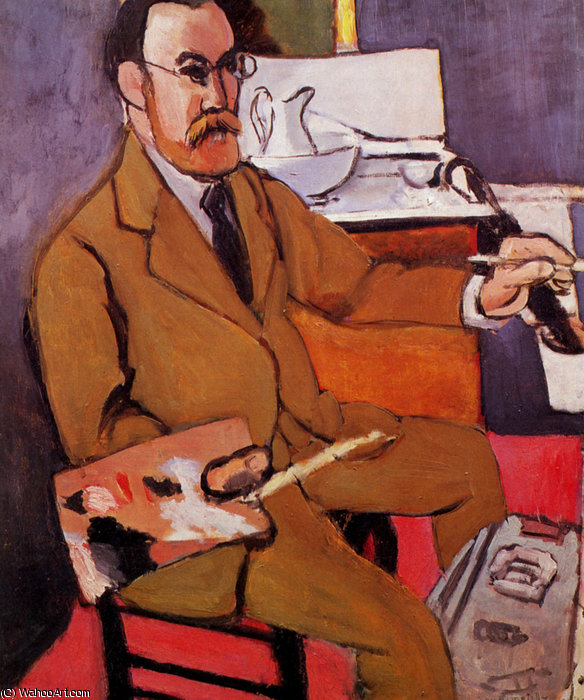
Autoportrait, Nice Hôtel Beau Rivage Le Cateau-Cambrésis, Musée Henri Matisse
Henri Matisse’s *Autoportrait*, painted in 1935 during his prolific period in Nice, stands as a cornerstone of Fauvist art and a poignant reflection on the artist's evolving artistic vision. Executed on canvas measuring 65 x 54 cm and currently housed at the Musée Henri Matisse in Le Cateau-Cambrésis, this work embodies Matisse’s masterful manipulation of color and his unwavering commitment to simplifying form—characteristics that define his signature style.
### The Artistic Style: Fauvism Revisited
Matisse's embrace of Fauvist principles represents a radical departure from Impressionistic conventions. Influenced by artists like André Derain and Maurice Denis, he sought to liberate painting from the constraints of naturalistic representation, prioritizing expressive color over accurate depiction. As Alfred Barr Jr., renowned art historian, eloquently stated, Matisse’s approach was “to transform reality into an emotional experience.” The bold hues—dominant shades of ochre, crimson, and turquoise—are applied with energetic brushstrokes that convey a palpable sense of movement and vitality. This deliberate disregard for tonal subtlety underscores Fauvist's core aesthetic ambition: to evoke feeling rather than simply mirroring the visual world.
### Composition and Symbolism: A Study in Tranquility
The painting’s composition is remarkably understated, focusing intently on Matisse himself seated at a table adorned with simple objects—a bowl containing fruit, a spoon, a bottle, and a cup. These carefully positioned elements serve as anchors for the gaze, guiding the viewer's attention inward toward the artist’s contemplative demeanor. The muted background—characterized by pale greens and blues—amplifies the luminosity of Matisse’s skin tones and enhances the overall atmosphere of serenity. Furthermore, the inclusion of his spectacles and mustache—distinctive features that appear throughout Matisse’s oeuvre—adds to the portrait's psychological depth, hinting at intellectual curiosity and self-awareness.
### Technique: Exploring Texture and Color Harmony
Matisse’s technique is marked by a meticulous layering of paint—a hallmark of Fauvist practice—that creates rich textural surfaces. He employs impasto—thickly applied pigment—to sculpt the canvas, capturing subtle nuances of light and shadow that contribute to the painting's expressive quality. The harmonious interplay of colors—particularly the juxtaposition of warm reds and oranges against cooler blues and greens—creates a visual equilibrium that reinforces the mood of tranquility. Matisse’s masterful handling of color demonstrates his profound understanding of its transformative potential—its ability to convey emotion and imbue an image with symbolic resonance.
### Legacy: An Icon of Modern Art
*Autoportrait* solidified Matisse's position as one of the foremost innovators of modern art, securing his place in the annals of artistic history alongside Pablo Picasso. Its enduring appeal stems from its uncompromising honesty—its refusal to compromise on Fauvist principles—and its profound exploration of human psychology. As a testament to Matisse’s artistic genius and a captivating exemplar of Fauvist aesthetics, this painting continues to inspire admiration and contemplation among art lovers worldwide. It exemplifies the artist's unwavering dedication to capturing the essence of experience through color and form—a legacy that resonates powerfully across generations.
- Provenance: Hôtel Beau Rivage Le Cateau-Cambrésis, Nice
- Dimensions: 65 x 54 cm
- Medium: Oil on Canvas
- Date: 1935
Museum: Musée Henri Matisse, Le Cateau-Cambrésis
Genre: Portrait
Style: Fauvist
Artist: Henri Matisse