A Symphony in Color: Exploring Henri Matisse’s “Girl with Tulips”
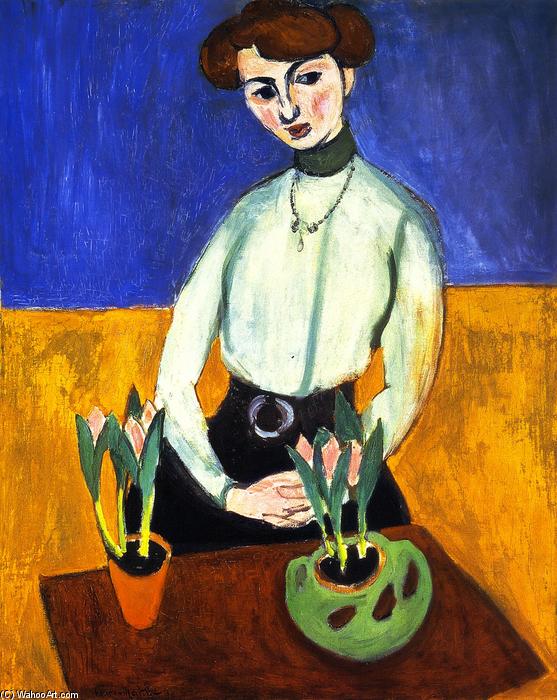
Henri Matisse's "Girl with Tulips," painted in 1910, isn’t merely a portrait; it’s an immersion into the heart of Fauvist aesthetics. This oil on canvas masterpiece, currently residing within the esteemed halls of The State Hermitage Museum in St. Petersburg, pulsates with a vibrant energy rarely witnessed outside of Matisse's oeuvre. More than just a depiction of a young woman and her floral companions, it’s a carefully constructed exploration of color, emotion, and the very essence of seeing – a testament to Matisse’s revolutionary approach to art.
The painting immediately captivates with its audacious palette. Gone are the muted tones and realistic representations of earlier periods; instead, we're confronted with an explosion of intense hues: fiery oranges, deep blues, shocking pinks, and verdant greens collide and intertwine. This deliberate departure from traditional color theory was a defining characteristic of Fauvism – a movement Matisse spearheaded – where color served not as a means to mimic reality, but as a powerful tool for conveying feeling and creating an immediate emotional response. The brushstrokes themselves are equally expressive, loose and gestural, contributing to the painting’s dynamic and almost feverish quality.
At the center of this chromatic drama sits Jeanne Vaderin, a close friend of Matisse's who served as a frequent model. She is presented in a simple white shirt, her dark hair framing a serene expression that belies the intensity surrounding her. The arrangement around her – two potted plants overflowing with tulips – isn’t merely decorative; it’s symbolic. Tulips, universally recognized as emblems of love and passion, are juxtaposed against the woman's calm demeanor, creating an intriguing tension between outward exuberance and inner tranquility. Matisse masterfully uses these elements to evoke a sense of contemplative beauty, inviting the viewer to contemplate the complexities of human emotion.
Looking deeper into the painting’s construction reveals influences from several artistic currents. The flattened perspective and simplified forms hint at Proto-Cubism, a movement Matisse was exploring during this period – an interest in breaking down objects into geometric shapes while retaining their essential character. Simultaneously, there's a subtle nod to traditional Still Life paintings, particularly in the careful arrangement of the plants and vase, suggesting a familiarity with classical compositional techniques. However, Matisse transcends these influences, forging his own unique style that prioritizes emotional expression above all else.
“Girl with Tulips” stands as a pivotal work in the history of modern art, demonstrating Matisse’s profound impact on subsequent artistic movements. Its bold use of color and expressive brushstrokes paved the way for Expressionism and Abstract Expressionism, influencing generations of artists to prioritize subjective experience and emotional intensity. It's a painting that continues to resonate today, not just for its beauty but also for its daring innovation and enduring power to evoke feeling.
For more information on Henri Matisse and his works, visit Henri Matisse at ArtsDot. Explore other Fauvist masterpieces, such as Girl with Tulips, and discover the beauty of handmade oil painting reproductions.
Experience the beauty of handmade oil painting reproductions at ArtsDot.