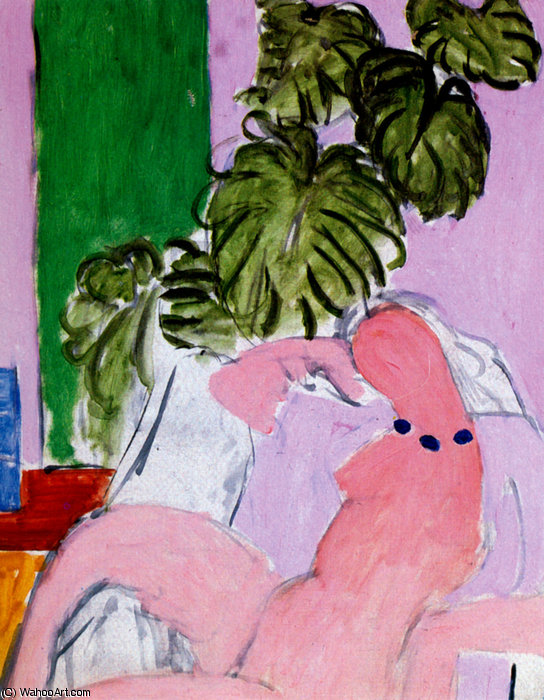
Nu au Fauteuil et Feuillage: A Fauvist Embrace of Color and Movement
Henri Matisse’s Nu au fauteuil et feuillage, an “Esquisse Huile sur Toile” (Sketch in Oil on Canvas) created in 1938 and currently residing within the hallowed halls of the Musée Matisse in Nice, France, is far more than a simple depiction of a woman seated in repose. It’s a vibrant distillation of Fauvist principles—a bold declaration of color, an exploration of movement, and a testament to Matisse's revolutionary approach to painting. Measuring a modest 73 x 61 cm, this work belies the immense emotional resonance it evokes, inviting viewers into a world saturated with light, warmth, and a palpable sense of interaction.
The scene unfolds within an intimate interior space, dominated by a woman seated comfortably in a chair. Her posture is relaxed yet engaged, her legs spread wide—a gesture that subtly suggests conversation or contemplation. The room itself is adorned with the lush greenery of potted plants, strategically placed to create pockets of shadow and highlight, adding depth and dynamism to the composition. Two figures are glimpsed in the background, their presence hinting at a private world unfolding beyond the immediate focus of the subject. A vase, positioned centrally, acts as a focal point, its form echoing the curves of the chair and contributing to the overall sense of harmony.
The Language of Fauvism
Matisse’s work firmly establishes itself within the framework of Fauvism, a movement he co-founded alongside André Derain. This style, emerging in France around 1905, rejected the traditional constraints of academic painting—the muted palettes and meticulous realism—in favor of unrestrained color and expressive brushstrokes. In Nu au fauteuil et feuillage, this is immediately apparent. Matisse employs a dazzling array of hues – vibrant reds, oranges, yellows, and blues – applied with thick, impasto strokes that create a palpable sense of texture and energy. The colors aren’t meant to represent reality faithfully; instead, they are used intuitively to convey mood, emotion, and the subjective experience of seeing.
The loose brushwork further contributes to the painting's dynamism. Notice how the lines flow and overlap, creating a sense of movement and spontaneity. There is no attempt to render surfaces with photographic accuracy; rather, Matisse prioritizes capturing the essence of form and color through expressive gestures. This deliberate departure from traditional techniques was revolutionary at the time, challenging established artistic conventions and paving the way for future generations of artists.
Compositional Harmony and Symbolic Resonance
The composition itself is carefully orchestrated to create a sense of balance and visual interest. The central figure anchors the scene, while the surrounding elements—the chair, the plants, and the background figures—contribute to a harmonious whole. The use of warm colors in the foreground draws the viewer’s eye inward, creating a feeling of intimacy and warmth. The cool greens of the foliage provide a counterpoint, adding depth and contrast to the scene.
Beyond its purely aesthetic qualities, Nu au fauteuil et feuillage also carries symbolic weight. The woman's relaxed posture suggests a state of contentment and ease. The presence of the plants symbolizes life, growth, and connection with nature. The interaction implied by her position invites viewers to imagine a conversation—a moment of shared experience. Matisse’s ability to imbue his paintings with such layered meaning is one of his greatest strengths.
A Legacy of Color and Innovation
Henri Matisse's work, including Nu au fauteuil et feuillage, remains profoundly influential today. His bold use of color, expressive brushwork, and innovative approach to composition continue to inspire artists across a wide range of disciplines. This particular sketch offers a glimpse into the artist’s creative process—a moment of spontaneous inspiration captured on canvas. It's a reminder that art can be both beautiful and deeply meaningful, capable of transporting us to another world through the power of color and emotion. For those seeking a high-quality reproduction of this iconic work, ArtsDot offers meticulously crafted hand-painted reproductions that faithfully capture the essence of Matisse’s genius.