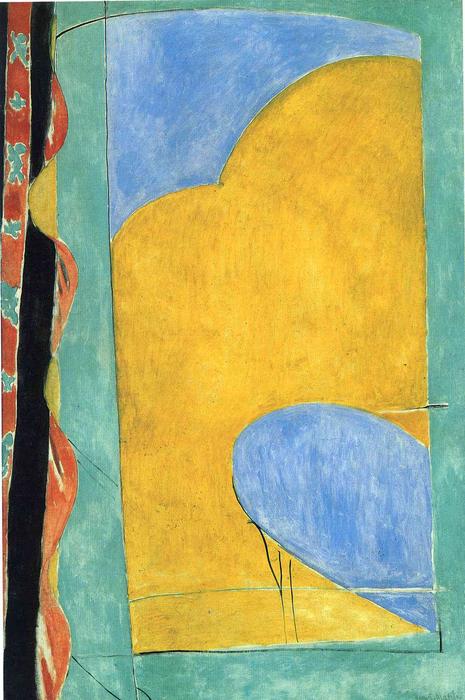
The Yellow Curtain
Henri Matisse’s *The Yellow Curtain*, painted in 1915, stands as an emblem of Post-Impressionism and a pivotal moment in the artist's artistic evolution. Currently residing at the Museum of Modern Art (MoMA) in New York City—a testament to its enduring appeal—this canvas transcends mere visual representation, delving into explorations of color, form, and psychological resonance. Measuring 146 x 97 cm and executed in oil on canvas, *The Yellow Curtain* embodies Matisse’s masterful synthesis of influences from Cézanne and Fauvist experimentation.
Composition and Symbolism: A Window Into Matisse's Vision
At first glance, the painting presents a deceptively simple scene—a window framed by verdant greenery and bathed in azure sky—yet within this apparent tranquility lies a complex interplay of visual elements. Dominating the composition is a yellow curtain hanging from the upper left corner, serving as both a focal point and a conduit for Matisse’s artistic concerns. The curtain's vibrant hue isn’t merely decorative; it symbolizes Matisse’s deliberate departure from Impressionistic optical realism toward a more expressive exploration of color itself. Alongside the curtain are two figures—one positioned on the right side of the canvas and another receding into the background—creating depth and perspective, while a chair sits near the bottom left corner grounding the scene. Finally, a clock in the upper right part adds to the overall spatial arrangement. These elements collectively contribute to an atmosphere of contemplative stillness, inviting viewers to contemplate the interplay between interior and exterior spaces.
Artistic Style and Influence: Cézanne's Legacy
Matisse’s stylistic approach reflects a significant shift from Fauvist tendencies toward a more restrained aesthetic informed by Paul Cézanne’s groundbreaking explorations of underlying structure and formal qualities. Like Cézanne, Matisse employs flattened planes of color—a technique characteristic of Analytical Cubism—to build up complex fields of tonal variation. Small brushstrokes are strategically deployed to capture the essence of form rather than striving for photographic accuracy. This deliberate simplification aligns with Matisse’s broader ambition to distill visual experience into its most fundamental components, mirroring Cézanne's profound conviction that art should prioritize geometric precision over illusionistic representation.
Artistic Movements: Bridging Fauvism and Cubo-Futurism
*The Yellow Curtain* occupies a crucial position within the artistic landscape of 1915, marking Matisse’s transition from the bold chromatic assertions of Fauvist painting to the more fragmented and conceptual concerns of Cubo-Futurist art. The painting's fractured lines and displaced viewpoints—a hallmark of Cubo-Futurism—demonstrate Matisse’s willingness to challenge conventional artistic conventions and embrace experimental techniques. However, unlike Cubist artists who sought to dismantle perspective and represent multiple viewpoints simultaneously, Matisse maintains a harmonious compositional balance, prioritizing visual clarity and emotional impact. The influence of Cézanne is palpable in the careful structuring of form and color, solidifying Matisse's place as a visionary artist at the forefront of modern art’s transformative period.
Conclusion: A Masterpiece of Color and Form
Henri Matisse’s *The Yellow Curtain* remains an unforgettable artwork that exemplifies his unparalleled ability to convey emotion through visual language. Its enduring fascination stems from its masterful blending of Cézanne's structural principles with Fauvist color palettes—a testament to Matisse’s artistic genius. To experience this iconic piece firsthand, visit the Museum of Modern Art (MoMA) in New York or explore ArtsDot’s curated collection of handmade oil painting reproductions at
Henri Matisse: Yellow Curtain. For deeper insights into Post-Impressionism and Cubo-Futurism, consult Wikipedia:
Abstract art and
Cubo-Futurism.