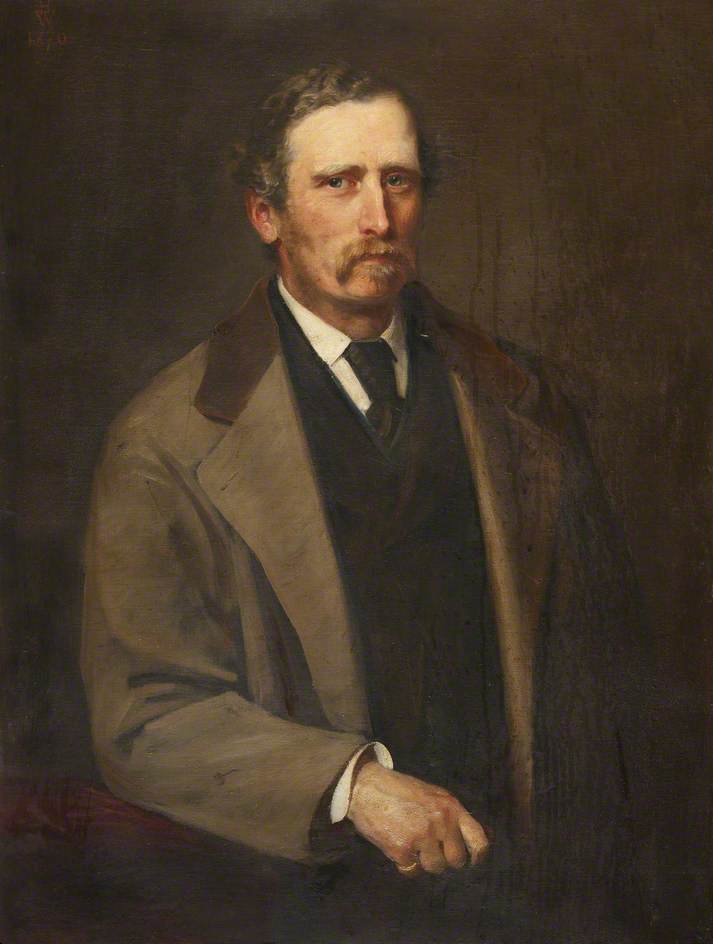
A Portrait of Victorian Dignity: John Archibald Shaw Stewart
Henry Weigall’s “John Archibald Shaw Stewart” is more than simply a likeness; it's a carefully constructed tableau of mid-Victorian life, imbued with the quiet confidence and restrained elegance characteristic of the era. Executed in 1879 – a period of burgeoning industrialization yet still deeply rooted in traditional values – this oil on canvas portrait offers a poignant glimpse into the world of a gentleman of means. Measuring an imposing 88 x 70 cm, the scale itself speaks to the importance placed upon portraiture as a marker of status and achievement within British society.

(Placeholder Image - Replace with actual image URL)
The Man and His Moment
Stewart himself is presented with a studied composure. Dressed in the dark, impeccably tailored suit of the time – a deep charcoal grey or navy blue – he embodies the formality expected of a man of his standing. The crisp white shirt collar and meticulously knotted tie reinforce this impression of order and respectability. His mustache, a fashionable addition for gentlemen during this period, adds to his air of self-assuredness. Notably, Weigall has captured him in an act of observation – seemingly gazing off-camera – which invites the viewer into the scene and encourages speculation about his thoughts and intentions. This subtle gesture elevates the portrait beyond a mere representation; it becomes a moment frozen in time.
Technique and Style: Academic Realism
Weigall’s mastery lies in his ability to seamlessly blend academic training with a distinctly personal style. Influenced by Thomas Webster, he adhered to the principles of realism, prioritizing accurate depiction and tonal harmony. The brushwork is controlled and precise, particularly evident in the rendering of Stewart's clothing – each fold and drape meticulously observed and translated onto the canvas. Note the subtle gradations of light and shadow, skillfully employed to create a sense of volume and depth. This meticulous attention to detail, combined with a restrained palette dominated by browns, greys, and whites, contributes significantly to the portrait’s dignified and timeless quality. The use of impasto – thick application of paint – is minimal, allowing for smooth transitions and a polished finish.
Symbolism and Context
The commission itself speaks volumes about the social landscape of the late Victorian period. Portraits were not merely decorative; they served as vital documents, recording lineage, wealth, and professional standing. Research reveals that John Archibald Shaw Stewart was a prominent figure in Renfrewshire, Scotland, holding positions within local government and business. The painting’s location at Keble College, Oxford, suggests an association with the intellectual and cultural life of the university – a hub for scholarship and debate during this era. Furthermore, the Shaw-Stewart Baronetcy (detailed on Wikipedia) adds another layer to the portrait's significance, connecting Stewart to a lineage of landed gentry and aristocratic heritage. The overall effect is one of quiet power and established tradition, reflecting the values and aspirations of Victorian society.