A Descent Into Cosmic Horror: Exploring Bosch’s Fragment of Paradise
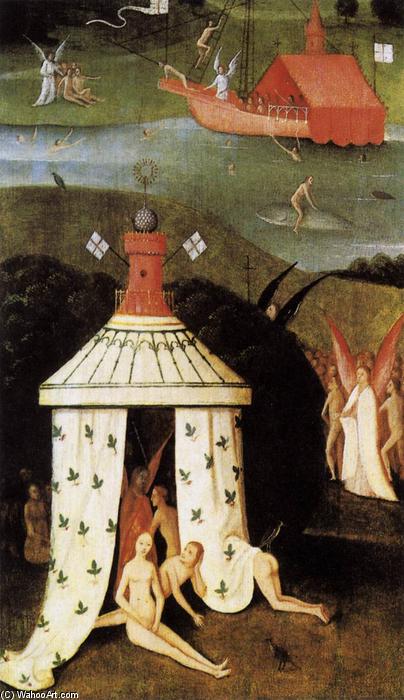
To gaze upon Hieronymus Bosch’s Last Judgment (fragment of Paradise) is to step beyond the threshold of reality and into a fever dream of unparalleled complexity. This arresting fragment serves as a visceral plunge into a landscape of psychological torment, rendered with a level of detail that is as unsettling as it is magnificent. While many Renaissance works sought to capture the idealized beauty of the human form or the serene light of the divine, Bosch deliberately chose a different path. He invites us into a universe where the boundaries between the celestial and the grotesque dissolve, offering a window into the profound moral anxieties that gripped Europe during the late fifteenth and early sixteenth centuries.
The painting functions as a haunting testament to the spiritual turmoil of the era. As a fragment likely originating from a much larger mural commissioned for the St. Janskathedraal in ’s-Hertogenbosch, it offers us only a glimpse into a much vaster, more chaotic narrative. Within this small window, we witness a symphony of chaos: human figures are caught in various states of existence—some standing in quiet contemplation, others reclining or struggling amidst the unfolding cosmic drama. The presence of angels, drifting through the composition, provides a stark, ethereal contrast to the earthly turmoil below, suggesting a divine oversight that is both protective and terrifyingly judgmental.
The Master’s Hand: Technique and Visionary Detail
Bosch’s technical mastery is evident in every meticulous layer of oil paint applied to the wood. He was a pioneer of detail, employing sophisticated glazing techniques to achieve an astonishing realism that breathes life into even his most fantastical creatures. One cannot help but be captivated by the painstaking rendering of textures; the way light catches the glistening scales of a serpent or the weathered, decaying surfaces of the damned creates a tactile experience for the viewer. This level of precision is what makes a high-quality reproduction of this piece so transformative for an interior space—it demands close inspection, rewarding the observer with new, hidden symbols upon every encounter.
His style, which anticipates the darker, more distorted currents of Mannerism, rejects the conventional artistic norms of his time. Rather than adhering to the polished perfection of his contemporaries, Bosch embraced a rebellious spirit fueled by folklore, alchemy, and visionary experiences. This creates an emotional impact that is uniquely heavy; there is a weight to the atmosphere, a sense of "cosmic horror" that resonates deeply with the modern viewer. For the collector or interior designer, this piece acts as a profound focal point, bringing a sense of intellectual depth and historical gravity to any curated collection.
Symbolism and the Eternal Struggle
Every element within this fragment is heavy with meaning, acting as a coded language for the late medieval mind. The presence of a boat, caught in the midst of the unfolding judgment, serves as a powerful metaphor for the soul's journey through the turbulent waters of life toward an uncertain destiny. The composition itself, characterized by its lack of a traditional, stable horizon, suggests a world in flux—a state of perpetual transition between salvation and perdition.
For those seeking to decorate with art that tells a story, Bosch’s work offers endless inspiration. It is not merely a depiction of biblical prophecy, but a profound meditation on the human condition, morality, and the struggle for spiritual clarity. Owning a reproduction of such a masterpiece allows one to possess a piece of history that challenges the eyes and stirs the soul, making it an incomparable addition to any sophisticated gallery or thoughtfully designed living space.