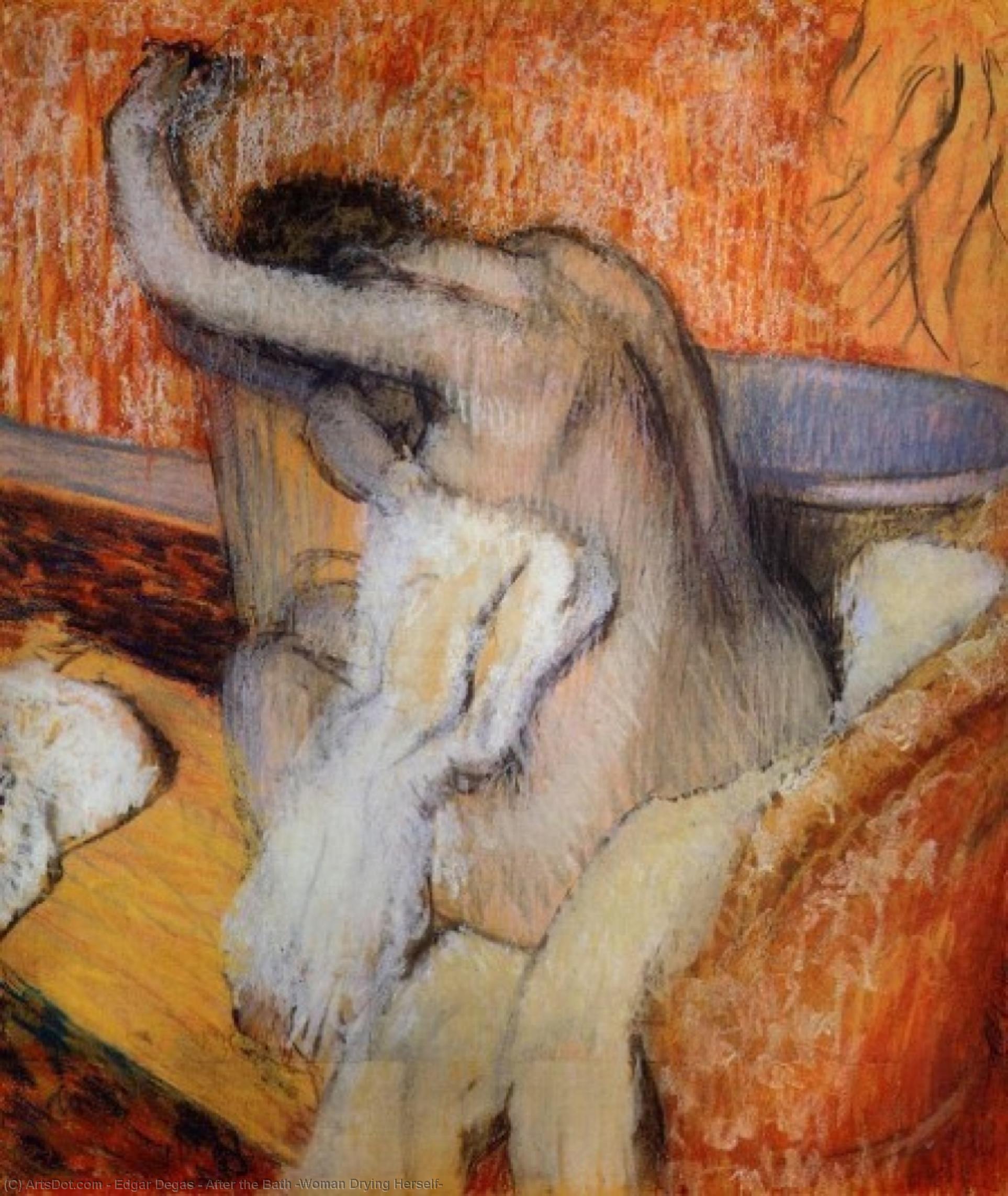
After Bathing, Woman Drying Herself
Edgar Degas, a towering figure in Impressionism and Realism alike, captivated audiences with his masterful pastel drawings and oil paintings. Among his most celebrated works is After Bathing, Woman Drying Herself (1900), a piece that embodies his unwavering dedication to capturing fleeting moments of everyday life with remarkable precision and emotional resonance.
The Painting's Composition
Degas’s depiction centers on a woman emerging from a bathtub, her arms outstretched as she delicately dries herself off. The scene exudes tranquility—a deliberate contrast to the bustling Parisian cityscape of his time—and speaks volumes about vulnerability and quiet dignity. A dog lies patiently at her feet, adding an element of companionship that softens the overall mood. Careful observation reveals a simple chair positioned behind her, likely used before or after the bath, subtly anchoring the composition.
Artistic Techniques and Style
Degas’s masterful use of pastel—a medium he championed throughout his career—creates an ethereal softness that perfectly complements the serene atmosphere. Unlike Impressionists who prioritized vibrant color palettes, Degas favored muted tones, prioritizing tonal gradations and subtle textures to convey a sense of realism. His meticulous attention to detail is evident in every brushstroke, capturing the woman’s posture with remarkable accuracy and conveying her inner stillness.
Context and Significance
Degas's artistic vision stemmed from his profound respect for classical draughtsmanship—a legacy he carried forward into his exploration of modern life. He famously declared, “Draw lines, young man, and still more lines,” reflecting his belief that drawing was the foundation of all representation. His series on bathing women wasn’t merely a visual experiment; it represented a deliberate challenge to academic conventions, prioritizing psychological complexity over idealized beauty.
Relevance in Art History
Degas's influence extends far beyond Impressionism itself. Artists like Mary Cassatt—who similarly tackled themes of domestic life and female subjectivity—acknowledged his pioneering approach to portraying the human experience. Furthermore, Degas’s emphasis on light—a cornerstone of Impressionist aesthetics—established a precedent for subsequent generations of painters who sought to capture the ephemeral qualities of visual perception.
Conclusion
After Bathing, Woman Drying Herself stands as an enduring testament to Degas’s artistic genius. Its understated elegance, combined with its profound psychological insight and masterful execution, secures its place among the most iconic artworks of the Impressionist era—a timeless masterpiece that continues to inspire admiration and contemplation.