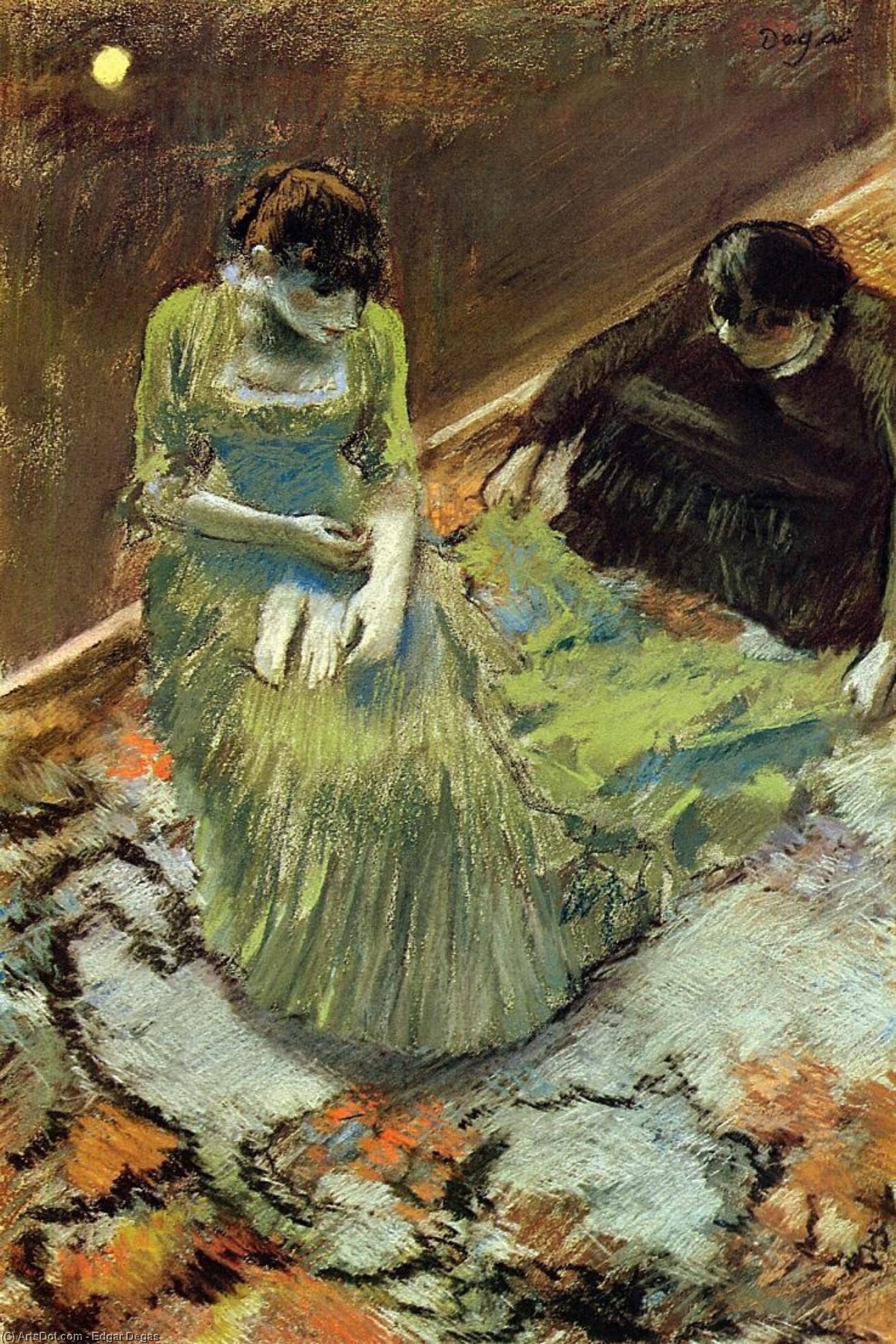
Captured in Impressionist pastel hues, Edgar Degas’s ‘Before the Curtain Call’ portrays two women poised before a performance, embodying grace and quiet contemplation—a timeless masterpiece available for exquisite reproductions at ArtsDot.com.
パリ
フランス
エドガー・ドガ
ヒレール・ Germain-エドガール・ドガ
19世紀を代表するフランスの画家、エドガー・ドガ。バレエダンサーやパリの日常風景を捉え、革新的な構図と卓越した描写力で印象主義に影響を与えました。『踊り子』『カフェ・ド・シャワール』など、現代生活の真実を描き出した傑作群。
印象派、写実主義
パブロ・ピカソ
ギュスターヴ・クールベ
1834年7月19日
1917年9月27日
ヒレール・ Germain-エドガール・ドガ
フランス人
タムブリンを持つ踊り子
フランス、パリ
入絵主義
1
エドガー・ドガは、レーベルを拒否しながらも、どの芸術運動と関連付けられることが多いですか?
A Moment Frozen in Anticipation: Exploring Degas’s “Before the Curtain Call”
“Before the Curtain Call,” painted by Edgar Degas in 1892, is more than just a depiction of two women backstage; it's an exquisitely crafted pastel drawing that encapsulates the spirit of Impressionism and offers a profound glimpse into the artist’s meticulous observation of human experience. This piece—measuring 51 x 34 cm—holds a captivating stillness amidst the bustle of performance, inviting viewers to contemplate the quiet moments preceding artistic expression.
The Impressionist Vision: Style and Technique
Degas famously resisted categorization as an Impressionist, preferring to label himself a Realist. Yet, “Before the Curtain Call” undeniably embodies many hallmarks of this influential movement. The pastel medium—a technique favored by Degas for its ability to achieve luminous color gradations and subtle tonal variations—allows for a velvety texture that softens the harshness of traditional oil paints. Unlike his contemporaries who sought to capture fleeting impressions of light, Degas focused on capturing psychological nuance; he meticulously rendered the postures and expressions of his subjects, conveying an unspoken tension between contemplation and readiness. The artist’s masterful use of chiaroscuro—the interplay of light and shadow—further enhances the drama of the scene, emphasizing the contours of the women's figures and creating a sense of depth that transcends mere visual representation.
Historical Context: Dance and Artistic Observation
The painting emerged during a period of significant artistic innovation in Paris, where Impressionists were challenging academic conventions and redefining notions of beauty. Degas’s fascination with ballet stemmed from his desire to document the physicality of dance—a pursuit driven by an unwavering commitment to realism. He spent countless hours observing dancers rehearsing, capturing their movements not as idealized forms but as honest representations of human activity. The theater itself served as a symbol of artistic aspiration and societal performance, reflecting Degas’s broader interest in portraying life as it unfolded before his eyes. Furthermore, the inclusion of the curtain—a recurring motif in Degas's oeuvre—represents both the anticipation of an upcoming event and the ephemeral nature of beauty itself.
Symbolism: Vulnerability and Reflection
The positioning of the women—one gazing downwards at her hands, the other upward—suggests a moment of introspection before the performance begins. This posture speaks to the vulnerability inherent in artistic creation – the artist’s willingness to expose oneself emotionally and intellectually. The subtle gestures convey a sense of quiet contemplation, hinting at the inner lives of these figures beyond their outward appearance. Degas's deliberate choice of color palette—dominated by muted tones of pink, mauve, and gray—contributes to the painting’s melancholic atmosphere, underscoring the beauty found in stillness and reflection.
Emotional Impact: Capturing a Fleeting Moment
Ultimately, “Before the Curtain Call” succeeds in conveying an emotional resonance that transcends its formal elements. It captures not just what is seen but what is felt—the palpable anticipation of performance, the quiet dignity of observation, and the subtle beauty of human vulnerability. Like all great art, it invites viewers to pause and consider the complexities of human experience. A reproduction on high-quality canvas would allow admirers to appreciate Degas’s masterful technique and capture the ethereal quality of this iconic Impressionist masterpiece. Consider exploring similar works by Degas at ArtsDot.com for inspiration.