A Moment Frozen in Time: The Observational Genius of Degas
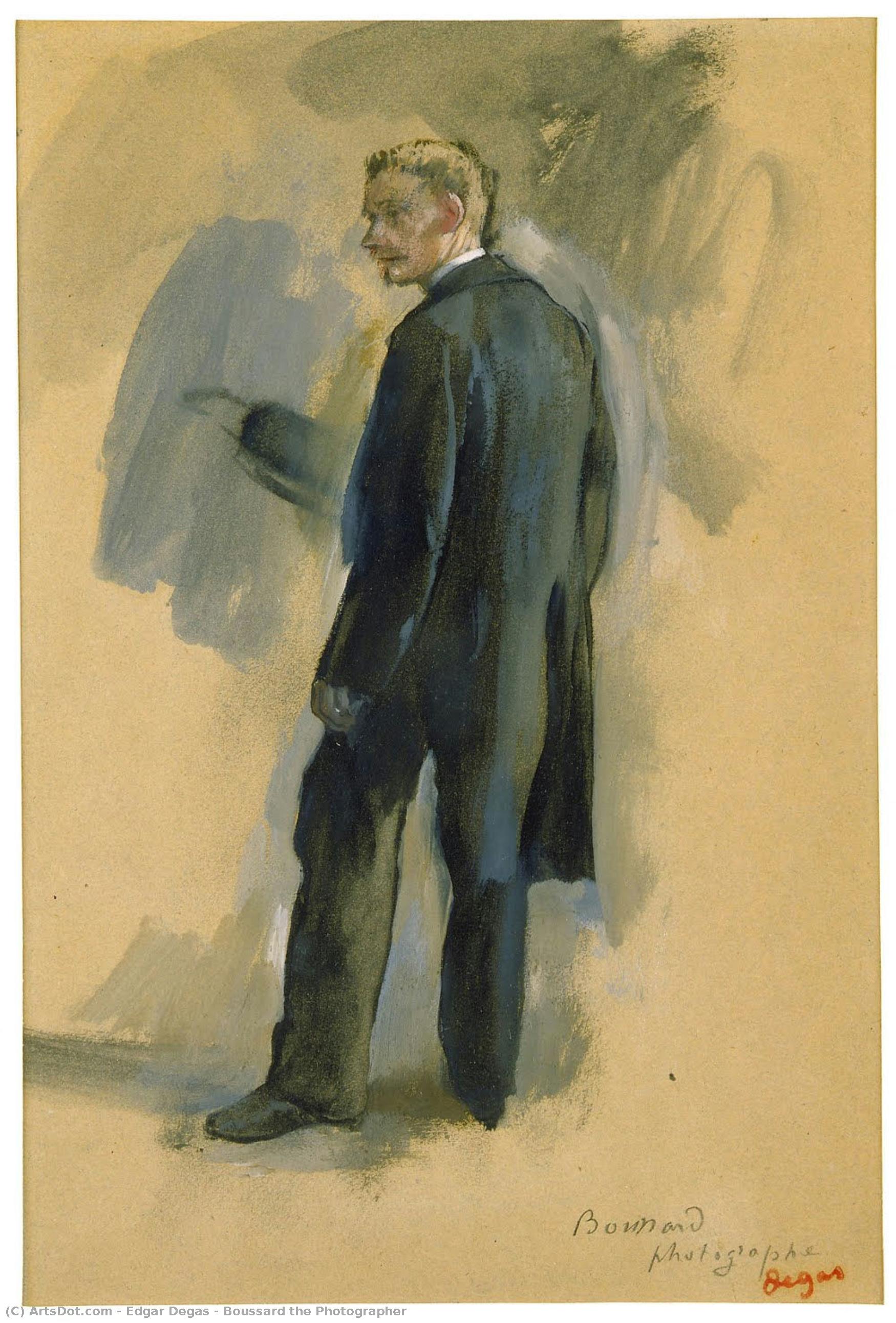
In the bustling heart of late 19th-century Paris, where the boundaries between traditional fine art and the emerging mechanical eye of the camera were beginning to blur, Edgar Degas captured a profound intersection of reality and perception. His work, "Boussard the Photographer," is far more than a mere portrait; it is a contemplative study of the act of seeing itself. Created between 1872 and 1874, this piece presents us with Monsieur Boussard, a man poised on the precipice of a technological revolution. As he stands before a muted backdrop, his gaze is directed toward something unseen by the viewer, inviting us to participate in his silent, focused observation. Degas, a master who often resisted the label of Impressionist in favor of Realism, uses this subject to explore how the camera lens began to reshape the human experience of time and memory.
The composition is masterfully arranged to evoke a sense of psychological depth. By placing Boussard slightly off-center, Degas introduces a subtle tension, a feeling of unease that mirrors the photographer's own concentration. The presence of figures in the distant background—shadowy and peripheral—suggests the wider world continuing its motion, even as the central subject attempts to arrest it within a single frame. For the collector or interior designer, this painting offers a sophisticated narrative of focus and stillness, making it an ideal centerpiece for spaces that value intellectual depth and quiet contemplation.
Technique and Texture: The Grain of Reality
Degas’s technical approach in this work is nothing short of revolutionary, mirroring the very subject matter he depicts. Eschewing the smooth, porcelain-like finishes favored by the academic tradition, Degas employs a technique characterized by short, choppy strokes that lend the surface a tactile, almost vibrating quality. This method creates a texture that intentionally evokes the grainy, ephemeral nature of early photographic prints. Through the medium of watercolor and gouache on paper, he achieves a delicate balance between transparency and opacity, allowing light to play across the surface in a way that feels both immediate and fleeting.
The color palette is dominated by a warm, muted yellow hue that bathes the scene in an atmospheric glow. This choice of color serves a dual purpose: it provides a luminous warmth to the composition while symbolically nodding to the concept of enlightenment and the dawn of a new era of progress. The interplay between the sharp, decisive marks of the brush and the soft, bleeding edges of the watercolor creates a visual rhythm that keeps the eye moving, searching for the details within the frame. It is this very complexity—the marriage of precision and spontaneity—that makes a high-quality reproduction of this piece so captivating in a modern setting.
A Timeless Addition to the Modern Collector
For those looking to curate an environment of elegance and historical resonance, "Boussard the Photographer" offers an unparalleled opportunity. The artwork transcends its era, speaking to contemporary fascinations with image-making, surveillance, and the fleeting nature of digital life. It is a piece that does not merely decorate a wall; it starts a conversation. Whether placed in a minimalist gallery-style room or a richly textured study, the painting’s ability to balance light, shadow, and subject matter ensures it remains a focal point of enduring interest.
Investing in a fine art reproduction of this Degas masterpiece allows one to bring the spirit of Parisian innovation into the home. The work's emotional impact—a blend of curiosity, nostalgia, and profound stillness—provides a sense of groundedness in an increasingly fast-paced world. It is a tribute to the power of the gaze, reminding us that even in a world of constant motion, there is immense beauty to be found in the moments we choose to stop and truly observe.