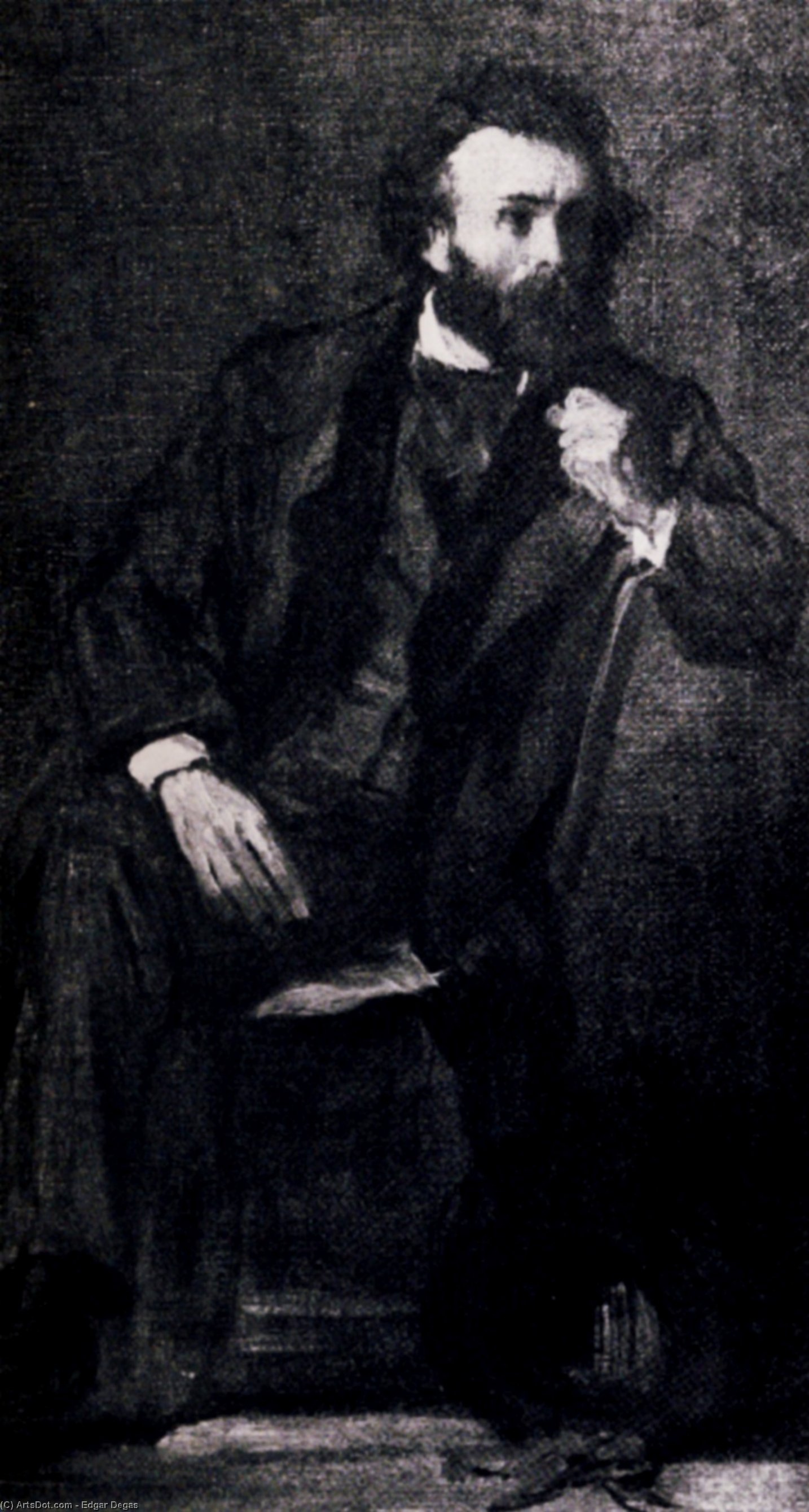
A Portrait of Contemplation: Degas’s 1868 Study
This meticulously rendered portrait, executed in 1868 by Edgar Degas, offers a profound glimpse into the artist's fascination with capturing fleeting moments and the quiet intensity of human thought. Measuring 40 x 27 cm, this work transcends a simple likeness; it’s an exploration of introspection, rendered with the precision characteristic of Degas’s mature style. The photograph reveals a black-and-white study dominated by shades of gray, creating an immediate sense of age and timelessness – a testament to the artist's commitment to realism and his skillful manipulation of tonal values. The subject, a gentleman seated in an ornate chair, embodies a contemplative mood, inviting the viewer into his private world of reflection.
Technical Mastery and Realist Approach
- Technique: Degas’s technique is immediately apparent through the visible brushstrokes and subtle blending of tones. Executed in oil paints on canvas or panel, the work demonstrates a loose rendering style that avoids overt idealization, aligning perfectly with his self-identified realist approach. The artist masterfully employs hatching and cross-hatching to build up form, particularly evident in the man’s beard and clothing, adding significant textural depth.
- Materials: The use of oil paints speaks to Degas's dedication to traditional methods, allowing for nuanced color mixing and layering – a crucial element in achieving the painting’s atmospheric quality.
Decoding Symbolism and Emotional Resonance
The composition itself is laden with symbolic weight. The man’s posture—hands resting on his chin, gazing into the distance—immediately evokes feelings of melancholy and deep thought. This pose, combined with the somber lighting and monochromatic palette, creates a powerful sense of quiet contemplation. Degas was deeply interested in portraying not just appearances but also the inner lives of his subjects, suggesting a character wrestling with complex ideas or perhaps burdened by unspoken emotions. The ornate chair, a detail that occupies a significant portion of the frame, further emphasizes the subject's isolation and focus.
Historical Context: A Realist Amidst Impressionism
Created in 1868, this portrait reflects Degas’s position as a pivotal figure navigating the shifting artistic landscape of late 19th-century France. While he shared some affinities with the burgeoning Impressionist movement – particularly his interest in capturing fleeting moments and unconventional subjects – he resolutely rejected the label, preferring to remain true to his commitment to realism. This work exemplifies his dedication to meticulous observation and accurate representation, a hallmark of his artistic practice. Degas’s focus on detail and psychological depth anticipated many of the concerns that would later become central to modern art.