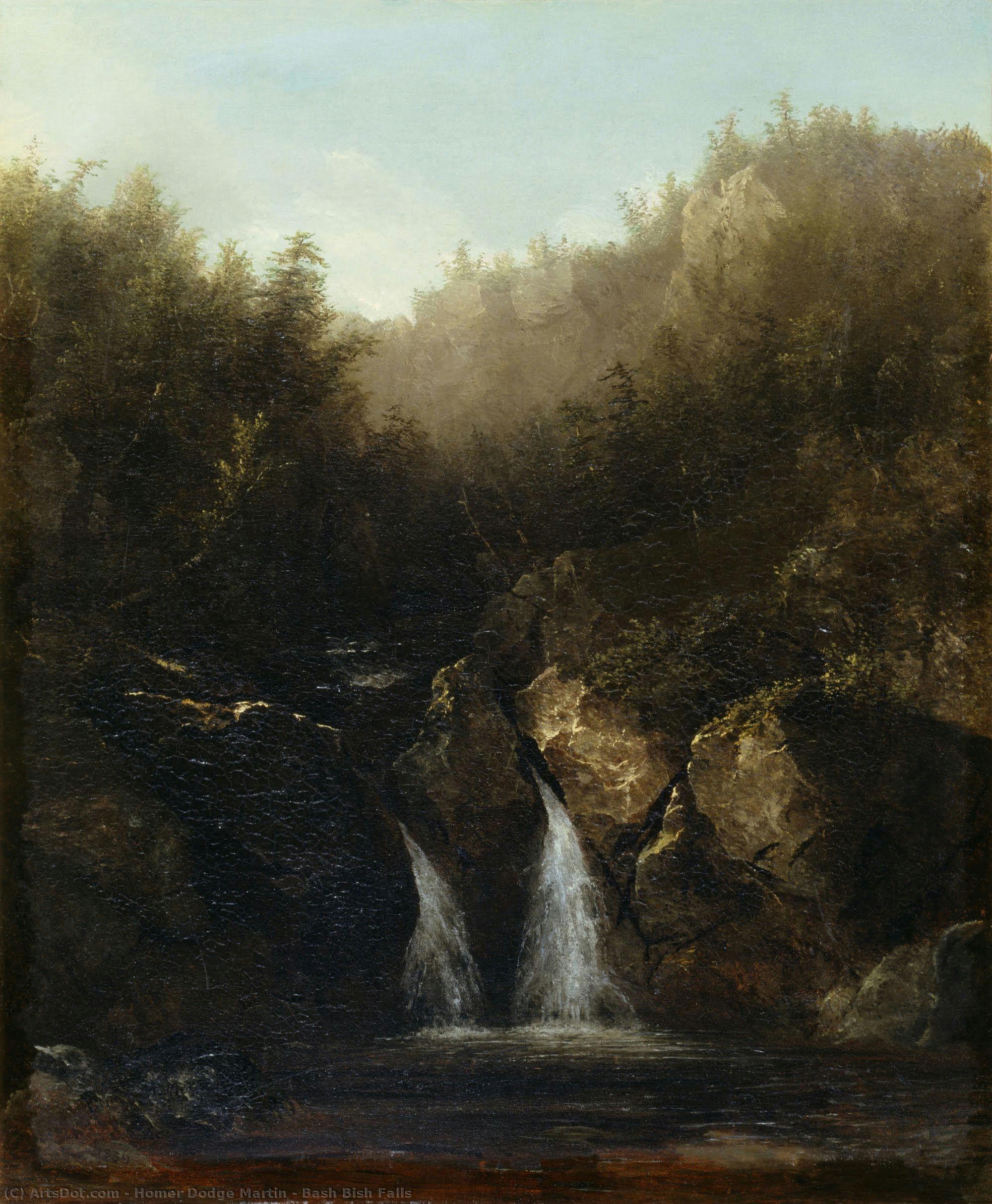
Bash Bish Falls: A Vision of American Romanticism
The painting “Bash Bish Falls,” executed by Homer Dodge Martin in 1859, stands as a quintessential example of Hudson River School landscape artistry—a movement that championed the sublime beauty of America’s untamed wilderness and sought to inspire awe and reverence for God's creation. Captured with meticulous detail and imbued with atmospheric perspective, this piece transports viewers back to a pivotal moment in American art history, bridging the gap between idealized Romanticism and the nascent Impressionist explorations of light and color.
A Detailed Observation: Composition & Technique
Martin’s masterful technique—primarily oil paint on canvas—demonstrates a layered approach characteristic of the Hudson River School. Loose brushstrokes dominate the depiction of foliage and rock formations, creating a textured surface that captures the dynamism of the forest environment. Lines delineate the contours of trees and cascades of water, establishing a strong visual hierarchy that guides the eye upwards towards the central waterfall. The artist skillfully employs shading to convey depth and volume, mirroring the geological realities of Bash Bish Falls State Park—a location famed for its dramatic plunge into the Connecticut River Gorge. Careful attention is paid to capturing the diffused light filtering through the mist, enhancing the painting’s ethereal quality and reinforcing its connection to Barbizon landscapes.
Historical Context & Artistic Influences
Born in Albany, New York, Martin honed his skills under William Hart and surrounded himself with fellow artists who shared a passion for portraying the grandeur of the American wilderness. Like many Hudson River School painters, Martin drew inspiration from the Barbizon school’s emphasis on capturing natural light and color without resorting to idealized representations—a subtle yet significant departure from earlier academic traditions. The painting reflects the broader cultural preoccupation with exploring and celebrating America's vast landscapes during a period marked by westward expansion and burgeoning national identity.
Symbolism & Emotional Resonance
Beyond its visual splendor, “Bash Bish Falls” carries symbolic weight. The waterfall itself represents both physical power—the relentless force of nature—and spiritual renewal—a symbol of cleansing and transcendence. Martin’s depiction captures not merely a topographical scene but also an emotional response to the sublime—a feeling of awe mingled with humility before the immensity of God's design. It invites contemplation on humanity’s place within the natural world, fostering a sense of wonder and appreciation for the unspoiled beauty of Bash Bish Falls.
Resources & Further Exploration
For more information about Homer Dodge Martin and “Bash Bish Falls,” please visit:
Image Credit: Albany Institute of History & Art