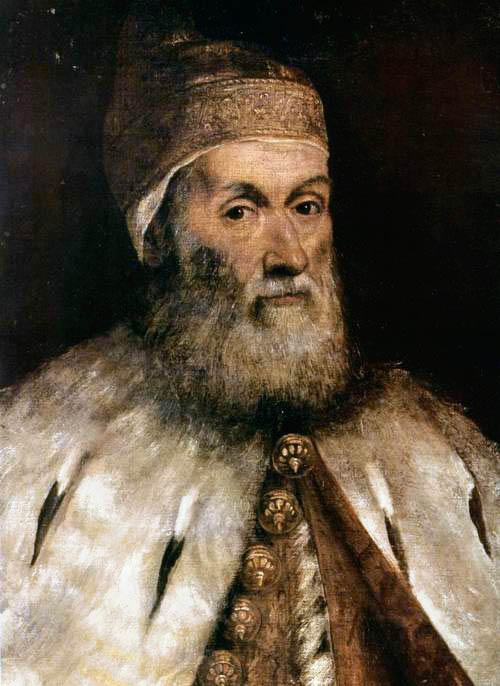
A Gaze of Venetian Authority
To encounter Tintoretto’s portrait of Doge Gerolamo Priuli is to be pulled directly into the heart of the Venetian Republic's most dramatic era. The painting does not merely present a likeness; it stages a confrontation. Through a masterful command of the subject's gaze, Jacopo Tintoretto ensures that the viewer cannot look away from the stern, commanding presence of the man who ruled Venice from 1567 to 1570. There is an undeniable theatricality at play here, a hallmark of the Venetian Baroque style, where the sitter’s eyes seem to pierce through the canvas to engage the observer in a silent dialogue of power and responsibility.
The composition is anchored by a profound sense of psychological depth, achieved through Tintoretto's legendary use of chiaroscuro. By plunging the background into a dense, impenetrable darkness, the artist forces the light to dance across the textures of the Doge’s regalia. This interplay between shadow and illumination does more than create three-dimensional volume; it imbues the portrait with a sense of mystery and gravity. The light catches the subtle sheen of his robes and the intricate details of his facial features, highlighting a countenance marked by both the confidence of a sovereign and the heavy burden of leadership.
The Artistry of the Furious Master
Technically, this work serves as a breathtaking testament to Tintoretto’s prowess with oil on canvas. Known to his contemporaries as il Furioso for his energetic and rapid brushwork, Tintoretto employs a layering technique that builds a rich, tactile surface. One can almost feel the weight of the heavy fabrics and the cold hardness of the crown adorative to Priuli's head. His ability to manipulate paint to mimic different textures—from the soft skin of the face to the metallic luster of ceremonial ornaments—is nothing short of extraordinary.
Beyond the mere physical representation, every element within the frame is steeped in symbolic significance. The crown resting upon the Doge’s brow is not simply an ornament of wealth; it is a potent symbol of divine right and his role as the protector of Venetian Christendom. Even the choice of a dark, obscured background serves a narrative purpose, representing the political uncertainties and the "obscurity" of the challenges faced by the state during a period of intense religious reformation and maritime competition. It is a visual metaphor for the complexities of navigating power amidst the shadows of conflict.
An Eternal Presence for the Discerning Collector
For the art lover or the interior designer, a reproduction of this masterpiece offers more than just decoration; it provides an anchor of historical prestige and emotional intensity. The painting’s ability to command a room is unparalleled, making it an ideal centerpiece for spaces that demand character, sophistication, and a touch of the sublime. Whether placed in a private library or a grand salon, the portrait of Gerolamo Priuli invites contemplation on the human condition, the nature of authority, and the enduring legacy of the Venetian Renaissance.
Owning a high-quality hand-painted reproduction allows one to bring this piece of history into a modern setting, preserving the dramatic tension and the masterful light that Tintoretto so famously captured. It is an investment in atmosphere, offering a window into a vanished world of maritime splendor and artistic audacity that continues to inspire awe centuries after the brush first touched the canvas.