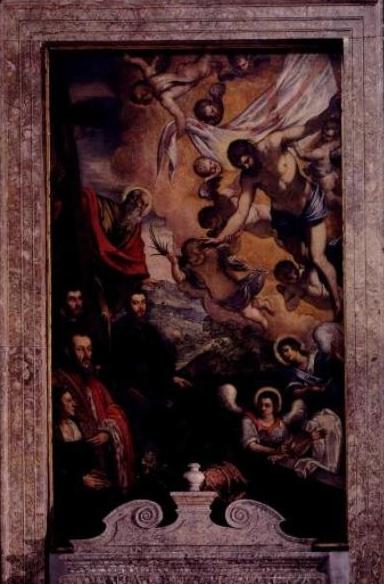
Tintoretto's monumental depiction of Christ's resurrection embodies Venetian Baroque drama and masterful use of light, capturing a pivotal moment in Christian faith with intricate detail and emotive grandeur.
「ティントレト」はヴェネツィアで生まれ、ダヤルの息子として知られるイタリアの画家です。彼の作品は劇的な構成と大胆な筆致が特徴で、特にサンマルコ聖堂の絵画はバロック美術の重要な遺産となりました。「最後の晩餐」など、彼の傑作は視覚的な感動を呼び起こし、芸術家たちに大きな影響を与えました。
A Celestial Revelation in Motion
In the heart of the Venetian Renaissance, few works capture the visceral shock of the divine as powerfully as Jacopo Tintoretto’s Risen Christ with St. Andrew and members of Morosini family. This monumental canvas is far more than a mere religious depiction; it is a theatrical event frozen in time. At its epicenter, the resurrected Jesus Christ emerges, not merely as a figure of peace, but as a force of nature, bathed in an ethereal luminescence that seems to pierce through the very fabric of the painting. The viewer is immediately drawn into a whirlwind of spiritual ecstasy and human sorrow, where the boundaries between the earthly and the divine become beautifully blurred. Through this dramatic arrangement, Tintoretto invites us to witness not just a historical event, but a profound emotional transformation.
The Alchemy of Light and Shadow
To behold this masterpiece is to witness Tintoretto’s revolutionary command over the medium of oil. Utilizing his signature alla prima technique—applying pigment directly to the canvas without the traditional, laborious layers of underpainting—the artist achieved a level of luminosity that was unprecedented in his era. Through the delicate application of translucent glazes, he mastered the interplay of light and shadow, creating a sense of depth that pulls the observer into the scene. This dramatic use of light does not merely illuminate the figures; it sculpts them, casting long, evocative shadows that emphasize the monumental scale of Christ’s ascent. For the discerning collector or interior designer, such a technique offers an unparalleled visual richness, providing a focal point that breathes life and movement into any sophisticated space, offering a texture that feels alive under varying lights.
A Stage for Devotion and Legacy
The composition functions much like a Renaissance stage production, where every figure plays a vital role in the unfolding drama. To the side, St. Andrew leans toward the light, his gaze a testament to profound devotion, while the surrounding angels swirl in a celestial dance of triumph. Yet, amidst this divine upheaval, Tintoretto grounds the scene with the presence of the Morosini family. Their inclusion transforms the biblical narrative into a personal, historical moment, blending the eternal with the temporal. This complex arrangement of mourners and witnesses creates a rhythmic movement across the canvas, guiding the eye through a landscape of grief and glory. It is this seamless integration of human emotion and divine majesty that makes Tintoretto’s work an enduring inspiration, making it a perfect choice for those seeking to adorn their surroundings with art that speaks to both the soul and the senses.