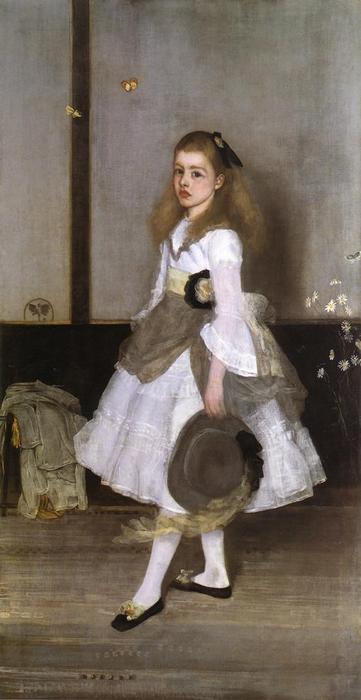
Harmony in Grey and Green: Miss Cicely Alexander
James Abbott McNeill Whistler (1834–1903) stands as one of the most enigmatic figures in American art history, a painter who championed “art for art’s sake” – prioritizing aesthetic beauty above moral or narrative content. His singular vision profoundly influenced his contemporaries and continues to fascinate scholars today. Born July 10, 1834, in Lowell, Massachusetts, Whistler's early life was marked by familial upheaval and relocation, fostering adaptability and exposing him to diverse environments. He initially pursued military aspirations but quickly realized that the rigid discipline of West Point wasn’t suited to his artistic temperament. Instead, he embraced a bohemian existence, immersing himself in Parisian culture and forging friendships with writers like Oscar Wilde and Dante Gabriel Rossetti—connections that solidified his commitment to artistic experimentation.
- Parisian Influence: Whistler's formative years were spent honing his skills under the tutelage of Sébastien Bouré, mastering oil painting and watercolor techniques.
- Early Works: His initial paintings explored landscapes and portraits with a subtle tonal palette—a characteristic that would define his signature style.
- The Ruskin Controversy: Whistler’s reputation was irrevocably altered by the Ruskin Trial of 1872, where he defended his artistic principles against criticism from John Ruskin, the celebrated Victorian art critic. This trial cemented Whistler's belief in prioritizing aesthetic experience over didactic intent.
Whistler’s artistic philosophy revolved around “art for art’s sake,” rejecting the conventions of academic painting and advocating for a focus on pure visual sensation—harmony achieved through tonal modulation rather than detailed representation. He famously declared, "I do not paint pictures to decorate walls; I paint pictures to make people feel." This conviction drove him to create works that prioritized mood and atmosphere above narrative storytelling. His nocturnes – paintings of night scenes – exemplify this approach, capturing the ethereal beauty of darkness illuminated by moonlight—a technique he termed “sympathy.” Whistler’s meticulous attention to detail—particularly in his use of color—was revolutionary for its time. He painstakingly blended pigments to achieve subtle gradations of tone, creating luminous surfaces that evoked emotion rather than conveying information.
- Tonalism: Whistler's style is considered tonalism, a movement characterized by the suppression of detail and the emphasis on tonal harmony—the interplay of light and shadow—to convey mood and atmosphere.
- Color Palette: Whistler’s paintings often employed muted shades of grey and green, reflecting his fascination with Japanese aesthetics and his desire to capture the essence of natural beauty.
- Composition: He favored asymmetrical compositions that prioritized balance and visual equilibrium, mirroring the principles of Zen Buddhism—a profound influence on his artistic worldview.
Perhaps Whistler’s most iconic work is “Whistler's Mother” (1871), a portrait of his mother rendered in a deceptively simple tonal palette. The painting’s understated elegance and psychological depth continue to resonate with viewers today, prompting interpretations ranging from maternal tenderness to existential contemplation. It exemplifies Whistler’s commitment to capturing the inner life of his subjects—a feat achieved through masterful tonal modulation and careful compositional arrangement. This masterpiece remains housed at the Tate Gallery in London, a testament to Whistler's enduring legacy as one of America’s foremost Impressionist painters. Its quiet beauty speaks volumes about Whistler’s artistic vision—a vision rooted in profound contemplation and unwavering devotion to the pursuit of aesthetic perfection.