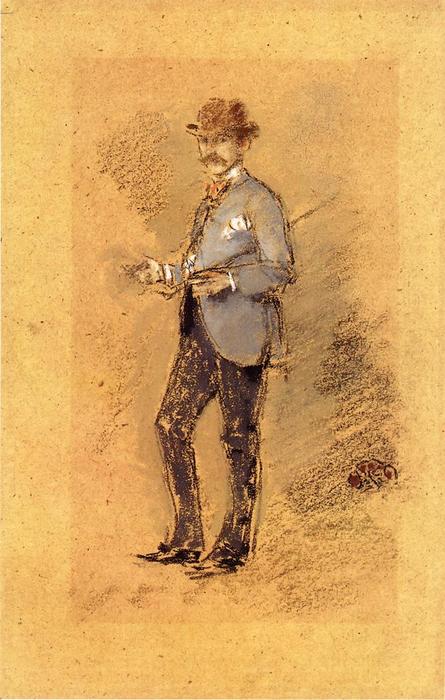
James Abbott Whistler’s ‘Harper Pennington’: A Study in Urban Melancholy
James Abbott McNeill Whistler's “Harper Pennington,” painted circa 1876, is more than just a depiction of a man with an umbrella; it’s a meticulously crafted meditation on the alienation and quiet beauty inherent within the burgeoning urban landscape of Victorian London. This evocative work, rendered in Whistler’s signature tonal palette – predominantly muted blues, grays, and browns – immediately draws the viewer into a scene steeped in atmospheric melancholy. The subject, identified as Harper Pennington, a prominent American art dealer and collector, is presented with an almost detached formality, his posture suggesting both contemplation and a subtle sense of isolation. Whistler’s deliberate blurring of details, achieved through his characteristic ‘broken colour’ technique, elevates the painting beyond a simple portrait, transforming it into a study of light, shadow, and texture – elements central to his aesthetic philosophy of “art for art's sake.”
The Aesthetic Movement and Whistler’s Rebellion
- Aestheticism: "Harper Pennington" is a quintessential example of the Aesthetic movement, which flourished in late 19th-century Britain. Rejecting the Victorian emphasis on moral or didactic art, aesthetes sought to create beauty for its own sake, prioritizing sensory experience and formal qualities over narrative content.
- Broken Colour Technique: Whistler’s innovative ‘broken colour’ technique involved applying small strokes of pure color alongside diluted tones, allowing the viewer's eye to blend them optically. This created a shimmering effect and emphasized the atmospheric conditions of the scene.
- Rejection of Realism: Unlike the prevailing realism of the time, Whistler deliberately avoided detailed representation, opting instead for an impressionistic treatment that prioritized mood and atmosphere over photographic accuracy.
Symbolism and Urban Landscape
The painting’s symbolism is subtle yet profound. The umbrella, held aloft by Pennington, isn't merely a practical accessory; it becomes a visual metaphor for protection – perhaps from the harsh realities of urban life or the emotional storms within. The indistinct figures in the background represent the anonymous masses that comprised Victorian London, highlighting the individual’s vulnerability within the vastness of the city. The building itself, rendered with careful attention to architectural detail, suggests a sense of established order and tradition, yet its muted tones contribute to the overall feeling of quiet unease. The composition echoes Whistler's fascination with Japanese prints, particularly their use of asymmetry and flattened perspective, further emphasizing the painting’s formal qualities.
Emotional Impact and Artistic Legacy
"Harper Pennington" possesses a remarkable ability to evoke a sense of quiet contemplation and melancholic beauty. Whistler's masterful manipulation of light and shadow creates an atmosphere that is both captivating and unsettling, inviting the viewer to reflect on themes of isolation, urban alienation, and the pursuit of aesthetic experience. This work solidified Whistler’s position as a leading figure in the Aesthetic movement and continues to resonate with audiences today, demonstrating his profound understanding of color, form, and the emotional power of art. Its influence can be seen in subsequent generations of artists who sought to challenge conventional notions of representation and prioritize formal qualities over narrative content.