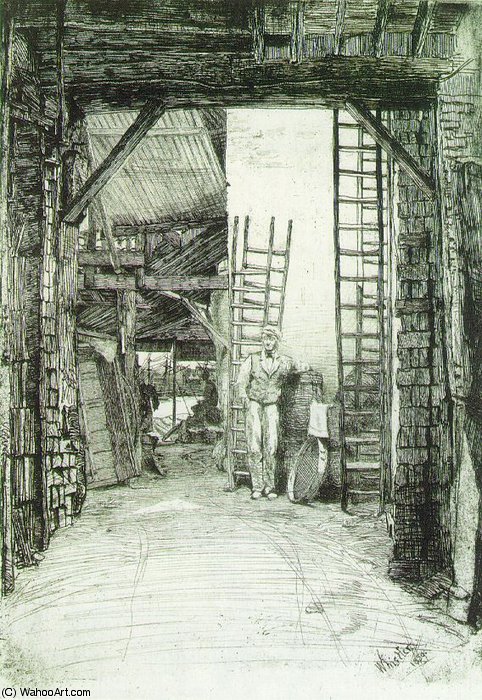
Lime burner

James Abbott McNeill Whistler’s evocative Lime burner captures a moment of quiet contemplation amidst urban activity—a striking black and white composition reflecting the Aesthetic movement's focus on formal beauty. Explore this masterful reproduction and bring Whistler’s vision home.


ジェームズ・アボット・マクニール・ホイッスラー (1834 - 1903)

ウィスラーは、絵画における美しさのみを追求する「芸術のための芸術」という思想を提唱し、印象派とは異なり、色彩とトーンの調和を重視した独特のスタイルで知られるアメリカの画家です。彼の代表作は、『モザイクの母』や『黒と金のノクターン』などがあり、美術批評家ジョン・ルシンとの訴訟は美術界に大きな影響を与えました。

A Portrait of Quiet Observation: Exploring Whistler’s “Lime Burner”

  • James Abbott McNeill Whistler's "Lime Burner," painted circa 1867, stands as a cornerstone of Aestheticism—a movement that prioritized beauty and sensory experience above didactic moral instruction. This seemingly simple composition belies a profound engagement with artistic principles and a deliberate rejection of Victorian societal expectations.
  • The painting depicts a man standing before a building adorned with scaffolding, clutching a suitcase, and gazing directly at the viewer. Alongside him are two figures—one positioned centrally and another to his right—creating an intimate tableau that invites contemplation. An umbrella rests near the left edge of the canvas, adding a subtle element of domesticity against the backdrop of industrial construction.

Style and Technique: Impressionistic Echoes Amidst Formal Precision

  • Whistler’s approach transcends mere representation; he strives for “tone,” prioritizing color harmonies and atmospheric effects over meticulous detail. Influenced by Impressionism, particularly Claude Monet's explorations of light and color, Whistler employs loose brushstrokes to capture the fleeting nuances of illumination—particularly evident in the dappled shade cast by the scaffolding.
  • Despite this Impressionistic influence, Whistler maintains a remarkable level of formal control. The geometric structure of the building provides stability against the fluidity of the paint application, resulting in an image that balances spontaneity with deliberate composition. This careful balance exemplifies Whistler’s commitment to elevating art beyond mere imitation of nature.

Historical Context: Aestheticism and Its Critique

  • "Lime Burner" emerged during a period of significant artistic ferment—the Aesthetic Movement—which challenged the Victorian obsession with narrative storytelling and moral uplift. Whistler’s manifesto declared that “art for art’s sake” was sufficient justification for creative endeavor, rejecting the notion that art should serve a social or didactic purpose.
  • This stance provoked considerable controversy within the artistic establishment. Critics accused Whistler of elitism and intellectual vanity, arguing that his focus on aesthetic beauty distanced him from the concerns of ordinary people. However, Whistler defended his position with unwavering conviction, asserting that true artistry resided in capturing the essence of experience—the subtle vibrations of color and form—rather than conveying moral lessons.

Symbolism and Emotional Resonance: Beyond Surface Appearance

  • The suitcase symbolizes travel and perhaps a journey away from convention. The man’s gaze toward the viewer establishes an immediate connection, inviting us to share in his contemplative moment. Simultaneously, the scaffolding represents progress—the relentless march of industry—yet it is juxtaposed with the quiet stillness of domestic life embodied by the umbrella.
  • "Lime Burner" resonates deeply with themes of observation and introspection. Whistler’s masterful manipulation of tonal color creates a mood of serene contemplation, prompting viewers to consider not just what they see but how they feel. It's a portrait not merely of a man, but of an artist striving to distill the beauty of existence into a single frame.

Conclusion: An Enduring Legacy of Artistic Integrity

  • Whistler’s “Lime Burner” remains a testament to his unwavering belief in artistic autonomy—a refusal to compromise on aesthetic ideals for the sake of popular acclaim. Its enduring appeal lies in its ability to capture a moment of profound stillness amidst the bustle of Victorian life, offering viewers a glimpse into Whistler's vision of art as an independent realm of beauty and contemplation.