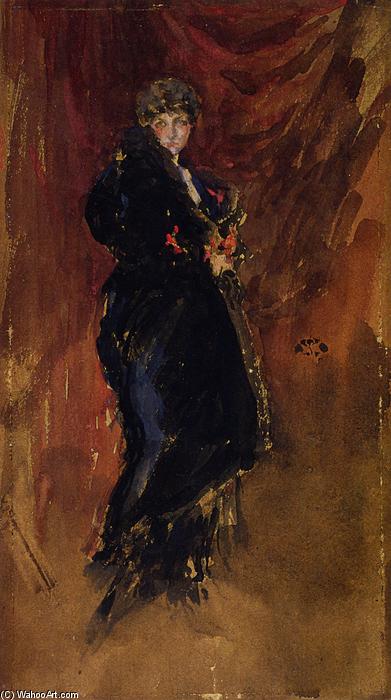
Experience Whistler's 'Red and Black,' a masterful 1883 study in tone painting that captures aesthetic beauty over narrative; discover this timeless vision today.
ウィスラーは、絵画における美しさのみを追求する「芸術のための芸術」という思想を提唱し、印象派とは異なり、色彩とトーンの調和を重視した独特のスタイルで知られるアメリカの画家です。彼の代表作は、『モザイクの母』や『黒と金のノクターン』などがあり、美術批評家ジョン・ルシンとの訴訟は美術界に大きな影響を与えました。
A Symphony of Crimson and Shadow
The moment one encounters James Abbott McNeill Whistler’s 1883 masterpiece, Red and Black, there is an immediate sense of being drawn into a private, theatrical moment frozen in time. The painting presents a striking figure—a woman poised upon a stage, her presence commanding yet shrouded in a certain enigmatic stillness. Draped in the deep, velvety tones of black and accented by a vibrant red scarf that cuts through the darkness like a sudden flame, she becomes the focal point of a carefully orchestrated visual drama. Behind her, heavy red curtains rise in layers of shadow and light, providing a rich, textured backdrop that lends the scene an air of profound elegance and sophistication. While other figures linger in the periphery, blurred and secondary, the true subject is the interplay between the woman’s confident silhouette and the atmospheric weight of the stage itself.
The Art of Tonal Harmony
Whistler was not merely a painter of subjects, but a composer of colors. In Red and Black, he moves away from the frantic energy of traditional Impressionism to embrace what he termed “tone painting.” Rather than relying on bold, visible brushstrokes that demand attention, Whistler utilized thin, translucent layers of pigment mixed with turpentine to create seamless gradations. This technique results in a remarkably matte surface that seems to absorb light rather than reflect it, inviting the viewer into a state of quiet contemplation. The way the crimson of the drapery bleeds into the deep blacks creates a sense of depth that feels almost tactile. For the collector or interior designer, this mastery of tonal harmony offers a sophisticated aesthetic that brings a sense of calm, luxurious weight to any space, acting as a window into a world of refined, muted splendor.
A Defiant Stand for Aestheticism
To understand the emotional gravity of this work, one must look to the historical rebellion it represents. Painted during an era when the Victorian public demanded that art serve as a moral compass or a storyteller, Whistler used Red and Black to champion the philosophy of “art for art’s sake.” He stripped away the need for a didactic narrative, choosing instead to focus on the pure sensory experience of color and form. This was a provocative stance, asserting that the beauty of a composition lies in its ability to evoke emotion through visual stimuli alone, rather than through a moral lesson. This painting is a testament to artistic autonomy—a celebration of the ephemeral moment and the profound impact of visual balance. It remains an enduring icon for those who appreciate art that speaks through atmosphere, texture, and the silent power of a perfectly balanced palette.