James Abbott McNeill Whistler: Champion of Aestheticism
Whistler’s artistic vision stood apart from his contemporaries—a steadfast belief that art should exist solely for its own intrinsic beauty, divorced from didactic purpose or moral instruction. This radical stance, rooted in the burgeoning aesthetic movement of the late Victorian era, positioned him as a provocateur within a society increasingly concerned with social reform and religious piety. His formative years instilled within him an adaptability honed by frequent relocations accompanying his father’s railroad engineering endeavors, exposing him to varied landscapes and fostering a keen observational eye—a skill that would prove invaluable throughout his prolific career. Despite a brief but unsuccessful foray into military training at West Point, Whistler persevered in pursuing his artistic ambitions, securing employment with the U.S. Coast and Geodetic Survey which provided crucial financial stability while simultaneously delaying his transatlantic journey to Europe. It was during this period that he honed his drawing skills and solidified his determination to establish himself as a professional artist—a commitment that ultimately propelled him into the orbit of Paris’s artistic elite, where he would encounter luminaries like Monet and Degas and irrevocably alter the course of modern art history.
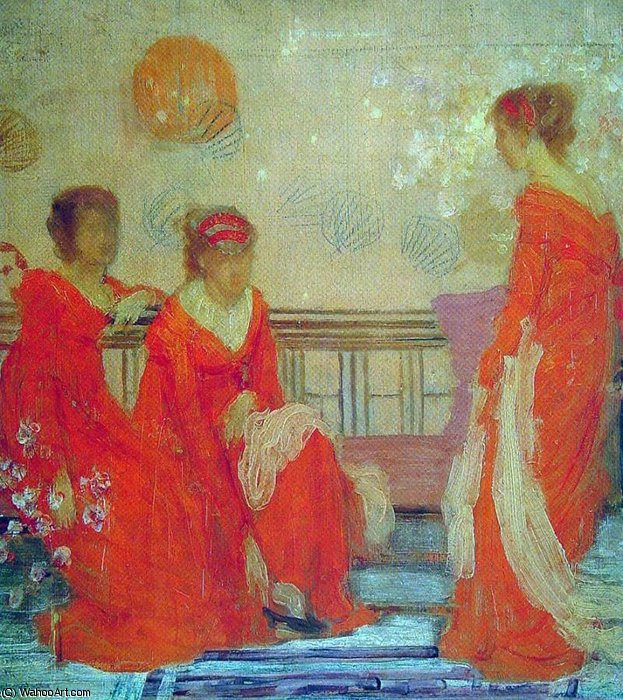
- Subject Matter: Whistler's oeuvre consistently explored portraits – often depicting women engaged in quiet contemplation or social interaction. He favored intimate compositions that prioritized psychological nuance over literal representation, striving to capture not merely physical likeness but also inner character and emotional resonance.
- Style: Whistler’s distinctive style—characterized by its understated elegance and deliberate ambiguity—became synonymous with “art for art’s sake.” Rejecting traditional narrative conventions, he embraced a minimalist aesthetic that emphasized tonal harmony and formal structure, prioritizing visual sensation over intellectual interpretation.
Technique: Orchestrating Tone and Color
Whistler meticulously crafted his paintings using a technique known as “tone,” which involved applying thin layers of oil paint to create subtle gradations of color—a process that demanded extraordinary patience and precision. He eschewed bold brushstrokes in favor of smooth, blended surfaces, achieving remarkable luminosity through careful manipulation of light and shadow. This approach mirrored Whistler’s broader philosophical preoccupation with capturing the essence of experience rather than merely documenting its surface appearance; it was a deliberate effort to evoke feeling and contemplation without resorting to explicit symbolism or narrative embellishment. Furthermore, Whistler's use of color—often muted and harmonious—was informed by his fascination with Japanese prints, which profoundly influenced his compositional sensibilities and aesthetic ideals.
- Japanese Influence: Whistler’s encounter with Japanese woodblock prints during his travels in Japan ignited a passion for asymmetrical compositions and flattened perspectives—elements that would become hallmarks of his artistic style. He admired the Japanese aesthetic's emphasis on simplicity, elegance, and tonal subtlety, adopting these principles to create paintings that transcended Western conventions.
- Formal Structure: Whistler’s canvases were meticulously planned according to geometric principles—often employing rectangles and squares to establish a sense of balance and stability. This deliberate structuring reflected his belief in the importance of visual form as an independent source of aesthetic pleasure, prioritizing compositional harmony over narrative complexity.
Historical Context: Challenging Victorian Ideals
Whistler’s artistic rebellion occurred against the backdrop of Victorian society—a period defined by moral conservatism and religious orthodoxy. His refusal to engage in didactic storytelling directly confronted these prevailing cultural values, asserting instead that art possessed inherent worth irrespective of its communicative function. This stance resonated with a growing segment of intellectuals and artists who questioned the unquestioned assumptions of their time—individuals who recognized the transformative potential of aesthetic contemplation as an antidote to societal pressures.
Symbolism & Emotional Impact: Beyond Representation
While Whistler deliberately avoided overt symbolism, his paintings nevertheless conveyed profound emotional resonance. The muted tones and understated compositions invited viewers into a realm of quiet introspection—encouraging them to contemplate the beauty of form and color without demanding intellectual analysis. Ultimately, Whistler’s work served as a testament to the enduring power of aesthetic experience—a reminder that art could enrich our lives by fostering contemplation, stimulating imagination, and elevating our senses beyond the confines of everyday reality.