A Window into the Dutch Golden Age
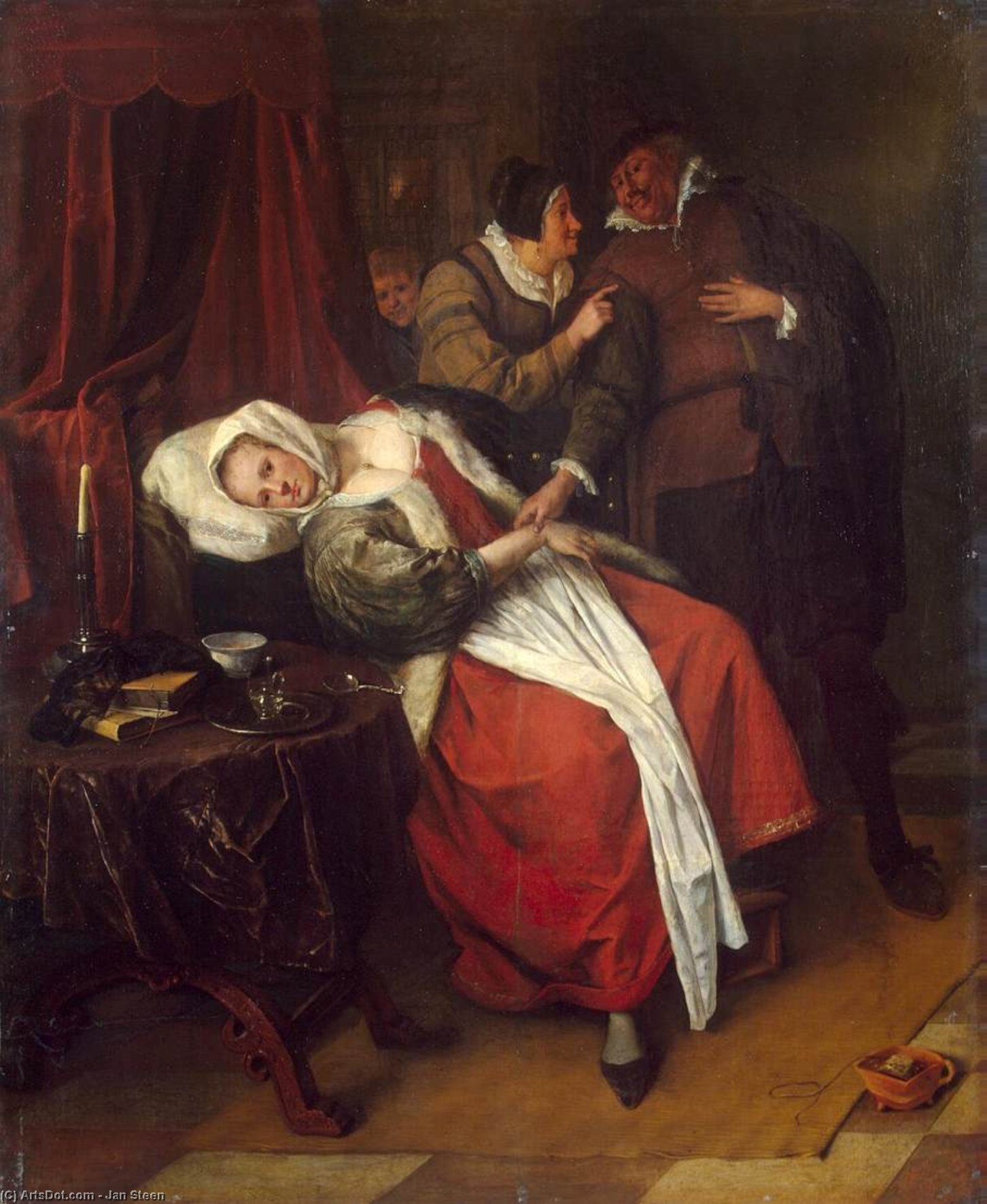
To stand before Jan Havickszoon Steen’s “The Doctor's Visit” is to step unceremoniously into the intimate, breathing heart of seventeenth-century Dutch life. Completed in 1660, this masterpiece eschews the lofty, often distant dramas of mythology and grand historical conquest to focus instead on a quiet, profoundly human moment of domestic concern. Within the frame, a woman rests in the stillness of her bed, her vulnerability palpable as she drifts between sleep and wakefulness. She is attended by a physician and others, creating a tableau that feels less like a staged performance and more like a captured breath of reality. Steen, a master chronicler of the human comedy, invites us to witness a scene where the boundaries between private illness and social ritual blur, offering a glimpse into the tender, often anxious rhythms of a household in care.
The painting is far more than a mere record of a medical consultation; it is a richly textured narrative woven with subtle layers of meaning. Steen utilizes chiaroscuro—the dramatic interplay of light and shadow—to sculpt the figures within their domestic setting, lending a sculptural depth that draws the viewer into the room. The light falls softly upon the reclining woman, highlighting her dependence, while the shadows pool around the scattered objects that populate the scene. A wine glass, an open book, and various cups are not merely incidental decorations; they serve as silent witnesses to the era's social customs. In the Dutch Golden Age, such objects often carried moral weight, hinting at the complexities of courtship, the temptations of the flesh, or the intellectual pursuits of the middle class. Through these details, Steen transforms a simple room into a stage for profound psychological depth.
Mastery of Technique and Emotional Resonance
Technically, “The Doctor's Visit” is a triumph of Baroque precision and vibrant color. Steen’s brushwork is meticulous, characterized by an observant eye that captures the tactile reality of fabric, wood, and glass. The artist employs a palette that is both warm and lively, using rich tones to heighten the emotional impact of the scene. There is a palpable sense of texture—the softness of the bedding, the cold sheen of a ceramic cup, the weight of the physician's presence—that makes the composition feel incredibly immediate. This level of detail does not overwhelm the viewer but rather serves to ground the painting’s more symbolic elements in a convincing, tangible world.
For the discerning collector or interior designer, this work offers an unparalleled opportunity to introduce a sense of history and narrative complexity into a space. The painting possesses a unique ability to anchor a room, providing a focal point that sparks conversation and contemplation. It does not merely decorate a wall; it provides a window into a vanished world, evoking a sense of nostalgia and intellectual curiosity. Whether placed in a quiet study or as a centerpiece in a grand living area, Steen’s work brings with it an atmosphere of sophisticated storytelling and an enduring appreciation for the beauty found within the everyday.