A Delicate Brushstroke: The Life and Art of Jean-Antoine Watteau
Jean-Antoine Watteau (1684-1721), a name that whispers elegance and fleeting beauty, stands as one of the most influential figures in eighteenth-century French art. Born into modest circumstances in Valenciennes—his father a craftsman specializing in roofing—Watteau’s artistic journey began humbly, sketching the vibrant life of his hometown streets with an observant eye honed by early exposure to everyday scenes.
Initial struggles for recognition within Paris’s rigid artistic circles fueled his determination. Despite facing rejection from established institutions, Watteau persevered, securing patronage primarily through connections with influential figures like Gabrielle Niel and Guillaume de Gontaut-Biron. This resilience proved crucial as it allowed him to cultivate a distinctive style—the Fête Galante—that would redefine the aesthetic landscape of its time.
The Birth of the Fête Galante
Unlike the grandeur and dramatic narratives championed by the Baroque, Watteau’s artistic vision embraced an intimate realm of leisure and refined emotion. He rejected monumental canvases for smaller-scale paintings that captured fleeting moments of aristocratic gatherings—picnics in the countryside, dances beneath moonlight—scenes imbued with a palpable sense of melancholy and idealized beauty.
This stylistic innovation wasn't merely about visual preference; it represented a profound shift in artistic sensibilities. Watteau deliberately distanced himself from theatrical grandeur, favoring instead subtle gestures and expressions that conveyed inner feelings rather than outward declarations. He skillfully employed pastel hues—particularly pale blues and pinks—to create luminous atmospheres and evoke the ethereal quality of twilight or dawn.
Technique and Inspiration: Rubens' Influence
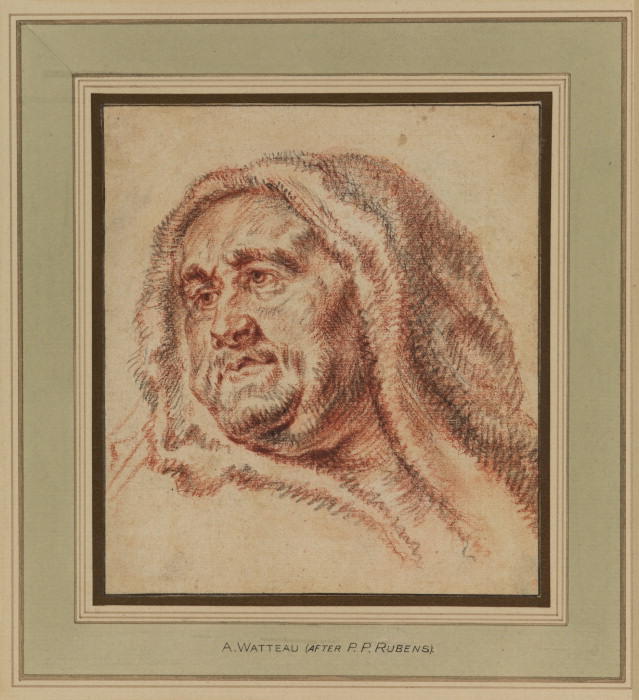
The image before us – “Male Head - After Rubens” – exemplifies Watteau’s masterful technique. While undeniably influenced by Peter Paul Rubens, whose monumental paintings dominated the Baroque era, Watteau distilled Rubens’ dramatic style into a remarkably restrained form. Observe the meticulous rendering of facial features—the furrowed brow, the gaze directed towards the horizon—a testament to Watteau's dedication to anatomical accuracy.
However, Watteau’s genius lay not solely in technical precision but in his ability to infuse his compositions with psychological depth. The pose itself suggests contemplation and introspection, mirroring the contemplative spirit of Rubens’ “Miracles of St. Francis Xavier,” a painting that served as an important source of inspiration for Watteau.
Rubens' monumental canvases explored themes of faith and divine majesty, whereas Watteau focused on capturing the ephemeral pleasures of aristocratic life—a deliberate contrast that underscores the artist’s commitment to portraying human emotion with sensitivity and nuance. The pastel medium further enhances this effect, creating a luminous surface that softens contours and lends an air of dreamy tranquility.
Symbolism and Emotional Resonance
"Male Head - After Rubens" speaks volumes about Watteau's artistic intentions. The robe worn by the subject symbolizes nobility and sophistication, while the gaze into the distance embodies longing for something beyond immediate experience—a characteristic motif found throughout Watteau’s oeuvre.
Ultimately, Watteau’s art transcends mere visual representation; it invites viewers to contemplate themes of beauty, melancholy, and the fleeting nature of existence. Like Rubens' monumental works, Watteau’s paintings aspire to elevate the human spirit, capturing moments of grace and vulnerability with unparalleled artistry. Reproductions of this captivating piece offer a glimpse into the heart of Rococo aesthetics—a celebration of delicate sensibilities and an enduring testament to Watteau’s artistic legacy.