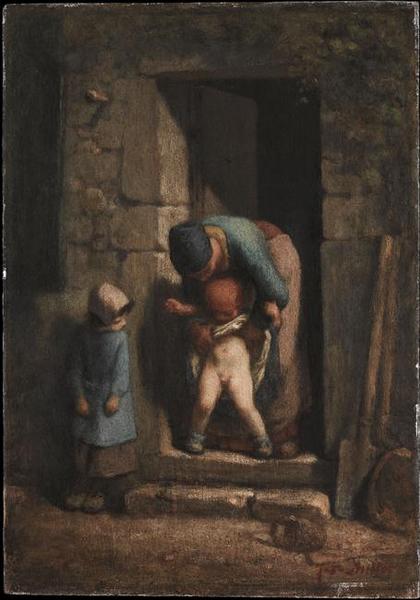
A tender moment of rural devotion unfolds in this Realist masterpiece by Jean-François Millet, capturing the quiet dignity of motherhood through soft light and earthy textures that invite you to explore his timeless vision.
ミレット(1814-1875):バルビゾン学派のフランス人画家。農民の生活を力強く描き出し、写実主義芸術に大きな影響を与えました。『収穫後の風景』や『祈りの天使』など、その作品は人間の尊厳と自然との調和を表現しています。
Paris
France
パリのルーブル美術館を探索!モナ・リザやミロのヴィーナスなど、古代エジプトからルネサンス期の傑作まで。訪問計画はこちら。
The Louvre
Musée du Louvre
France
Paris
Louvre Museum
Mona Lisa
8.7 million (2024)
380,000+ objects
Art museum
1793
A royal residence
3
Originally, what was the Louvre primarily built as?
La Précaution Maternelle: A Window into Rural Dignity
Jean-François Millet’s “La Précaution Maternelle,” painted in 1850, transcends mere representation; it embodies the very essence of Realist art and offers a profound meditation on motherhood, faith, and the quiet beauty of peasant existence. Executed during the Barbizon School's golden age—a movement dedicated to capturing the immediacy of nature and portraying rural life with uncompromising honesty—the painting depicts a woman tenderly nursing her infant child against a weathered brick wall backdrop. This seemingly simple scene is imbued with layers of symbolic significance, reflecting Millet’s deep empathy for the working class and his unwavering belief in the dignity inherent within their daily lives.
A Portrait of Rural Harmony
The composition itself speaks volumes about Millet's artistic vision. The woman—likely depicted as Marie Rousseau, a local farmer’s wife—is positioned centrally, her gaze focused downwards on her child, conveying an aura of serene devotion. Her posture exudes comfort and care, mirroring the instinctive bond between mother and child. Beside her stands another figure, presumably Rousseau’s husband, offering support and companionship. The subtle inclusion of this second person underscores the importance of community and familial connection within rural society—a theme central to Millet's artistic preoccupations.
Technique and Impressionistic Light
Millet employed a masterful technique characterized by meticulous observation and tonal modulation. Using oil paints on canvas, he achieved remarkable realism through painstaking layering of colors, capturing the textures of fabric, skin, and brick with astonishing accuracy. However, unlike some of his contemporaries who sought to slavishly reproduce every detail, Millet skillfully utilized Impressionistic principles—particularly the manipulation of light—to imbue the scene with an ethereal glow. The diffused sunlight filtering through the doorway casts a warm hue upon the figures, enhancing their emotional resonance and conveying a sense of tranquility.
Historical Context: Embracing Authenticity
“La Précaution Maternelle” emerged during a period of significant social upheaval in France—the Industrial Revolution was reshaping urban landscapes and challenging traditional ways of life. Millet’s decision to depict rural labor—specifically breastfeeding—was deliberately provocative, rejecting idealized depictions of peasant life favored by Romantic artists. Instead, he championed the honest portrayal of everyday struggles and triumphs, aligning himself with a burgeoning movement that sought to elevate the status of the common people and celebrate the beauty found in simplicity.
Emotional Resonance: A Testament to Human Connection
Ultimately, “La Précaution Maternelle” succeeds as an artwork because it transcends mere visual representation. It captures a moment of profound human connection—the unwavering love between mother and child—and speaks to universal themes of compassion, vulnerability, and faith. Millet’s painting continues to inspire viewers today with its quiet dignity and its poignant reminder that beauty can be found in the most unassuming corners of existence. Its enduring appeal lies in its ability to evoke empathy and contemplation, prompting us to consider the values that underpin a life rooted in connection to the natural world and to one another.