A Symphony of Joy in the Rococo Garden
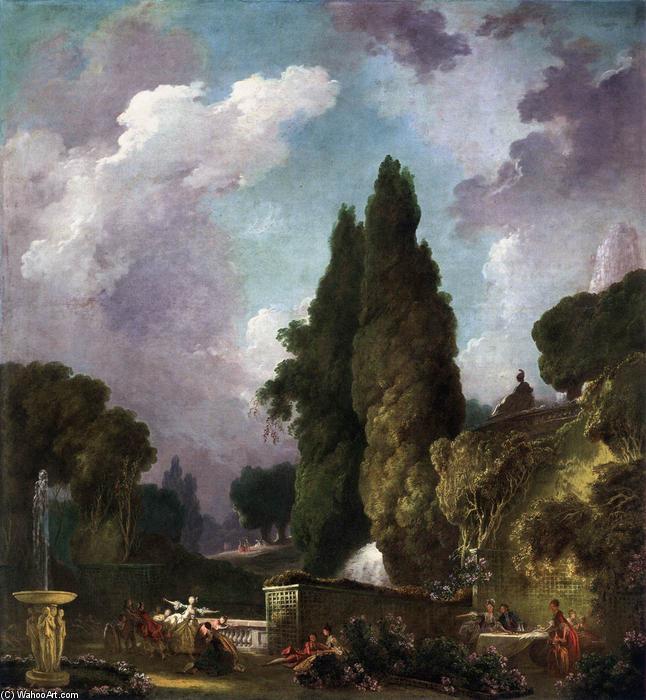
In the luminous masterpiece Blindman’s Buff, Jean-Honoré Fragonard invites us into a world where the boundaries between reality and a dreamlike pastoral fantasy dissolve. Completed around 1775, this monumental canvas transcends mere depiction to embody the very spirit of Rococo artistry—a celebration of sensuality, frivolity, and the fleeting beauty of youth. As we gaze upon this idyllic garden scene, we are transported to the height of Louis XV’s reign, witnessing a quintessential social pastime that offered the aristocracy a glimpse into an era of unparalleled leisure. The painting's palette is a masterclass in airy optimism, dominated by soft pastel hues of pink, peach, and lemon yellow that seem to shimmer with an inner light, establishing an atmosphere of carefree enjoyment and effortless grace.
The composition itself is a deliberate dance of movement and light. Fragonard employs an asymmetrical arrangement that guides the viewer’s eye across the lush, verdant landscape, creating a sense of spontaneity as if we have stumbled upon a private moment of delight. Within this manicured sanctuary, elegantly dressed figures are scattered strategically throughout the greenery; some linger in the foreground while others recede into the soft-focus distance, adding depth to the social tapestry. A tranquil fountain rests towards the left, providing a serene counterpoint to the energetic playfulness of the men engaged in the game. This juxtaposition of stillness and motion creates a rhythmic vitality that is central to the painting's emotional pull.
Technique and the Language of Light
To behold Blindman’s Buff is to witness the technical brilliance Fragonard perfected during his time in the atelier of François Boucher. His technique is characterized by a remarkable facility and an exuberant use of oil paint on canvas. He utilizes loose, fluid brushstrokes and shimmering glazes to achieve an ethereal effect, layering translucent colors to create a sense of profound luminosity. This meticulous attention to detail allows the light to appear as though it is filtering through leaves and reflecting off silk garments, imbuing the scene with a tactile richness. For the discerning collector or interior designer, this technique offers a captivating texture that brings a sense of life and movement to any space, making a high-quality reproduction feel like a window into another century.
Beyond the mere physical beauty of the paint, the artwork is rich with symbolic resonance. Scattered amongst the blooming blossoms, several birds flutter through the air—a recurring motif in Fragonard’s oeuvre that serves as a poignant symbol of liberty, joy, and the eternal renewal of nature. The game of Blindman’s Buff itself acts as a metaphor for the veiled eroticism and playful uncertainty often found in Rococo genre paintings. It captures a moment of "joie de vivre," where the pursuit of pleasure is both a social ritual and a spiritual release from the rigid formalities of the era.
An Eternal Legacy of Elegance
Historically, this work serves as a profound reflection of the aristocratic culture of 18th-century France. During this period, elaborate gardens and sophisticated social gatherings were essential expressions of status, refinement, and the pursuit of aesthetic perfection. Fragonard captures the very soul of the Ancien Régime—a world of whispered elegance in private salons and sun-drenched afternoons in manicured parks. For those seeking to infuse their surroundings with a sense of historical grandeur and romantic charm, this painting offers an incomparable source of inspiration.
Whether adorning a grand gallery or serving as a focal point in a contemporary living space, Blindman’s Buff continues to resonate with its themes of intimacy and enchantment. It remains a timeless testament to the ability of art to capture the ephemeral nature of happiness, offering a permanent sanctuary of light and laughter for all who behold it.