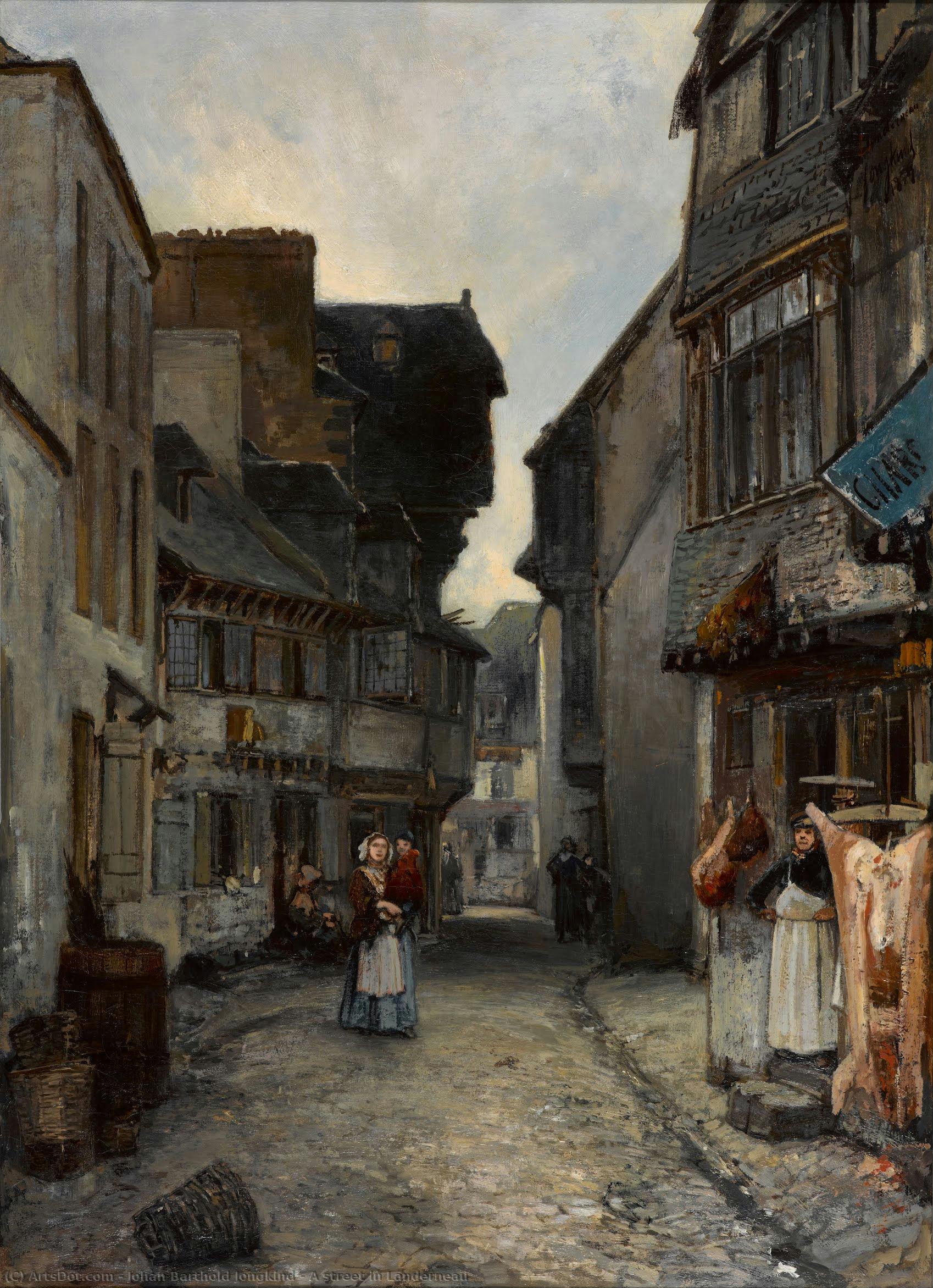
A Street in Landerneau: Capturing Impressionistic Light
Johan Barthold Jongkind stands as a pivotal figure in the burgeoning movement of Impressionism, albeit often overshadowed by his more celebrated contemporaries like Monet and Renoir. Born in 1819 in Lattrop, Netherlands, Jongkind’s artistic journey began with a grounding in traditional Dutch landscape painting under Andreas Schelfhout, fostering an unwavering dedication to meticulous observation of nature—a cornerstone that would later infuse his canvases with the revolutionary spirit of Impressionism. His relocation to Paris in 1837 marked a decisive step toward embracing this groundbreaking aesthetic, fueled by encouragement from Eugène Isabey who championed the allure of Normandy and Brittany’s coastal vistas. This serendipitous encounter with Claude Monet proved formative; Monet himself acknowledged Jongkind's influence on his artistic eye, recognizing the importance of portraying atmospheric conditions as accurately as possible.
- Subject Matter: Jongkind’s focus was consistently on capturing the ephemeral beauty of the sea and shorelines—particularly those of Brittany and Normandy. “A Street in Landerneau” exemplifies this dedication, presenting a tranquil snapshot of Breton life.
- Style & Technique: The painting embodies Impressionistic principles through its broad brushstrokes and emphasis on diffused light – techniques honed during Jongkind’s formative years with Schelfhout. He skillfully utilizes horizontal planes to convey the expansive sky and coastline, creating a sense of openness and tranquility.
Landerneau: A Scene of Everyday Life
The composition depicts Landerneau, France, showcasing ordinary figures engaged in daily activities—a butcher tending his shop and a woman accompanied by her child strolling along the street. Jongkind’s deliberate choice to portray these commonplace subjects elevates them into moments of artistic significance, demonstrating that Impressionism wasn't solely concerned with grand landscapes but also with capturing the nuances of human experience within their surroundings. The artist’s attention to detail—the textures of clothing and buildings—adds depth and realism to the scene without detracting from its overall atmospheric quality.
Influence & Legacy
Jongkind’s artistic vision profoundly impacted Monet, who recognized Jongkind's astute understanding of how to translate light onto canvas. This collaborative spirit solidified Jongkind’s position as a crucial precursor to Impressionism and cemented his enduring legacy as an artist committed to portraying the world with sensitivity and precision. His work continues to inspire artists today, reminding us that beauty can be found in the simplest of observations—a lesson beautifully embodied in “A Street in Landerneau.”
Reproductions & Decorative Potential
A high-quality reproduction of Jongkind’s “A Street in Landerneau” would bring a touch of serene Impressionistic charm to any interior space. Its muted palette and masterful depiction of light create an atmosphere of calm contemplation, perfectly suited for hallways or living rooms seeking understated elegance. Consider framing it with natural wood tones to complement the painting's organic aesthetic—a thoughtful gesture honoring Jongkind’s artistic vision and celebrating the enduring power of Impressionistic art.