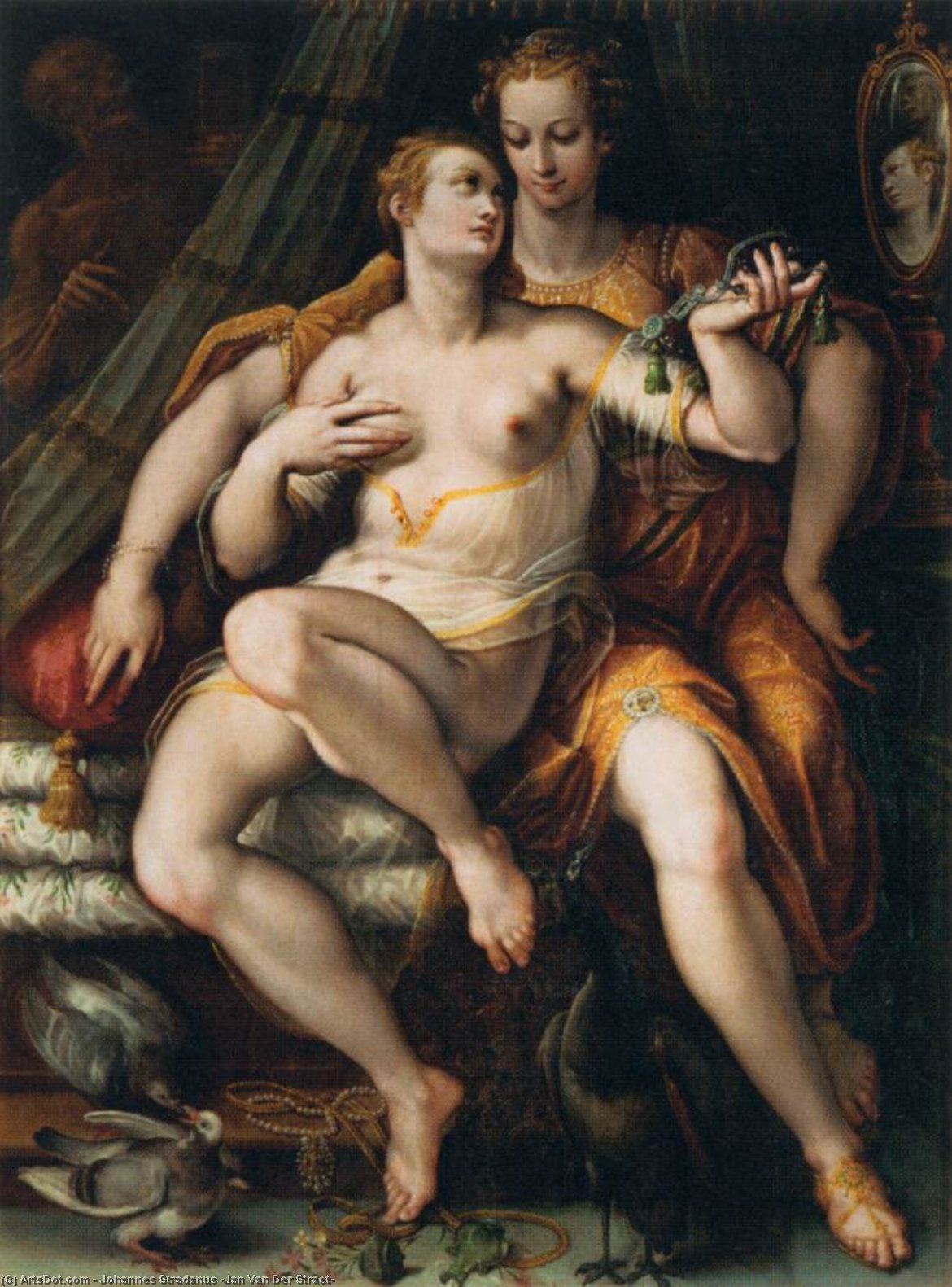
A Renaissance Meditation on Mortality
In the quiet, dramatic shadows of the late sixteenth century, Johannes Stradanus captured a profound tension between the ephemeral beauty of life and the inevitable approach of the end. His masterpiece, “Vanity, Modesty and Death,” serves as a hauntingly beautiful allegory, inviting the viewer into a deeply personal contemplation of human nature. Created around 1569, this work is not merely a painting but a philosophical dialogue rendered in oil, where every brushstroke contributes to a larger narrative about the soul's struggle against worldly temptation. The composition draws us into a private chamber, draped in heavy fabrics and rich textures, where the air feels thick with both luxury and omen.
The heart of the painting lies in its striking juxtaposition of two female figures, each embodying a conflicting virtue or vice. On one side, we encounter Lady Vanity, ensconced in an opulent setting of silks and velvories. She is lost in the seductive trap of her own reflection, her gaze fixed upon a mirror that captures not just her face, but the very essence of superficiality. This preoccupation with outward appearance—the shimmering jewelry and the meticulous grooming—perfectly encapsulates the aristocratic preoccupations of the Renaissance era. Yet, this splendor is interrupted by the presence of Lady Modesty, who stands as a silent, sobering sentinel. By holding a skull aloft, she introduces the concept of memento mori, forcing a confrontation between the glittering surface of life and the stark reality of death.
Mannerist Elegance and Symbolic Depth
Technically, Stradanus employs the sophisticated language of Flemish Mannerism to heighten the painting's emotional resonance. The artist utilizes dramatic lighting—a precursor to the chiaroscuro that would define later eras—to sculpt the figures from the darkness, creating a sense of three-dimensional weight and theatrical presence. The interplay of light on the metallic sheen of the jewelry and the soft folds of the bed linens demonstrates a masterful command of texture, making the scene feel tangibly real yet dreamlike in its intensity. This precision is balanced by a fluid, elegant grace in the figures' poses, a hallmark of the Florentine influence that Stradanus brought to his work after moving from Bruges.
Beyond the visual splendor, the painting is rich with subtle symbolic layers that reward deep observation. A small bird perched delicately upon the bed serves as a poignant counterpoint; it represents the fleeting nature of life and the vitality of the natural world, existing momentarily amidst the heavy themes of decay and vanity. For the discerning collector or interior designer, this piece offers more than just aesthetic beauty; it provides a focal point for intellectual engagement. It is a work that demands a space of reflection, making it an extraordinary addition to a curated collection or a sophisticated living space where art is intended to provoke thought and inspire conversation about the enduring mysteries of the human condition.