A Symphony of Serenity: The Luminous World of Kensett
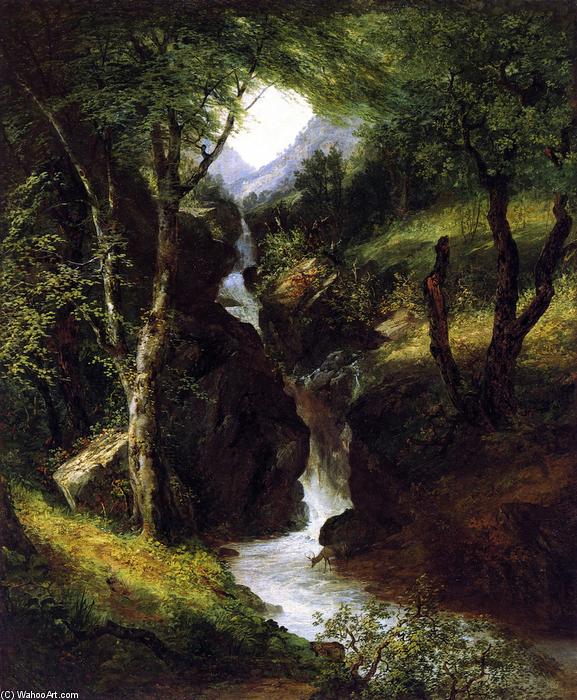
In the quietude of the mid-nineteenth century, a profound movement emerged in the American landscape, one that sought not just to document the wilderness, but to reveal its divine, underlying harmony. At the heart of this transcendental pursuit stood John Frederick Kensett, an artist whose brush possessed the rare ability to capture the very breath of nature. His 1852 masterpiece, Cascade in the Forest, serves as a breathtaking testament to this era. The painting invites the viewer into a secluded sanctuary where the rhythmic descent of water over ancient rocks creates a visual melody. It is a scene that transcends mere topography, offering instead a window into a world defined by stillness and light.
The composition is a masterclass in the Luminist style, a refined evolution of the Hudson River School. Kensett moves away from the dramatic, often turbulent vistas of his contemporaries to embrace a more subtle, atmospheric approach. In Cascade in the Forest, the technique is characterized by smooth, almost invisible brushwork that allows light to appear as if it is emanating from within the canvas itself. The water does not merely fall; it flows with a translucent grace, catching the soft, filtered light of the forest canopy. This meticulous attention to luminosity creates a sense of depth and clarity, making the lush greenery and the rugged textures of the stones feel tangibly present yet ethereally dreamlike.
Symbolism and the Soul of the Landscape
Beyond its technical brilliance, the artwork is rich with the symbolic language of the American Transcendentalist movement. The waterfall, a central motif, acts as a symbol of eternal renewal and the continuous flow of life. As the water cascades through the dense, verdant forest, it represents the untamed yet harmonious pulse of the natural world. A subtle, poignant detail—a single bird perched quietly upon a branch—introduces a moment of living consciousness into the landscape. This small inclusion serves to bridge the gap between the observer and the observed, reminding us that within this vast, tranquil ecosystem, every element is interconnected and vital.
For the discerning collector or interior designer, this piece offers more than just aesthetic beauty; it provides an emotional anchor. The painting’s ability to evoke a sense of profound peace makes it an ideal centerpiece for spaces designed for reflection and repose. Whether placed in a sun-drenched library or a sophisticated contemporary living room, Cascade in the Forest brings with it an aura of timelessness. It is a work that does not demand attention through noise, but rather commands it through a quiet, irresistible magnetism, making it a quintessential choice for those looking to infuse their surroundings with the restorative power of nature.