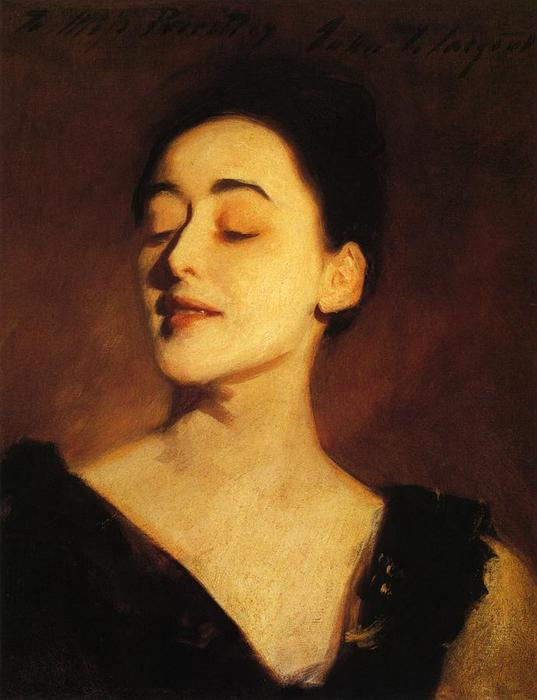
Flora Priestley (also known as Lamplight Study): A Portrait of Serene Introspection
John Singer Sargent's Flora Priestley (also known as Lamplight Study), painted in 1889, is a captivating oil on canvas measuring 45 x 30 cm. Currently residing at the Parrish Art Museum in Water Mill, New York, this artwork exemplifies Sargent’s mastery of portraiture and his ability to capture fleeting moments of human emotion through light and shadow.
The Painting: An Exploration of Light and Atmosphere
This intimate portrait depicts Flora Priestley with her eyes gently closed, conveying a sense of peaceful repose or quiet contemplation. Her long hair cascades down her back, framing a face illuminated by the soft glow of lamplight. Sargent’s skillful use of chiaroscuro – the contrast between light and dark – creates depth and volume, highlighting the delicate contours of Flora's features. The background subtly reveals two other figures, partially visible on either side of the canvas, suggesting an interior setting without distracting from the central subject. The warm tones and diffused lighting evoke a feeling of intimacy and tranquility, drawing the viewer into the scene’s peaceful atmosphere. Sargent doesn't merely depict Flora; he captures a moment suspended in time, inviting us to share in her quiet solitude.
John Singer Sargent: The Master of Portraiture
John Singer Sargent (1856-1925) was renowned for his exceptional ability to portray the personalities and emotions of his subjects. Born in Florence, Italy, to American parents, he received extensive training in Paris before establishing himself as a leading portraitist in London and beyond. His portraits are characterized by their realism, attention to detail, and a remarkable ability to convey psychological depth. Flora Priestley is a prime example of Sargent’s skill; the subtle expression on Flora's face, expertly rendered through light and shadow, speaks volumes about her inner state. Sargent’s technique moved beyond mere representation; he sought to capture the essence of his sitters, revealing their character and mood with remarkable sensitivity.
Historical Context & Artistic Style
Painted during the Gilded Age, a period of significant social and economic change in America and Europe, Flora Priestley reflects the era’s fascination with leisure and refinement. Sargent's style blends elements of Realism with Impressionistic techniques. While grounded in realistic observation, his loose brushwork and emphasis on capturing fleeting light effects demonstrate an awareness of contemporary artistic trends. The use of artificial lamplight as a central element is also noteworthy, reflecting the increasing prevalence of electric lighting in urban homes during this period and its impact on social life and interior spaces. Sargent’s ability to seamlessly integrate these elements creates a portrait that is both timeless and evocative of its historical context.
Symbolism & Emotional Impact
The closed eyes of Flora Priestley invite introspection and contemplation, suggesting a moment of quiet reflection away from the bustle of daily life. The soft lamplight symbolizes warmth, intimacy, and perhaps even a sense of protection or sanctuary. The overall effect is one of serene beauty and understated elegance. Flora Priestley transcends a simple portrait; it becomes an exploration of human emotion, capturing a fleeting moment of peace and tranquility that resonates with viewers across generations.