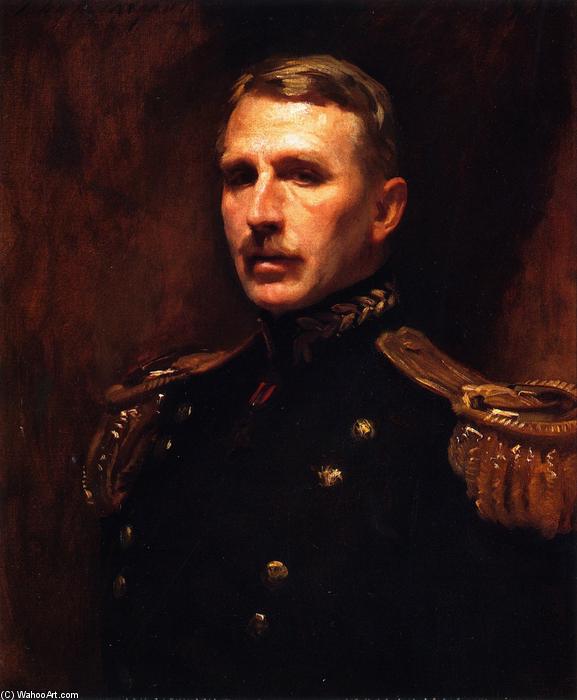
A Portrait of Authority: John Singer Sargent’s Major General Leonard Wood
John Singer Sargent's “Major General Leonard Wood,” painted in 1903, is more than just a military portrait; it’s a meticulously crafted study in power, confidence, and the subtle nuances of late Victorian society. The painting captures the commanding presence of General Wood, a prominent figure in the United States Army during a period of significant national expansion and reform. Sargent's masterful brushwork immediately draws the viewer into the scene, establishing an intimate connection with the subject through direct eye contact – a hallmark of his portraiture style.
- Subject Matter: The painting depicts Major General Leonard Wood, a highly respected officer known for his integrity and leadership during the Spanish-American War.
- Composition: Sargent employs a classic three-quarter pose, a favored technique to convey both dignity and approachability. The general’s direct gaze anchors the composition, demanding attention and projecting an aura of authority.
- Color Palette: The subdued color palette – dominated by browns, blacks, and gold – reflects the formality of the military environment while subtly highlighting Wood's status through the gleaming buttons on his coat.
The Gilded Age and the Portraiture of Power
Painted during the height of the Gilded Age, “Major General Leonard Wood” speaks to a society grappling with rapid industrialization, social change, and burgeoning American power. Sargent’s portraits were frequently commissioned by wealthy industrialists, politicians, and military leaders – individuals who sought to solidify their position within this dynamic landscape. This particular work exemplifies the era's fascination with portraying success and influence through carefully constructed images of masculine strength and refinement. The inclusion of two ties, a seemingly minor detail, subtly reinforces the general’s status as a man of impeccable taste and adherence to established social norms.
Sargent’s Technique: Light, Brushwork, and Psychological Insight
Sargent's technique is characterized by his loose, expressive brushstrokes and his ability to capture fleeting moments of light. He skillfully uses highlights to emphasize Wood’s features – particularly the strong jawline and confident gaze – creating a sense of depth and volume. More than just a technical exercise, Sargent’s approach reveals a deep understanding of human psychology. The general's posture and expression convey not only authority but also a quiet self-assurance, suggesting an inner strength that resonates with the viewer. The subtle modeling of the form, achieved through delicate gradations of tone, adds to the realism and impact of the portrait.
Symbolism and Emotional Impact
"Major General Leonard Wood" transcends a simple depiction of a military officer; it’s a powerful statement about leadership, honor, and the values of the American nation. The painting's enduring appeal lies in its ability to evoke a sense of respect and admiration for the subject while simultaneously offering a glimpse into the social and political climate of early 20th-century America. This reproduction offers an exceptional opportunity to own a piece of art history, capturing not just a likeness but also the spirit of a pivotal moment in American military and societal development.