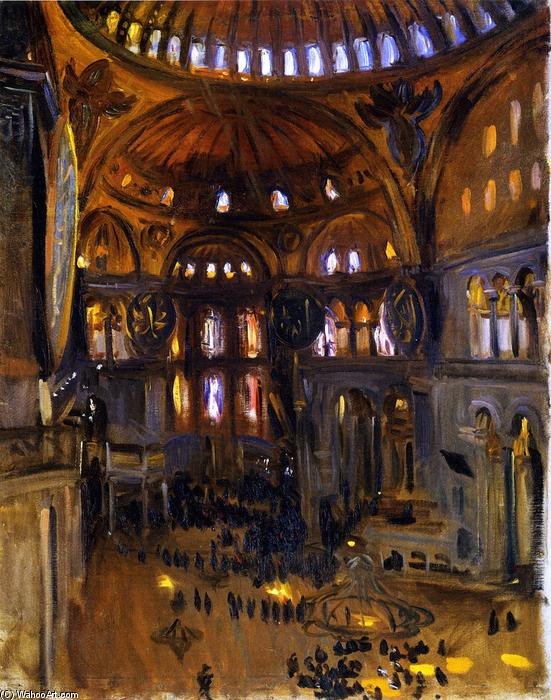
Explore John Singer Sargent’s stunning ‘Sketch of Santa Sophia’! Admire its grand architecture, dynamic brushstrokes & warm light in this iconic 1891 masterpiece.
「ジョン・シガー・サージェント」は、エドワード年代の優雅さを表現した印象派絵画や、豪華な肖像画で知られるアメリカ画家。彼の作品は美術史に大きな影響を与え、今なお多くの人々を魅了しています。特に『マダムX』は社会的なタブーをテーマにした作品として話題になりました。
メトロポリタン美術館
(New York, United States of America)
5千年の芸術と文化を体験!メトロポリタン美術館で、古代エジプトの遺産からルネサンス絵画まで、世界中の至宝を発見。ニューヨークの象徴的な美術館へ。
(229文字)
A Glimpse into Majesty: Sargent’s ‘Sketch of Santa Sophia’
John Singer Sargent's “Sketch of Santa Sophia,” painted in 1891, is far more than a preparatory study; it’s a powerfully evocative impression of one of the world’s most historically and architecturally significant structures. Captured during his travels through the Ottoman Empire, this oil on canvas offers a unique window into Sargent's artistic process and his fascination with light, space, and the grandeur of ancient civilizations. The painting resides within the esteemed collection of the Metropolitan Museum of Art, a testament to its enduring artistic merit. It’s important to note that while termed a “sketch,” the work possesses a remarkable completeness and expressive force, defying simple categorization.
Impressionistic Technique & Artistic Vision
Sargent's technique in this piece is characterized by his signature *alla prima* approach – painting directly onto the canvas without extensive underdrawing or layering. This lends the artwork an immediacy and freshness that captures the fleeting effects of light within the vast interior of Hagia Sophia. Bold, visible brushstrokes define the architectural forms—the soaring dome, massive arches, and colossal columns—not with rigid precision, but with a dynamic energy that conveys their immense scale. The color palette is dominated by warm ochres, ambers, and browns, reflecting the aged stone and gilded surfaces of the cathedral. However, Sargent masterfully introduces cooler tones – blues and grays filtering through the numerous windows – to create depth and atmospheric perspective. This isn’t a meticulous architectural rendering; it's an *impression* of awe-inspiring space and light.
Historical Context & Cultural Exchange
Painted during a period of increasing Western interest in Eastern cultures, “Sketch of Santa Sophia” reflects the burgeoning cultural exchange between Europe and the Ottoman Empire. Sargent’s travels were fueled by a desire to experience firsthand the architectural wonders he had only previously known through books and engravings. Hagia Sophia itself embodies this intersection of cultures – originally built as a Byzantine cathedral in the 6th century, it was later converted into a mosque following the Ottoman conquest of Constantinople (now Istanbul). Sargent’s painting subtly acknowledges this layered history, presenting the building not simply as an architectural marvel but as a symbol of shifting empires and religious traditions. It's a visual document of a specific moment in time, capturing the atmosphere of a space steeped in centuries of history.
Emotional Resonance & Symbolic Weight
The painting evokes a profound sense of awe and reverence. The sheer scale of Hagia Sophia is communicated through Sargent’s masterful use of perspective and light, dwarfing the few human figures scattered within the interior. This emphasizes the building's enduring power and timelessness. Beyond its architectural beauty, Hagia Sophia carries significant religious symbolism – representing both Christian and Islamic faith throughout its history. While Sargent doesn’t explicitly focus on these symbolic layers, they are undeniably present, adding depth to the viewer’s experience. The painting invites contemplation not only of the building itself but also of the broader themes of faith, power, and cultural legacy. It's a work that resonates with a sense of spiritual grandeur and historical weight.