A Symphony of Perception: The Vibrancy of Albers
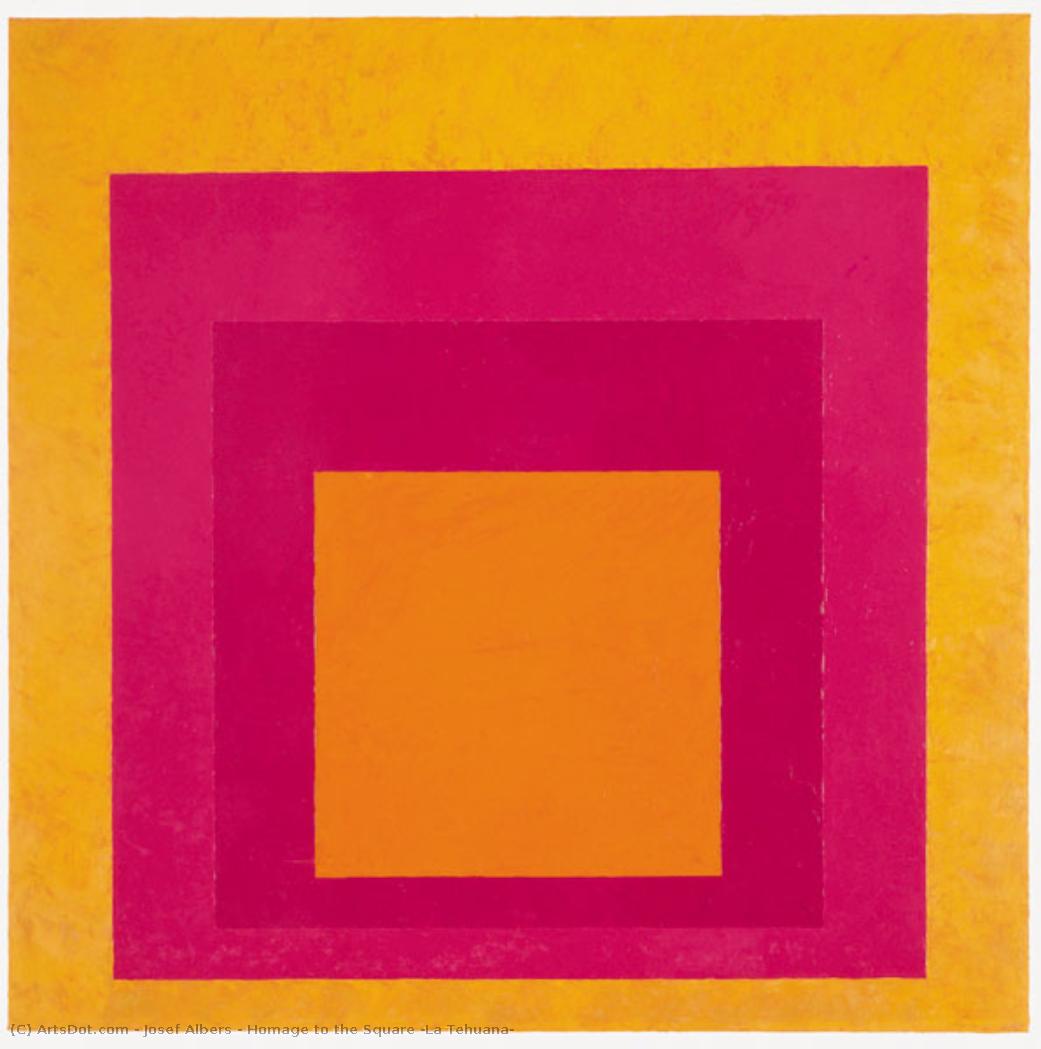
In the quiet contemplation of Josef Albers’s "Homage to the Square (La Tehuana)," one does not merely look at a painting; one enters into a profound dialogue with light and color. Created in 1951, this masterpiece serves as a mesmerizing meditation on how we perceive the world around us. At its heart, the work is an exploration of the Hard Edge aesthetic, a movement that sought to strip away the atmospheric ambiguity of Impressionism in favor of absolute clarity and geometric precision. The composition presents a striking arrangement of nested squares, where a dominant, sun-drenched yellow interacts with a muted magenta backdrop, cradling a smaller, warm orange core. There is no illusion of depth here, only the exhilarating tension created by the meeting of flat, vibrant planes.
The brilliance of Albers lies in his ability to prove that color is never static. Through his meticulous technique, he demonstrates that a single hue can transform depending on its neighbors. In "La Tehuana," the edges where the yellow meets the magenta are not merely boundaries; they are active zones of visual energy. This phenomenon, often referred to as color interaction, ensures that the painting feels alive, shifting subtly as the viewer moves or as the ambient light in a room changes. For the discerning collector or interior designer, this creates a dynamic focal point that breathes life into a space, offering a sophisticated layer of intellectual and visual stimulation.
The Legacy of the Bauhaus and the Spirit of Craft
To understand the soul of this work, one must look back to Albers’s formative years within the revolutionary Bauhaus school in Germany. His upbringing in a family of craftsmen instilled in him a deep reverence for the inherent qualities of materials—a philosophy that would later define his teaching at Black Mountain College and Yale University. This painting is a testament to that disciplined approach, where every stroke of oil paint on fiberboard is executed with an unwavering commitment to material truth. The precision of the lines and the flatness of the surface reflect a rejection of the subjective ego in favor of an objective, almost scientific investigation into the mechanics of sight.
Beyond its technical rigor, "Homage to the Square (La Tehuana)" carries an emotional resonance that transcends its geometric simplicity. There is a sense of profound balance and harmony within the piece, a structural stability that provides a sense of calm and order to any environment. It invites the viewer to slow down, to observe the subtle shifts in tone, and to appreciate the beauty found in mathematical precision. Whether gracing a modern gallery wall or serving as the centerpiece of a contemporary living space, this work remains an enduring icon of 20th-century abstraction, offering timeless inspiration for those who find beauty in the intersection of logic and emotion.