A Study in Quiet Defiance
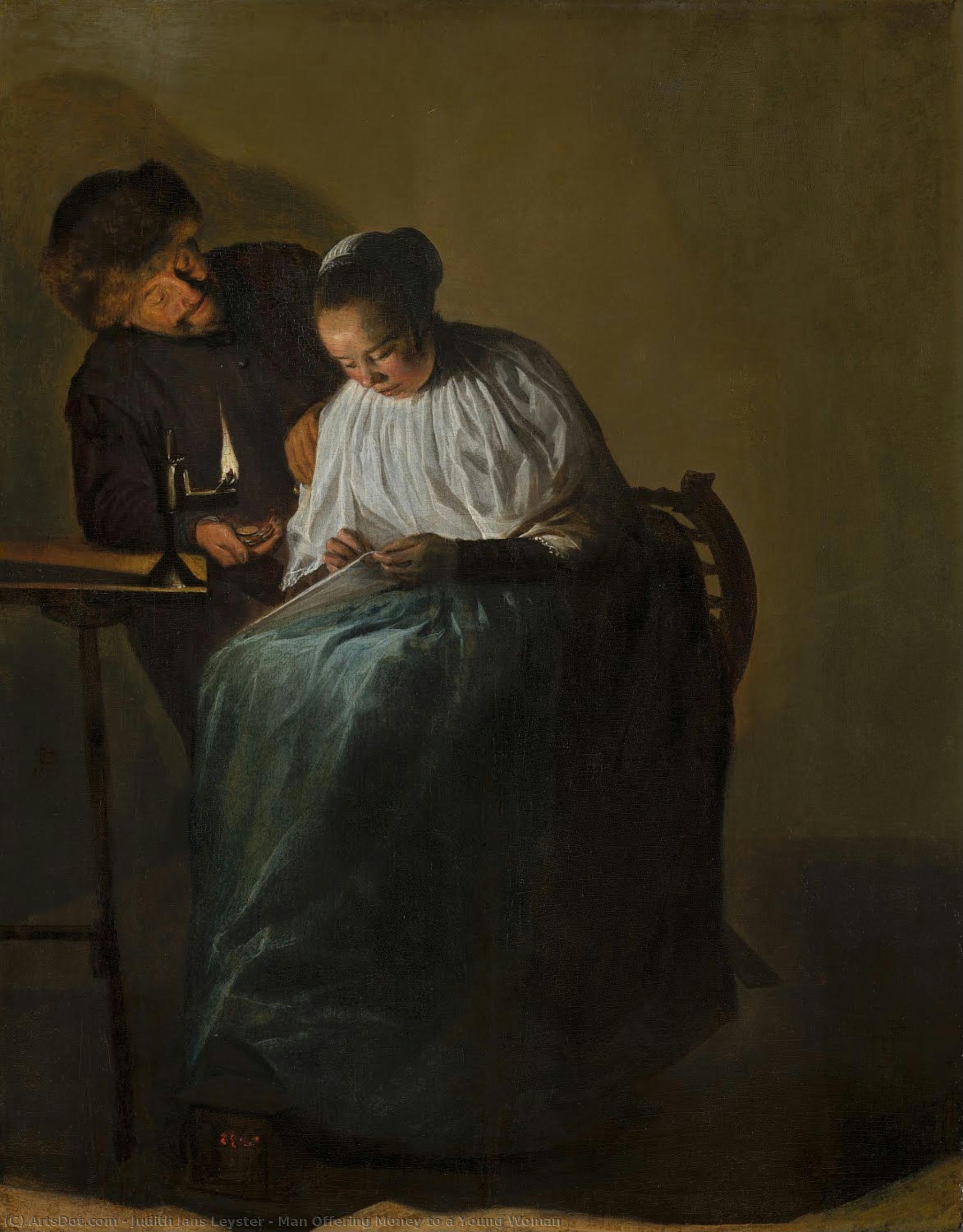
In the hushed, amber-lit corners of the Dutch Golden Age, few works capture the tension of human interaction as poignantly as Judith Jans Leyster’s Man Offering Money to a Young Woman. Painted around 1631, this intimate masterpiece transcends its modest dimensions to present a profound psychological drama. At first glance, the scene appears to be a standard genre painting of seventeenth-century domestic life, yet beneath the surface lies a complex narrative of temptation and moral fortitude. The composition centers on a young woman deeply immersed in her needlework, her focus so absolute that it creates a barrier against the world around her. Beside her, an older man leans into her personal space, his presence heavy with implication as he extends a handful of coins. It is a moment frozen in time, where the clink of metal and the soft rustle of fabric seem to hang suspended in the dim light.
Leyster’s mastery of chiaroscuro—the dramatic interplay between shadow and illumination—serves as the heartbeat of this piece. Drawing inspiration from the atmospheric depth of Rembrandt, she uses a single, directional light source to sculpt the figures out of the surrounding gloom. This technique does more than just provide visibility; it directs the viewer's emotional journey. The light catches the sheen of the man’s fur hat and the glint of the coins, drawing our eyes to the very instrument of temptation, before retreating into the soft shadows that shroud the woman’s face. This deliberate use of contrast emphasizes the textures of the era: the coarse weight of the man's clothing, the delicate threads of the embroidery, and the warm glow emanating from the foot warmer at the woman's feet. The result is a tactile experience that invites the viewer to step into the room and feel the heavy, contemplative atmosphere.
Symbolism and the Subversion of Tradition
To understand the true brilliance of this work, one must look past the literal transaction of money and into the symbolic subversion Leyster performs. During this period, Northern European art frequently utilized the "unequal love" motif—a trope where men used wealth to entice women into flirtatious or immoral encounters. However, Leyster subtly dismantles this cliché. There is no overt sensuality here, no reciprocal glance or blushing cheek. Instead, the woman’s unwavering concentration on her task serves as a silent, powerful form of resistance. Her needlework is not merely a domestic chore; it is a shield of virtue. By focusing on her labor rather than his advances, she reclaims her agency, transforming a scene of potential vulnerability into one of quiet strength.
For the discerning collector or interior designer, this painting offers much more than mere decoration. It provides a focal point of intellectual and emotional depth. The muted palette of deep browns, blacks, and somber blues allows the work to integrate seamlessly into sophisticated, classical interiors, while its intense subject matter provides a conversational spark. Whether displayed in a study filled with leather-bound books or as a centerpiece in a contemporary gallery space, Leyster’s work brings an air of historical gravity and timeless elegance. It is a piece that rewards repeated viewing, revealing new layers of meaning with every encounter with its shadows and light.