A Quiet Glimpse into the Artist's Soul
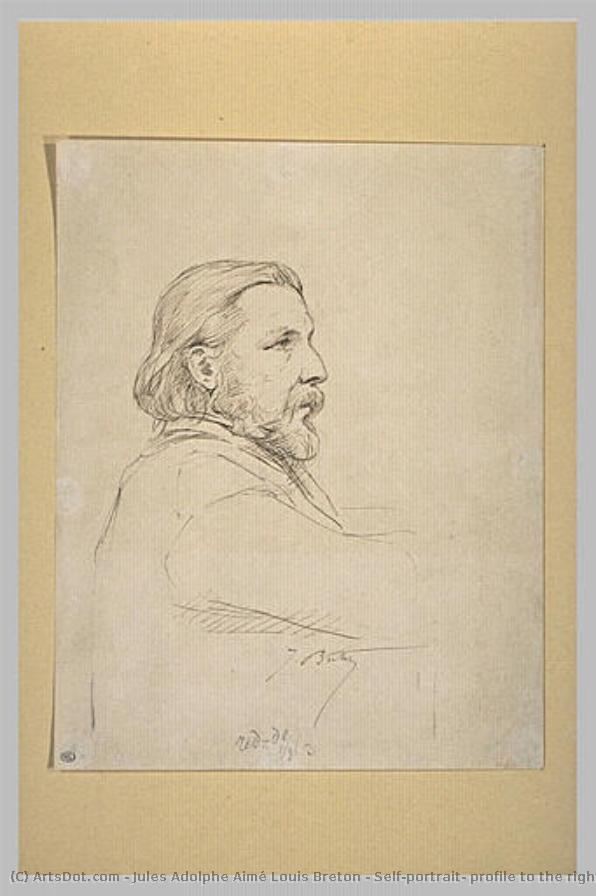
This intimate self-portrait of Jules Adolphe Aimé Louis Breton offers more than just a likeness; it presents a quiet meditation on the act of seeing itself. Captured in profile, facing gracefully to the right, the drawing allows us an unparalleled proximity to the artist’s contemplation. The composition is deceptively simple—centered around the head and shoulders—yet its power lies in the sheer concentration of observation. Breton, known for his unwavering commitment to depicting life as it truly was, turns that rigorous eye inward, offering us a moment of profound self-assessment rendered in delicate graphite or charcoal.
Mastery of Line and Shadow
Technically, this piece is a masterclass in drawing fundamentals. The artist has employed line work with an almost architectural precision, using hatching and cross-hatching not merely for shading, but to build palpable texture into the very fabric of the image. One can trace the careful delineation of facial contours, the subtle suggestion of the collar beneath his chin, all achieved through varying pressures on the paper. The palette itself—a muted symphony of browns and beiges—lends an immediate sense of age and authenticity, evoking the tactile quality of a sketch kept close to the heart for years. It is a study in restraint; depth is suggested through layered lines rather than dramatic contrast.
The Context of Realism
To understand this work is to understand Breton’s artistic spirit. As a key figure within French Realism, his entire career was dedicated to stripping away the romantic veneer and confronting the viewer with unvarnished truth. While his grander canvases celebrated the dignity of peasant life, this self-portrait serves as an equally potent declaration: the artist himself is worthy of such unflinching study. It connects directly to his formative years absorbing the lessons of Courbet—a commitment to depicting the observable world without embellishment.
Emotional Resonance and Interior Harmony
For the collector or designer, this piece offers a unique emotional anchor. Its quietude speaks volumes; it is not a dramatic outburst but a sustained breath. The feeling evoked is one of deep introspection—a sense of thoughtful solitude that can transform any space. Imagine this sketch rendered as a reproduction in your study or drawing-room; its understated elegance will complement richly textured furnishings, allowing the viewer to pause and engage with the quiet narrative unfolding on the page. It whispers of dedication, observation, and the enduring power of the human gaze.