Katsushika Hokusai: Rock Shelter On Fuji – A Vision of Serenity Amidst Majestic Peaks
Katsushika Hokusai’s “Rock Shelter on Fuji,” painted circa 1860s, stands as a cornerstone of Japanese art history and arguably the most recognizable image emanating from the Edo period. More than just a landscape depiction, it embodies the spirit of *Shinsei* – “new mountain enlightenment” – reflecting a profound shift in artistic sensibilities influenced by Western Impressionism and signaling a burgeoning interest in capturing fleeting moments of beauty.
Born in Tokyo around 1760, Hokusai’s life was marked by relentless experimentation and an unwavering dedication to mastering the art of *ukiyo-e*, woodblock printing. Initially apprenticed as a mirror maker, he swiftly transitioned into painting, establishing himself as one of Japan's foremost artists despite facing considerable familial disapproval. This rebellious spirit fueled his artistic journey, propelling him through decades of prolific creation and cementing his legacy as a visionary innovator.
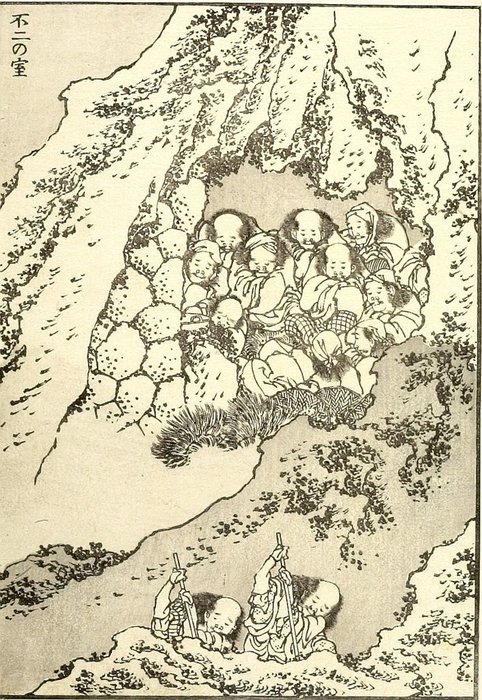
The artwork itself presents a serene tableau: a solitary pilgrim traversing the slopes of Mount Fuji amidst towering rock formations. Unlike traditional depictions prioritizing grandeur and majesty—characteristic of earlier landscape paintings—Hokusai eschews ostentation, favoring subtle tonal gradations and meticulous detail to convey an atmosphere of contemplative repose. The artist’s masterful use of Prussian blue pigment – a relatively new import from Europe – dramatically enhances the visual impact, capturing the ethereal luminescence of Fuji’s snow-capped peak at dawn.
Symbolically, “Rock Shelter on Fuji” speaks volumes about Edo society's preoccupation with spirituality and pilgrimage. The rock shelter serves as a refuge from the harsh realities of travel, representing inner peace and resilience amidst external challenges. Furthermore, Hokusai’s deliberate framing—emphasizing horizontal lines—mirrors the vastness of Mount Fuji itself, prompting viewers to contemplate the sublime beauty of nature and its capacity for inspiring awe.
Technically, Hokusai employed a complex layering process typical of *ukiyo-e*, utilizing multiple blocks carved from cherry wood to achieve astonishing tonal precision. Each block was inked individually, allowing for nuanced shading and texture—a technique that would later inspire Impressionist painters like Monet and Degas. The resulting print possesses an unparalleled luminosity and depth, capturing the essence of Fuji’s majesty with breathtaking accuracy.
“Rock Shelter on Fuji” continues to captivate audiences today not merely as a beautiful image but as a testament to Hokusai's artistic genius—a masterful synthesis of Eastern philosophy and Western aesthetic principles. Its enduring appeal resides in its ability to evoke feelings of tranquility, contemplation, and reverence for the natural world.
Historical Context: The painting emerged during Japan’s *Shinsei* movement – a period marked by renewed interest in Buddhist pilgrimage and a fascination with capturing fleeting moments of sublime beauty. This stylistic shift reflected broader cultural trends influenced by European Impressionism, signaling a departure from the formal conventions of earlier Japanese art.
Style & Technique: Hokusai’s approach to *ukiyo-e* distinguished him from his contemporaries. He prioritized tonal harmony and atmospheric perspective—techniques borrowed from Western painting—to convey an impressionistic sense of immediacy and luminosity. The meticulous carving of cherry wood blocks ensured exceptional precision, allowing for nuanced shading and texture.
Symbolism: The rock shelter itself symbolizes refuge and inner peace, mirroring the pilgrim’s quest for spiritual enlightenment amidst the imposing grandeur of Mount Fuji. The artist's use of Prussian blue—a pigment imported from Europe—added a vibrant hue to the scene, enhancing its ethereal quality.
Emotional Impact: “Rock Shelter on Fuji” inspires contemplation and reverence for nature’s majesty. Its serene composition invites viewers to immerse themselves in the tranquility of the mountain landscape and contemplate the sublime beauty of the natural world.