A Moment of Transient Beauty: An Exploration of Hokusai’s Pink Blossom
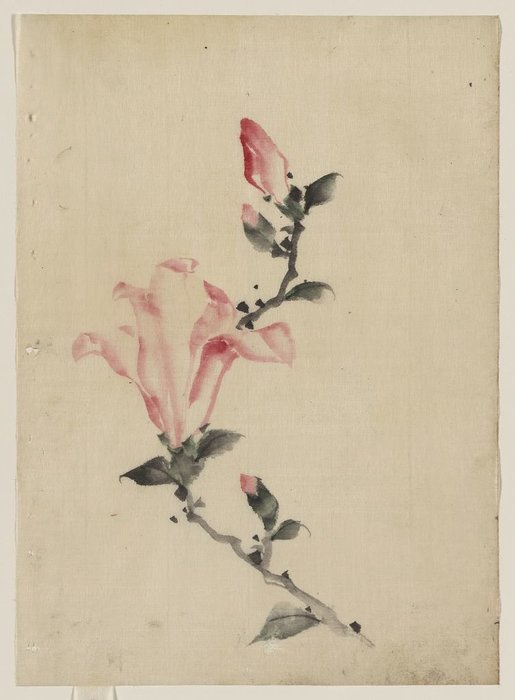
Katsushika Hokusai's *Large Pink Blossom On A Stem With Three Additional Buds* is more than just a depiction of a flower; it’s a distilled essence of Japanese aesthetics, a poignant meditation on the fleeting nature of beauty and life itself. Executed in the classic style of suibokuga – traditional Japanese watercolor painting – this artwork captures a single cherry blossom at its most vulnerable, a motif deeply ingrained within the cultural consciousness of Japan. Hokusai, already renowned for his monumental woodblock prints like *The Great Wave*, demonstrates here an exquisite sensitivity to detail and form, qualities that would come to define his enduring legacy.
- Subject Matter & Symbolism: The cherry blossom, or sakura, holds profound significance in Japanese culture. Its short but vibrant bloom symbolizes the ephemeral nature of existence – a reminder of beauty's transient quality and the acceptance of impermanence. This particular image, focusing solely on a single blossom and its accompanying buds, amplifies this sentiment, inviting contemplation on the delicate balance between joy and sorrow, life and death.
- Style & Technique: Hokusai’s approach here is remarkably restrained, characteristic of suibokuga. The artist masterfully employs subtle gradations in color – soft pinks layered with greens and browns – to create a sense of depth and volume within the petals and leaves. Delicate lines define the edges, lending an air of fragility, while brushstrokes vary in density, suggesting texture and adding a tactile quality to the image.
The Legacy of Edo: Contextualizing Hokusai’s Vision
To fully appreciate *Large Pink Blossom On A Stem With Three Additional Buds*, it's essential to understand the artistic landscape of Edo (modern-day Tokyo) during Hokusai’s lifetime. The late 18th and early 19th centuries were a period of immense social and cultural change in Japan, marked by the rise of urban centers like Edo and the flourishing of artistic traditions. Hokusai, born around 1760, was deeply influenced by this dynamic environment, absorbing diverse styles and techniques while simultaneously forging his own distinctive voice. His work reflects both the established conventions of Japanese painting and a burgeoning interest in naturalism – a desire to capture the essence of the world with unprecedented accuracy.
A Study in Light and Space
The composition of the artwork is deceptively simple, yet remarkably effective. The vertical orientation emphasizes the flower’s upward reach, while ample negative space around the blossom creates a sense of tranquility and allows the viewer to fully appreciate its delicate form. Hokusai skillfully utilizes soft, diffused lighting, eliminating harsh shadows and creating an ethereal quality. There's no strong perspective; instead, the view is relatively flat, typical of traditional Japanese painting, further enhancing the feeling of serenity and detachment from worldly concerns. The subtle variations in color intensity and overlapping elements create a convincing illusion of depth, suggesting spatial relationships within the composition.
Collecting a Masterpiece: Reproduction Considerations
ArtsDot offers meticulously crafted hand-painted reproductions of *Large Pink Blossom On A Stem With Three Additional Buds*, allowing you to bring this iconic artwork into your home or office. Our skilled artisans employ traditional watercolor techniques, faithfully recreating Hokusai’s nuanced style and capturing the emotional depth of the original. Each reproduction is a testament to artistic skill and dedication, ensuring that you receive a piece of art history that will endure for generations. Consider this exquisite print not just as an image, but as a window into the soul of one of Japan's greatest artists – a reminder to cherish beauty in all its fleeting forms.