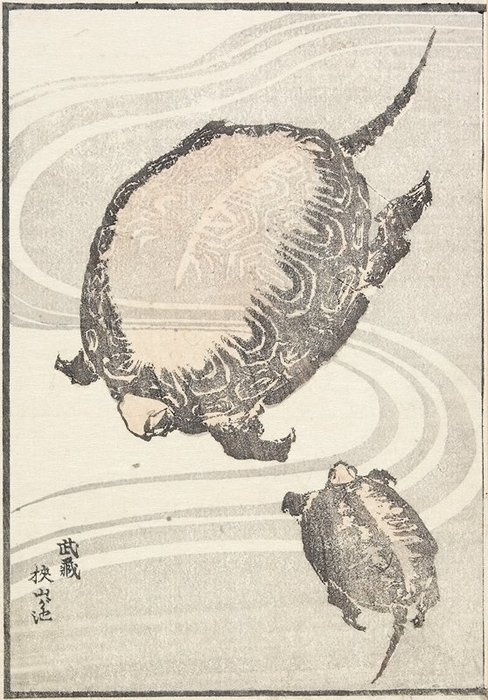
Sayama-ga-ike Pond In Musashi Province:A Masterpiece of Tranquility
Katsushika Hokusai’s “Sayama-ga-ike Pond In Musashi Province” transcends mere depiction; it embodies the very essence of Japanese landscape painting and artistic philosophy. Executed in monochrome—primarily Prussian blue—with subtle tonal variations achieved through meticulous layering and printing techniques characteristic of Ukiyo-e, this woodblock print stands as a testament to Hokusai’s unparalleled ability to capture fleeting beauty and convey profound emotion.
- Composition & Perspective: The vertical orientation immediately establishes dominance, emphasizing the grandeur of Mount Fuji dominating the horizon. Rather than relying on linear perspective—a technique prevalent in Western art at the time—Hokusai skillfully employs overlapping forms and tonal gradations to create a sense of depth and atmospheric haze, transporting viewers into the serene stillness of Musashi Province.
- Subject Matter & Symbolism: Two large turtles gliding across Sayama-ga-ike Pond serve as central figures. Turtles are universally recognized symbols of longevity, wisdom, and resilience—themes deeply ingrained in Buddhist cosmology and Japanese culture. Their presence underscores the enduring beauty of nature and invites contemplation on themes of permanence amidst change.
- Technique & Material: The print’s remarkable texture is achieved through the painstaking process of carving woodblocks and applying ink (primarily sumi) multiple times—a technique honed over decades by Hokusai. Each layer contributes to a rich, layered effect that captures the nuances of light and shadow, resulting in an image brimming with tactile detail.
- Historical Context: Created during the Edo period (1603–1868), “Sayama-ga-ike Pond” reflects the burgeoning interest in landscape painting—known as Shan Shui—amongst Japanese elites. Simultaneously, it aligns with Hokusai’s broader artistic ambition to explore diverse subjects and styles, marking a pivotal moment in Ukiyo-e's evolution from portraits of courtesans to grand vistas of nature.
- Emotional Impact: Viewing “Sayama-ga-ike Pond” evokes a feeling of tranquility, serenity, and connection with the natural world. The muted palette and deliberate brushstrokes foster contemplation—encouraging viewers to immerse themselves in the beauty of simplicity and appreciate the timeless wisdom conveyed by this iconic artwork.
A reproduction of “Sayama-ga-ike Pond” offers an opportunity to bring a piece of Japanese artistic heritage into your home, capturing not only its visual splendor but also the profound philosophical spirit that defines Hokusai’s legacy.