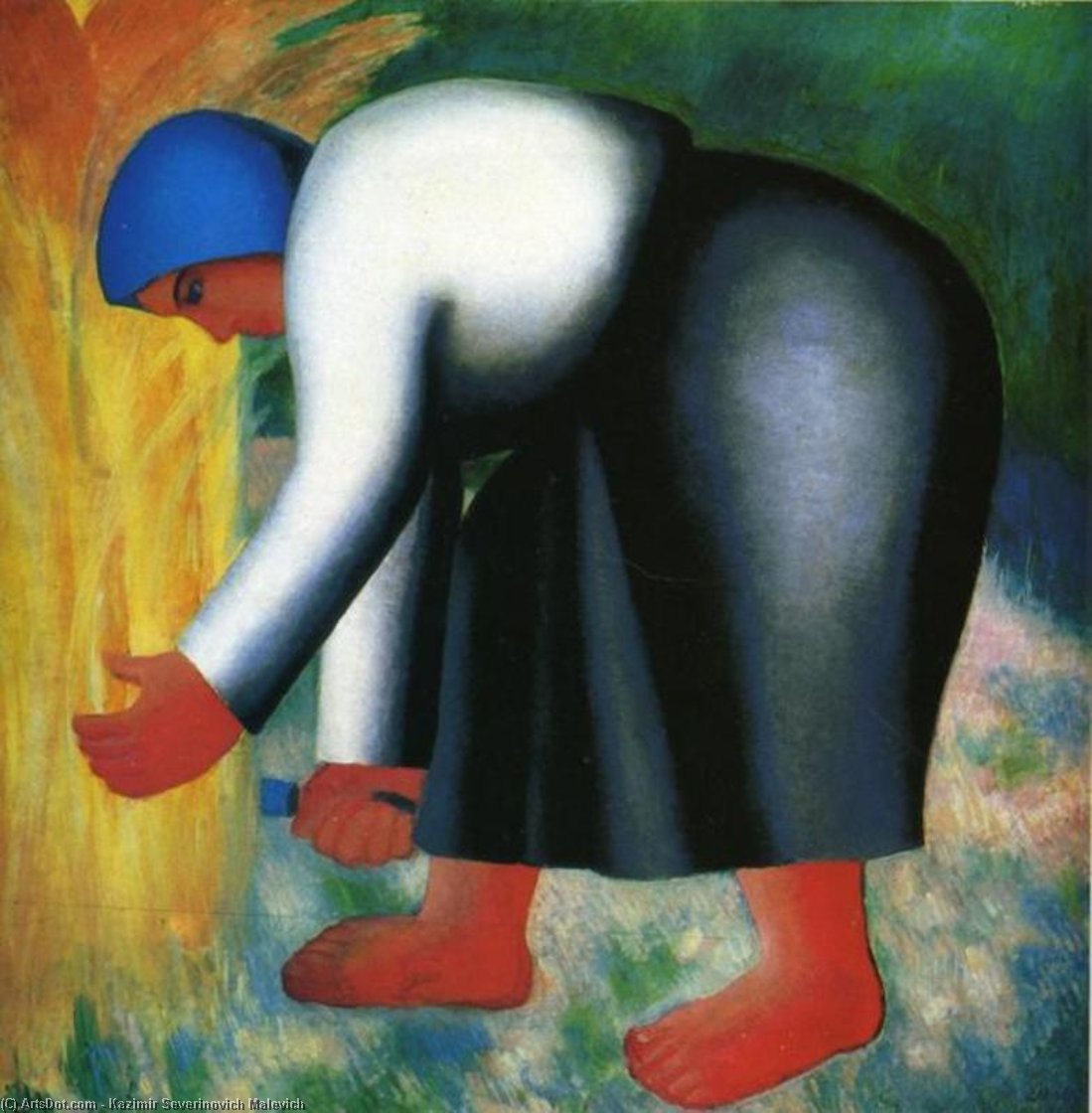
Reaper

Explore Kazimir Malevich’s ‘Reaper,’ a striking 1932 Suprematist painting featuring bold geometric forms & limited color palette. A key work of early 20th-century abstraction.


カジミール・マレーヴィチ (1878 - 1935)

カジミール・マレーヴィチ(1878-1935): Suprematismの創始者であり、抽象芸術の先駆者。黒方や白の中に白といった革新的な作品で知られ、20世紀美術に多大な影響を与えました。

A Vision of Labor: Decoding Kazimir Malevich’s ‘Reaper’ (1932)

  • Subject and Composition: ‘Reaper’ presents a striking, abstracted depiction of a female agricultural worker. Rather than aiming for realistic representation, Malevich employs a dynamic diagonal composition that thrusts the figure forward, imbuing the scene with energy and movement. The solitary figure dominates the canvas, set against a field of golden stalks rendered in broad, textured brushstrokes. This isn’t a portrait of an individual, but rather an exploration of the *idea* of labor itself.
  • Stylistic Innovation & Suprematist Roots: Painted in 1932, ‘Reaper’ stands as a fascinating transitional work within Malevich's oeuvre. While deeply rooted in his established Suprematist principles – prioritizing pure geometric forms and color over representational accuracy – it subtly hints at a return to figuration after years of radical abstraction. The figure is broken down into simplified shapes: white for the torso, black for the lower body, red feet, and a blue head covering. This fragmentation echoes Cubist influences absorbed during his 1912 visit to Paris, yet remains distinctly Malevich in its pursuit of non-objective feeling.

Color, Texture & Technique: A Study in Contrasts

  • A Limited Palette, Maximum Impact: The painting’s power lies in its restrained color palette. The warm golden yellow of the field provides a luminous backdrop for the stark contrasts of black, white, red and blue that define the figure. These colors aren't used descriptively; instead, they function as independent elements contributing to the overall visual harmony and emotional resonance.
  • Impasto & Surface Quality: Malevich’s technique is characterized by a compelling interplay of textures. Thick impasto in the background creates depth and suggests the physicality of the harvested field, while smoother surfaces are used for the figure, emphasizing its geometric construction. This tactile quality invites close inspection and enhances the painting's visual impact.

Historical Context & Symbolic Resonance

  • A Ukrainian Heritage & Societal Shifts: Born in Ukraine to a Polish family, Malevich’s early life was steeped in rural culture – an influence that subtly surfaces in works like ‘Reaper’. Created during a period of immense societal upheaval in the Soviet Union under Stalin, the painting can be interpreted as a commentary on the collective labor force and the changing role of peasantry. However, it's crucial to note Malevich’s increasing disillusionment with political agendas and his focus on purely artistic expression.
  • The Enduring Symbolism of Labor: The figure of the reaper is archetypal, representing not just agricultural work but also themes of toil, resilience, and the cyclical nature of life. Malevich strips away narrative details to distill these concepts into their essential geometric forms, inviting viewers to contemplate the universal human experience of labor.

Emotional Impact & Interior Design Considerations

  • A Powerful Presence: Despite its abstraction, ‘Reaper’ evokes a strong emotional response. The stark contrasts and dynamic composition create a sense of both energy and solemnity. It's a painting that demands attention and invites contemplation.
  • Interior Design Integration: This artwork would serve as a compelling focal point in a modern or minimalist interior. Its bold colors and geometric forms complement clean lines and neutral palettes. The painting’s size (72 x 72 cm) makes it suitable for both residential and smaller commercial spaces, adding a touch of intellectual sophistication and artistic depth.