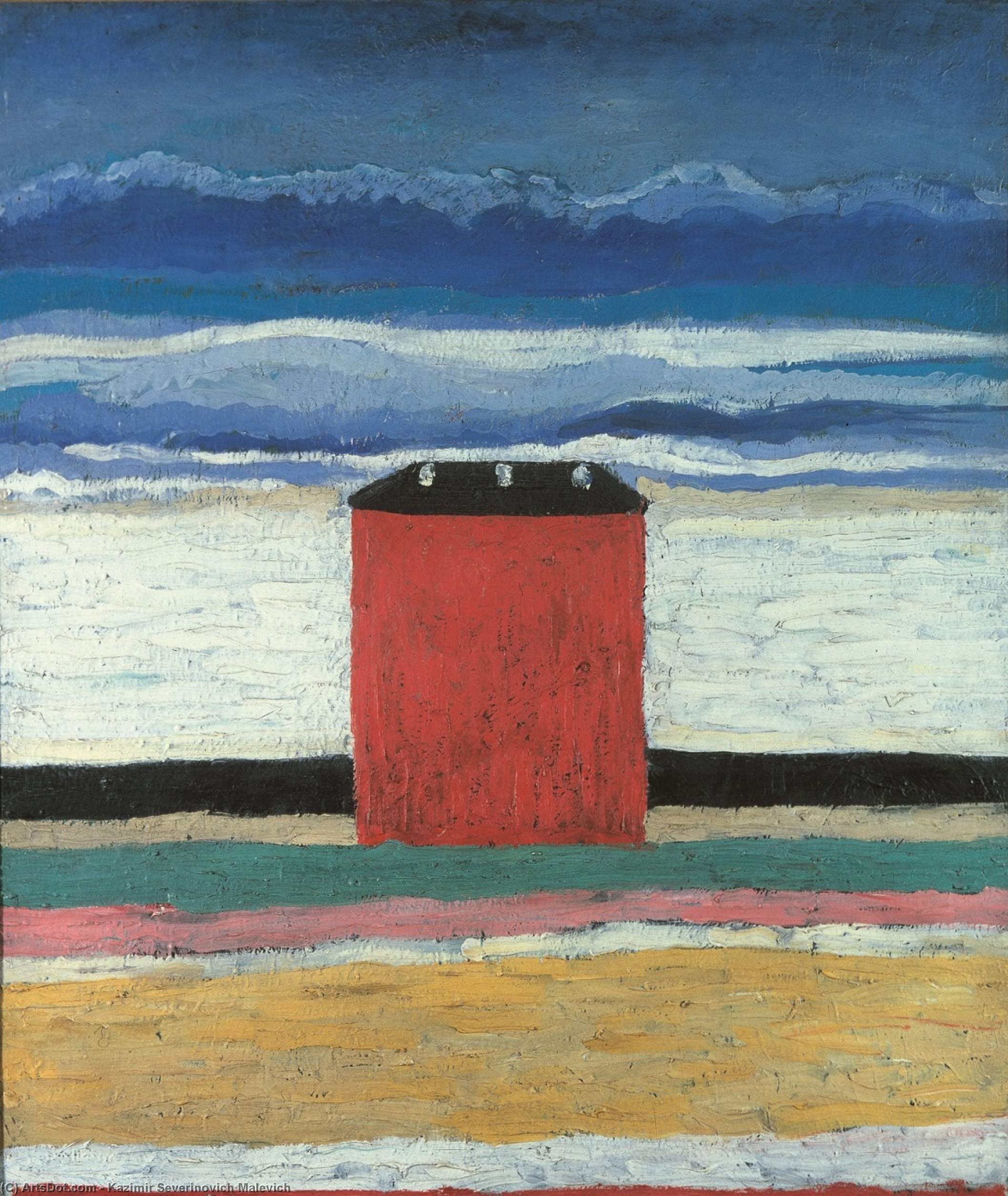
Kazimir Malevich’s Suprematist masterpiece, ‘Red House,’ captures the essence of geometric abstraction against a serene coastal backdrop. This bold 1932 canvas embodies Russian avant-garde ideals and invites you to explore its captivating simplicity – discover or acquire this iconic artwork.
カジミール・マレーヴィチ(1878-1935): Suprematismの創始者であり、抽象芸術の先駆者。黒方や白の中に白といった革新的な作品で知られ、20世紀美術に多大な影響を与えました。
A Bold Statement Against Representation: Kazimir Malevich’s Red House
The painting “Red House” by Kazimir Malevich stands as a monumental testament to Suprematism, an artistic movement that fundamentally challenged the conventions of Western art in the early 20th century. Executed in 1932, this canvas – measuring 63 x 55 cm – isn’t merely a depiction of a seaside dwelling; it's a deliberate rejection of illusionistic perspective and color palettes favored by preceding artistic traditions. Instead, Malevich presents us with an uncompromising exploration of pure geometric abstraction, embodying the core tenets of his revolutionary vision.
The Suprematist Aesthetic: Beyond Sight
Malevich’s approach to art stemmed from a profound intellectual conviction that painting should transcend sensory experience altogether. Influenced by Russian Orthodox iconography and philosophical ideas surrounding asceticism, he sought to liberate art from the constraints of depicting reality. This pursuit led him to develop Suprematism – “Supermatism” – which prioritized geometric forms like squares and circles over naturalistic imagery. The resulting compositions aim not to imitate what is seen but to express an inner spiritual state, prioritizing conceptual purity above visual accuracy. Malevich famously declared that "Painting should be like a musical note."
Technique and Composition: Simplicity as Power
The execution of “Red House” exemplifies Malevich’s meticulous technique. Using oil paints on canvas, he applied bold, flat planes of color – predominantly red for the house itself and black for its roof – creating an arresting visual impact. The background is rendered in shades of blue, subtly suggesting the ocean expanse without resorting to detailed shading or atmospheric perspective. This deliberate simplification isn’t a lack of skill; it's a conscious decision to distill art down to its essential elements. Malevich’s compositional strategy emphasizes balance and stability, mirroring the spiritual quest at the heart of his artistic philosophy. The placement of the house against the horizon line reinforces this sense of groundedness while simultaneously elevating it into an emblem of transcendence.
Historical Context: A Reaction Against Impressionism
“Red House” emerged during a period of intense artistic experimentation in Russia following World War I. Malevich’s Suprematism directly confronted the dominant Impressionist and Post-Impressionist styles that had prevailed for decades, arguing that they were hopelessly inadequate to convey the complexities of human experience. He saw these movements as trapped within the limitations of representing the visible world, whereas Suprematism sought to access a higher realm of consciousness. This rejection resonated with intellectuals and artists alike who were grappling with existential questions about art’s role in society and its capacity for spiritual transformation.
Symbolism Beyond Color: The House as Icon
While seemingly straightforward in its color scheme, “Red House” carries significant symbolic weight. Red, traditionally associated with passion, vitality, and divine presence – particularly within Orthodox Christianity – serves as a focal point of visual energy. Malevich deliberately chose this hue to represent not just the physical structure but also an idealized notion of home and refuge. The black roof symbolizes solemnity and permanence, grounding the composition while simultaneously hinting at the infinite expanse of the cosmos. Ultimately, Malevich’s masterpiece invites contemplation on themes of faith, purity, and the pursuit of spiritual enlightenment—a legacy that continues to inspire artists and collectors today.