A Stark Vision of Conflict: Kazimir Malevich’s “Soldier” (1913)
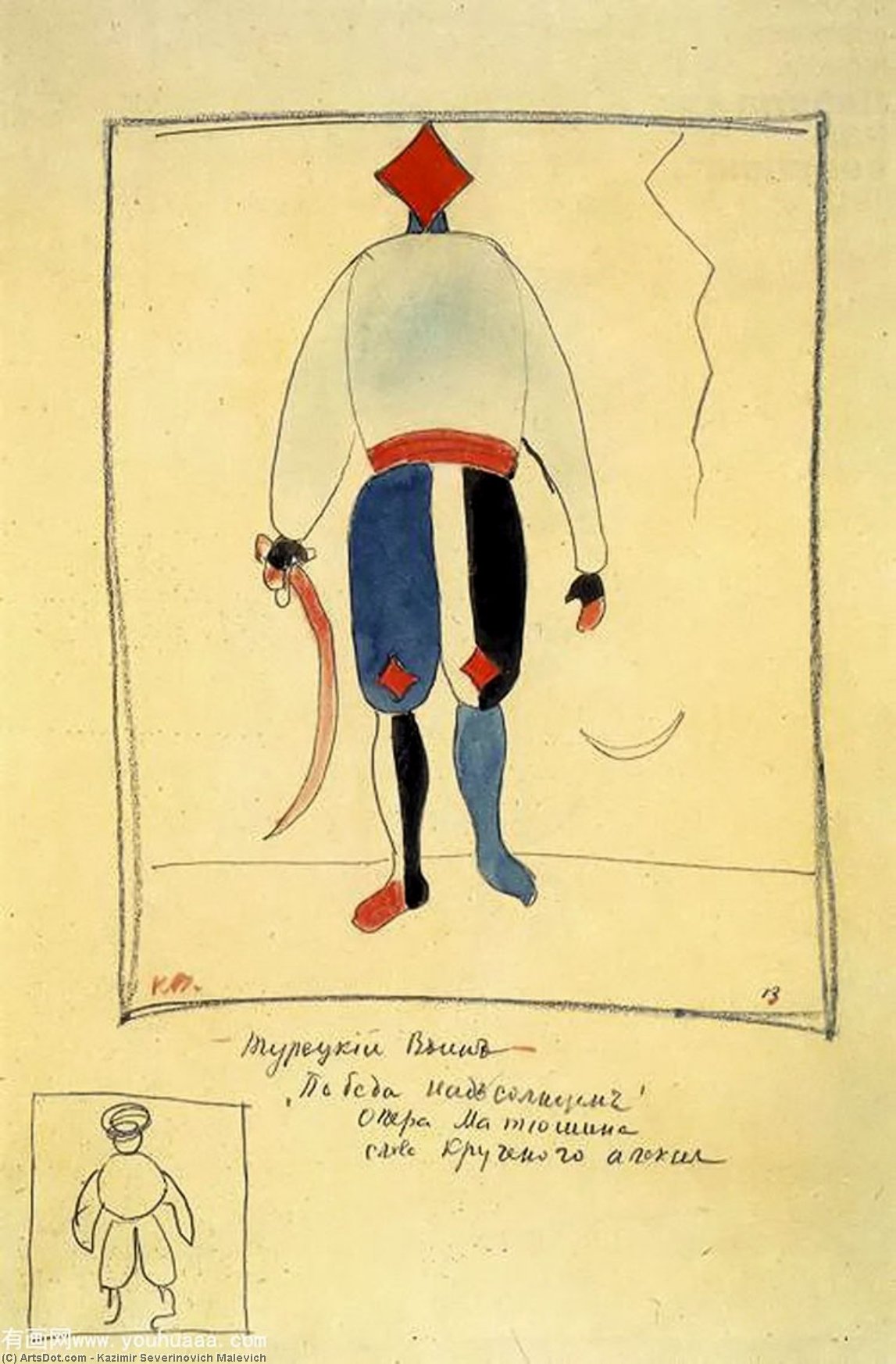
This arresting black and white drawing, titled "Soldier," created in 1913 by the revolutionary artist Kazimir Malevich, offers a profoundly unsettling glimpse into the burgeoning anxieties of the early 20th century. Measuring 54 x 35 cm, this sketch transcends mere representation; it’s a distilled essence of form and emotion, echoing the core tenets of Constructivism – a movement Malevich himself pioneered. The image depicts a solitary figure in military uniform, standing rigidly on one leg with hands firmly behind him, clutching a sword. The stark simplicity of the composition, reminiscent of the geometric precision favored by Kazimir Malevich, immediately draws the viewer into a world stripped bare of extraneous detail.
Constructivist Roots and Parisian Influence
Created during a pivotal moment in art history, “Soldier” reflects Malevich’s evolving artistic trajectory. Following his initial explorations of Impressionism, Symbolism, Fauvism, and Cubism – all styles he diligently studied – a transformative trip to Paris in 1912 proved decisive. Exposed to the radical ideas circulating within European avant-garde circles, Malevich began to dismantle traditional notions of perspective and representation. This sketch embodies this shift, moving away from illusionistic realism towards an exploration of pure form and geometric abstraction. The drawing’s forceful lines and deliberate lack of shading speak directly to the Constructivist desire to build a new visual language based on fundamental elements – line, plane, and volume.
Symbolism of Form and Military Presence
The subject matter itself—a soldier—holds significant symbolic weight. In 1913, Europe was teetering on the brink of war, and anxieties surrounding nationalism, militarism, and the potential for widespread conflict were palpable. Malevich’s depiction isn't a romanticized portrait of heroism; rather, it presents a stark, almost dehumanized figure – a symbol of power, discipline, and perhaps even impending destruction. The single-legged stance suggests instability and vulnerability, while the sword represents both defense and aggression. The drawing’s monochrome palette amplifies this sense of unease, evoking the atmosphere of a battlefield or a moment of intense contemplation.
Technique and Artistic Legacy
"Soldier" is executed in pencil, demonstrating Malevich's mastery of line and his ability to convey complex emotions through minimal means. The drawing’s distinctive style—often compared to that of Kazimir Malevich—is characterized by its geometric precision, forceful lines, and deliberate lack of shading. This work represents a crucial step in the development of Abstract Art, profoundly influencing subsequent generations of artists. As highlighted on WikiArt.org, this sketch is a valuable study and example of Malevich’s Constructivist style. Its enduring power lies in its ability to capture not just a physical image but also the psychological and emotional weight of a troubled era.