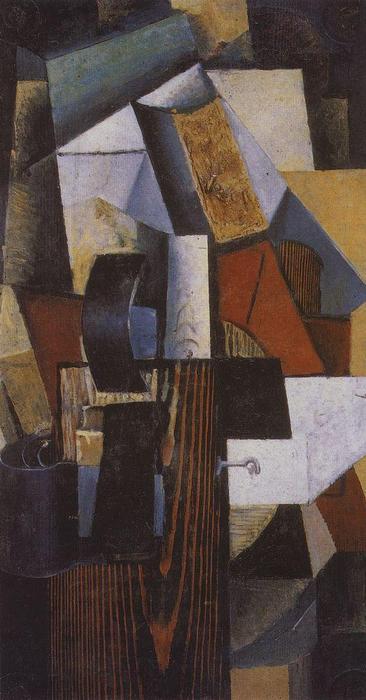
Station Without a Stop. Kunzevo.: A Reflection of Cubo-Futurist Vision
Kazimir Malevich’s “Station Without a Stop,” painted in 1913, stands as a cornerstone of Cubo-Futurist art—a movement that sought to shatter the conventions of Western painting and embrace radical experimentation. This striking cityscape captures not merely visual representation but an attempt to distill emotion into pure geometric form, reflecting Malevich’s profound belief in the transformative power of abstraction.
- Subject Matter: The artwork depicts a bustling urban scene—a train station—characterized by simplified architectural elements and figures. However, these forms are deliberately flattened and fragmented, prioritizing spatial relationships over realistic depiction.
- Style & Technique: Malevich employed Cubo-Futurist principles, combining influences from Cubism’s geometric dissection with Futurism's dynamism and rejection of traditional perspective. The painting utilizes bold colors—primarily reds and yellows—to convey energy and movement, despite the absence of illusionistic depth.
- Historical Context: Created during a period of intense artistic ferment in Russia, “Station Without a Stop” emerged from the broader context of Cubo-Futurist aspirations to liberate art from academic constraints. It aligns with the movement’s desire to express the speed and chaos of modern life through abstract visual language.
Beyond its formal qualities, “Station Without a Stop” carries symbolic weight. The geometric shapes—squares and rectangles—represent stability and order amidst the perceived instability of the urban environment. Malevich's deliberate simplification aims to transcend sensory experience, focusing instead on conveying fundamental concepts like space and form. It’s a visual manifesto for pure feeling – an attempt to capture the essence of existence without resorting to representational imagery.
- Symbolism: The prominent guitar symbolizes musical expression and creativity—a deliberate choice by Malevich to infuse his artwork with humanist values.
- Emotional Impact: The painting evokes a sense of urgency and dynamism, mirroring the frenetic pace of the city while simultaneously inviting contemplation on the nature of perception and representation.
A reproduction of “Station Without a Stop” offers an opportunity to engage with Malevich’s groundbreaking vision—a testament to the enduring power of abstract art to provoke thought and inspire emotion. Its bold colors and simplified forms resonate powerfully in contemporary interior design, providing a striking focal point for spaces seeking artistic sophistication.