A Vision of Transcendence: The Spiritual Geometry of Malevich
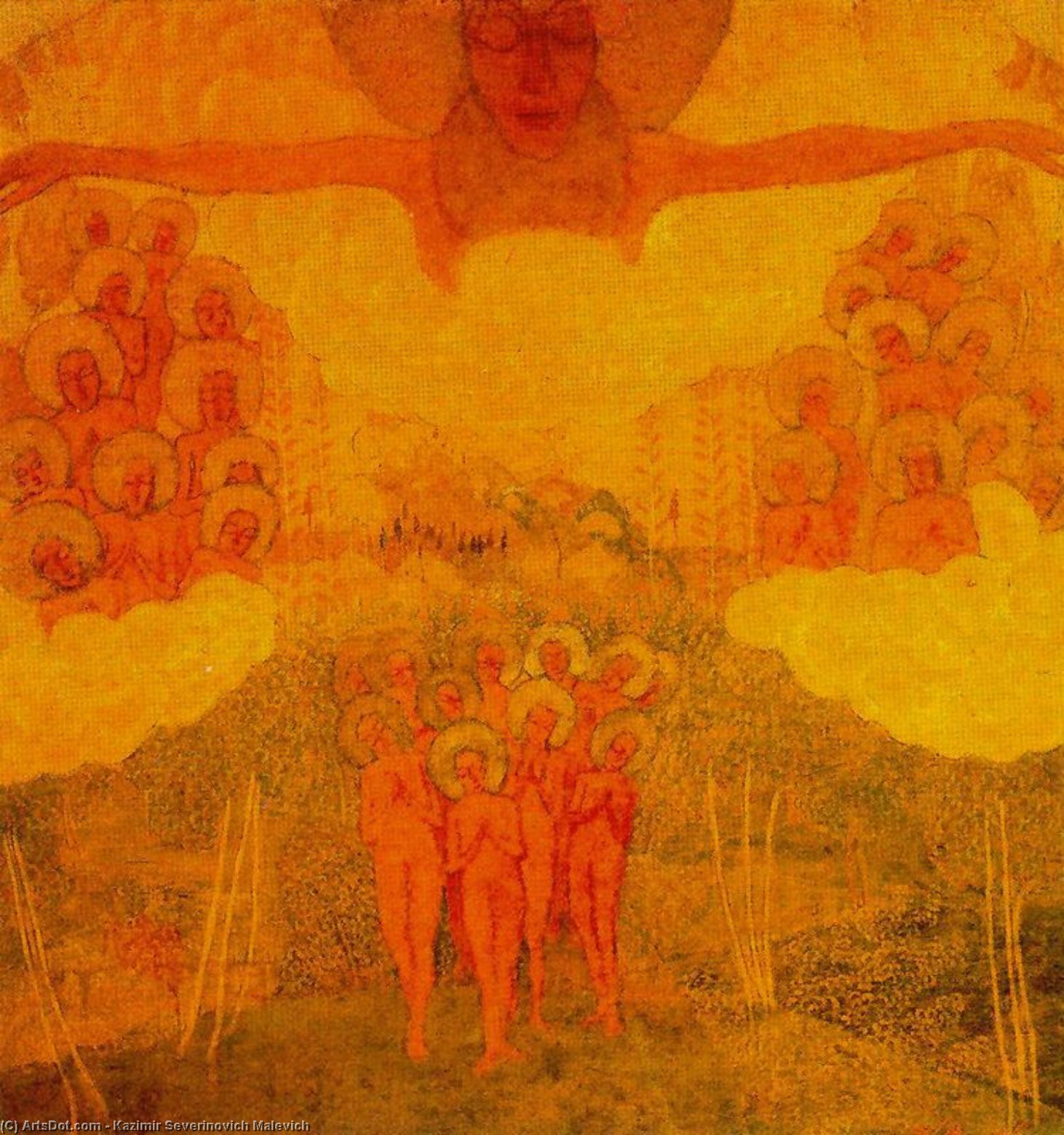
To stand before Kazimir Malevich’s "The Triumph of Heaven" is to witness a profound moment in the evolution of modern consciousness, where the boundaries between the earthly and the divine begin to dissolve. This masterpiece serves as a breathtaking bridge between the representational traditions of the past and the radical abstraction of the future. While many recognize Malevich for his stark, uncompromising Suprematism—the world of the Black Square—this particular work offers a rare, luminous glimpse into his ability to weave spiritual narrative with geometric precision. It is not merely a painting; it oration of transcendence, inviting the viewer to look past the physical skin of reality to find the skeletal truth of the soul.
The composition unfolds as a celestial gathering, dominated by a central female figure who radiates a quiet, monumental authority. Often interpreted as the Virgin Mary, she holds a child, anchoring the piece in a recognizable iconographic tradition that resonates with centuries of religious art. Yet, Malevich subtly deconstructs this familiarity. Surrounding her is a rhythmic assembly of figures, some bearing the ethereal grace of wings, suggesting an assembly of angels or celestial beings. The artist utilizes a deliberate simplification of form, where the soft curves of human anatomy begin to merge with the disciplined language of circles and squares. This technique creates a sense of geometric harmony, as if the very fabric of heaven is woven from the fundamental building blocks of the universe.
The Alchemy of Color and Form
In "The Triumph of Heaven," the artist’s palette plays a crucial role in establishing its solemn grandeur. Eschewing the garish or the overly dramatic, Malevich employs muted, sophisticated hues that evoke an atmosphere of serene contemplation. These tones do not shout; they whisper of ancient truths and eternal stillness. The interplay of light and shadow is not used to create three-dimensional illusion, but rather to suggest a non-perspective space—a realm where depth is measured by emotional weight rather than optical trickery. This approach allows the viewer to experience a sense of spiritual elevation, as the figures seem to float within a cosmic void that is both vast and intimately connected.
For the discerning collector or interior designer, this artwork offers an unparalleled opportunity to introduce a piece of profound intellectual and emotional depth into a space. The painting’s ability to balance complex symbolism with clean, modern aesthetics makes it a versatile cornerstone for sophisticated environments. Whether placed in a gallery-style setting or as a focal point in a contemporary living space, "The Triumph of Heaven" commands attention through its quiet strength. It provides more than just decoration; it offers a window into the Russian avant-garde spirit, bringing the revolutionary energy of the early 20th century into the modern home.
Investing in a high-quality reproduction of this work means preserving a vital chapter of art history. The texture of the brushwork and the subtle gradations of color in a masterfully executed painting allow the transformative power of Malevich’s vision to remain palpable. As you contemplate the triumph of form over matter, you are not just observing an image—you are participating in a lifelong dialogue with one of the most radical thinkers to ever pick up a brush.