A Mechanical Reverie: Decoding Leonardo da Vinci’s Codex Madrid I
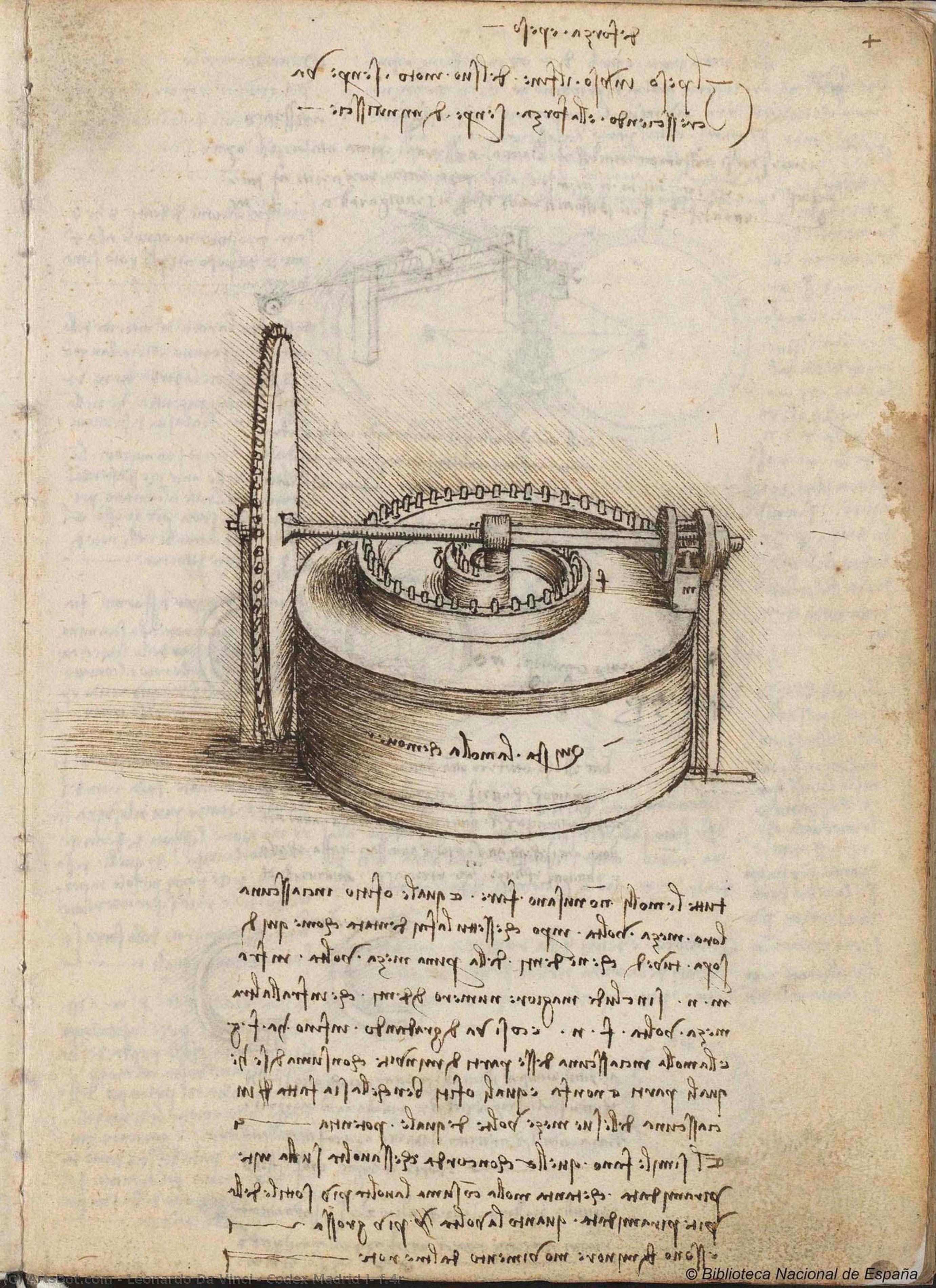
To gaze upon the Codex Madrid I, folio 4r is to witness a profound moment of intellectual awakening captured on parchment. This deceptively simple drawing by Leonardo da Vinci transcends its modest dimensions of 22 x 15 cm, offering an intimate window into the mind of history's most brilliant polymath. More than a mere technical sketch, this folio serves as a meditation on mechanics and observation, reflecting Da Vinci’s relentless pursuit of understanding the natural world through rational inquiry. The drawing focuses on a complex assemblage of gears and levers, capturing the very essence of rotational motion with a precision that feels startlingly modern.
The subject matter—a meticulously rendered depiction of what appears to be a windmill gear mechanism—embodies the spirit of Renaissance ingenuity. In these delicate lines, we see the seeds of engineering, where the artist’s eye for detail meets his scientific curiosity. The machine is not merely an object of study but a testament to the era's burgeoning interest in harnessing natural forces for practical human advancement. For the collector or designer, this piece offers a sophisticated focal point, bringing a sense of structured intelligence and historical depth to any curated space.
The Mastery of Line and Light
Executed with Leonardo's characteristic sfumato technique, the drawing achieves a remarkable realism through subtle gradations of tone. Even within the constraints of a technical diagram, Da Vinci employs a masterful command of light and shadow, utilizing chiaroscuro to create a sense of three-dimensional depth and texture. The way the light catches the edges of the gears suggests weight and substance, transforming a flat illustration into a tactile experience.
This technical brilliance is matched by the historical resonance of the work. Created around 1506 during Da Vinci's Florentine period, the Codex Madrid I exemplifies the humanist ideals prevalent at the time. It represents a harmonious blend of scientific observation and artistic expression—a hallmark of the Renaissance aesthetic. The drawing does not just record a machine; it records the very moment when art and science began to merge into a single, unified pursuit of truth.
Symbolism and the Spirit of Innovation
Beyond its mechanical utility, the windmill gear mechanism carries deep symbolic significance. In the context of the 16th century, windmills were potent symbols of agricultural productivity and prosperity. Through this depiction, Da Vinci expresses a profound concern for improving human life through technological progress. Furthermore, the intricate, interlocking gears serve as a metaphor for order, precision, and the clockwork regularity of the universe—qualities that Da Vinci valued immensely in both his scientific studies and his fine art.
For those seeking to adorn a home or gallery with a high-quality reproduction, this work offers more than just aesthetic beauty. It provides an emotional connection to the dawn of modern science. The aged, worn appearance of the original manuscript lends an air of venerable importance, making a reproduction of this folio an ideal choice for creating an atmosphere of contemplation, wisdom, and timeless elegance. It is a piece that invites the viewer to pause, to decode, and to marvel at the infinite complexity of a mind that refused to accept limits.