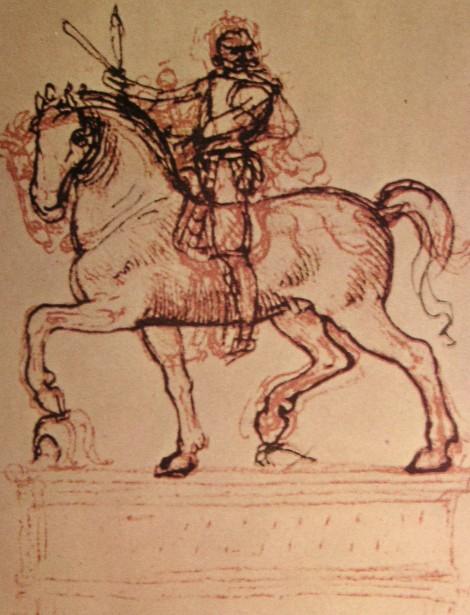
Drawing of an Equestrian Monument: A Renaissance Masterpiece
- Title: Drawing of an Equestrian Monument
- Artist: Leonardo da Vinci
- Date: 1500
- Medium: Pen and ink on paper
- Location: Royal Library (Windsor, United Kingdom)
Subject and Composition
This remarkable drawing depicts a study for an equestrian monument, showcasing Leonardo da Vinci's unparalleled ability to capture movement and emotion. The central focus is a powerful horse rearing up on its hind legs, conveying a sense of dynamic energy and controlled strength. A rider, clad in armor and holding the horse’s mane, maintains balance atop the animal. The composition isn't solely focused on the main subject; additional elements enrich the scene. Two birds are visible in the upper right corner, adding a touch of naturalism, while another bird is positioned near the top left. A figure stands on the far left, and another horse appears towards the bottom right, contributing to the overall narrative depth.
Historical Context and Commission
The drawing's creation dates back to 1500, a period of significant artistic innovation during the High Renaissance. It is believed to have been conceived as a preparatory study for an ambitious equestrian statue commissioned by Ludovico Sforza, Duke of Milan. Da Vinci’s involvement in this project highlights his multifaceted talents – he wasn't just an artist but also an engineer and inventor. The commission aimed to create a monument that would not only be aesthetically pleasing but also structurally sound, reflecting the Renaissance emphasis on both beauty and functionality. The statue itself was never fully realized during Da Vinci’s lifetime, making this drawing all the more valuable as a glimpse into his artistic process and vision.
Artistic Technique and Symbolism
Da Vinci's masterful use of pen and ink is evident in every detail of the drawing. The precise lines delineate the horse's musculature and the rider’s form, conveying a remarkable sense of realism. The rearing pose of the horse symbolizes power, nobility, and triumph – common themes in equestrian monuments of the period. The armor worn by the rider suggests military prowess and leadership. Da Vinci’s meticulous attention to anatomical accuracy, combined with his artistic license, creates a compelling image that transcends mere representation.
Emotional Impact and Legacy
The Drawing of an Equestrian Monument evokes a sense of awe and admiration for both the horse's power and the rider's control. The dynamic composition and expressive lines convey a feeling of movement and energy, drawing the viewer into the scene. This work has profoundly influenced countless artists throughout history, including Raphael (Raffaello Sanzio Da Urbino), who was also a prominent figure of the High Renaissance. It stands as a testament to Leonardo da Vinci's genius and his enduring legacy in the world of art.