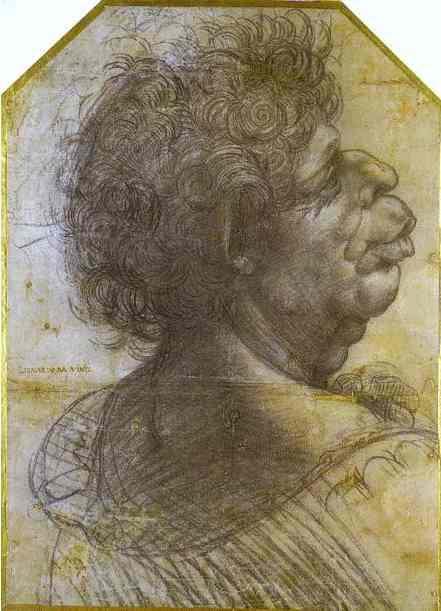
A Study in Unease: Deconstructing Leonardo’s “Grotesque Portrait of Man”
Leonardo da Vinci's "Grotesque Portrait of Man," a haunting oil painting created around 1502, isn’t merely a depiction of a face; it’s an exploration of the human psyche rendered in unsettling detail. Housed within the walls of the Christ Church Picture Gallery in Oxford, this work transcends its historical context to resonate with viewers centuries later, prompting questions about perception, mortality, and the artist's own internal landscape. The painting immediately commands attention not through idealized beauty, but through a deliberate distortion—a fractured visage that seems to wrestle with an unseen torment. It’s a departure from the prevailing Renaissance ideals of harmonious proportion, instead offering a glimpse into the darker recesses of human experience.
The core of the portrait lies in its unsettling facial features. The subject's eyes are narrowed and shadowed, conveying a profound sense of discomfort or perhaps even despair. His mouth is twisted into a grimace, hinting at suppressed pain or anger. Crucially, Leonardo doesn’t shy away from anatomical imperfections; the nose is noticeably elongated and distorted, while the overall structure feels subtly off-kilter. This deliberate manipulation of form isn't random; it serves as a powerful visual metaphor, suggesting a disruption within the individual—a reflection, perhaps, of the artist’s own anxieties or observations about the fragility of human existence. The painting’s power resides in its ability to evoke an immediate emotional response – a prickle of unease that lingers long after viewing.
Da Vinci's Techniques: A Masterclass in Observation and Illusion
Leonardo da Vinci was renowned for his meticulous observation and innovative techniques, and “Grotesque Portrait of Man” is a testament to these skills. The painting showcases his mastery of *sfumato*, the subtle blending of colors that creates an almost hazy effect, softening edges and lending a sense of depth and atmosphere. This technique is particularly evident in the shadows surrounding the subject’s face, contributing significantly to the overall feeling of mystery and unease. Furthermore, Leonardo employs *chiaroscuro* – the dramatic contrast between light and dark – to sculpt the figure's features, adding volume and dimensionality while simultaneously emphasizing his tormented expression.
- Oil Paint Mastery: Da Vinci’s use of oil paint allowed for unparalleled control over color and texture, enabling him to achieve the subtle gradations and nuanced details that define this portrait.
- Sfumato Technique: The blurring of lines and edges creates a dreamlike quality, intensifying the sense of mystery surrounding the subject.
- Chiaroscuro Effect: The dramatic lighting emphasizes the contours of the face, highlighting both its imperfections and the underlying emotional turmoil.
Historical Context & Interpretations
Created during Leonardo’s period in Florence, “Grotesque Portrait of Man” exists within a broader context of artistic experimentation and intellectual inquiry. The Renaissance was a time of renewed interest in classical antiquity, but also a period marked by growing skepticism and a fascination with the darker aspects of human nature. Some art historians interpret the portrait as a commentary on the fleeting nature of beauty and the inevitability of decay—a visual representation of mortality. Others suggest that it reflects Leonardo’s own struggles with self-doubt and his awareness of the limitations of human perception.
The painting's origins remain somewhat enigmatic, fueling speculation about its intended recipient and purpose. It was likely a study for a larger portrait, perhaps commissioned by a wealthy patron or created as a personal exploration of artistic possibilities. The fact that it was never completed adds to the work’s mystique, leaving viewers to ponder the artist’s intentions and the story behind this unsettling masterpiece.
Symbolism & Emotional Resonance
Beyond its technical brilliance, “Grotesque Portrait of Man” is rich in symbolic meaning. The distorted features can be seen as a representation of inner conflict—a struggle between reason and emotion, beauty and ugliness, life and death. The subject’s gaze, directed inward rather than outward, suggests a preoccupation with his own thoughts and feelings. This introspective quality invites the viewer to contemplate their own mortality and the complexities of the human condition.
Ultimately, this portrait transcends its historical context to speak to something fundamental about the human experience—our capacity for both beauty and suffering, our awareness of our own imperfections, and our enduring fascination with the mysteries of the mind. It’s a work that demands attention, provoking contemplation and leaving a lasting impression on all who encounter it.