A Quiet Rebellion: The Soul of Yvonne Duchamp
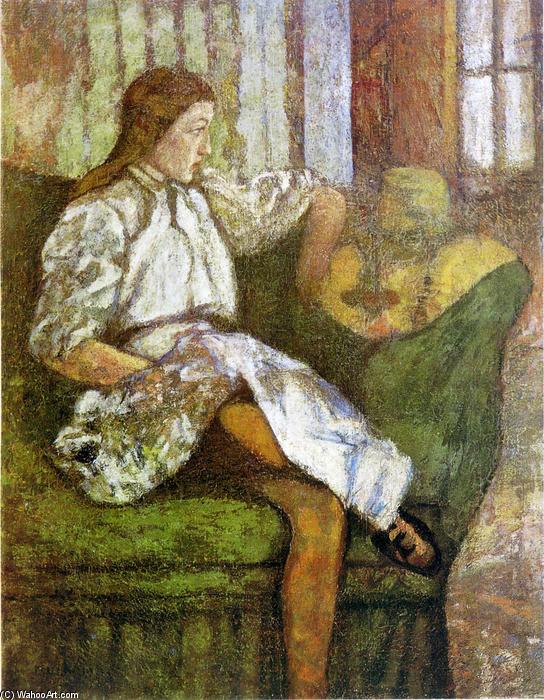
In the quietude of a single canvas, Marcel Duchamp captures a moment that feels both intimate and monumental. Portrait of Yvonne Duchamp, painted around 1907, serves as a profound window into the artist's early psychological landscape, long before he became the iconoclastic architect of Dadaism. The painting presents a woman seated with a poised, contemplative grace, her figure resting upon a couch with legs crossed in a manner that suggests a comfortable yet dignified solitude. As she rests her hand against her chin, her gaze invites the viewer into a shared space of introspection. The room around her—adorned with the subtle presence of vases and the soft light filtering through a distant window—is not merely a setting but an extension of her internal state, creating an atmosphere of serene, almost melancholic, contemplation.
The technique employed here reveals a master in transition. While Duchamp would later dismantle the very concept of the "art object," this early work demonstrates a sophisticated command of oil on canvas. Eschewing the frenetic, broken brushstrokes of the Impressionists, Duchamp instead embraces a more restrained and structured aesthetic. There is a deliberate flattening of the surface that hints at his burgeoning interest in Cubist geometry, moving away from traditional illusionistic depth toward a more modern, compositional clarity. The palette is a masterclass in subtlety; dominated by creamy whites, soft ivories, and muted tones, the colors do not shout but rather whisper, focusing the eye entirely on the interplay of form, light, and the delicate silhouette of the subject.
The Intersection of Tradition and Avant-Garde
To look upon this portrait is to witness the calm before the storm. Historically, this piece sits at a fascinating crossroads in art history. It was birthed from an era where the boundaries between Post-Impressionism and the radical new movements were being aggressively redrawn. While the subject matter remains rooted in the classical tradition of portraiture, the execution betrays a restless spirit. The geometric precision found in the arrangement of the furniture and the structural weight of the figure suggest that Duchamp was already beginning to reject the academic obsession with photographic realism. He was searching for something deeper—a way to represent the essence of a person through the balance of space and shape.
For the discerning collector or interior designer, this artwork offers more than just visual beauty; it offers a narrative of intellectual evolution. The painting possesses a timeless elegance that allows it to integrate seamlessly into sophisticated modern interiors, providing a focal point of calm and intellectual depth. It is a piece that rewards long periods of study, revealing new layers of meaning in its muted tones and structural harmony. Whether placed in a sunlit gallery or a private study, the Portrait of Yvonne Duchamp acts as a bridge between the classical past and the revolutionary future, making it an indispensable acquisition for those who value art that challenges the mind while soothing the eye.