A Window into the Amazon: Marianne North’s “Brazilian Wild Flowers”
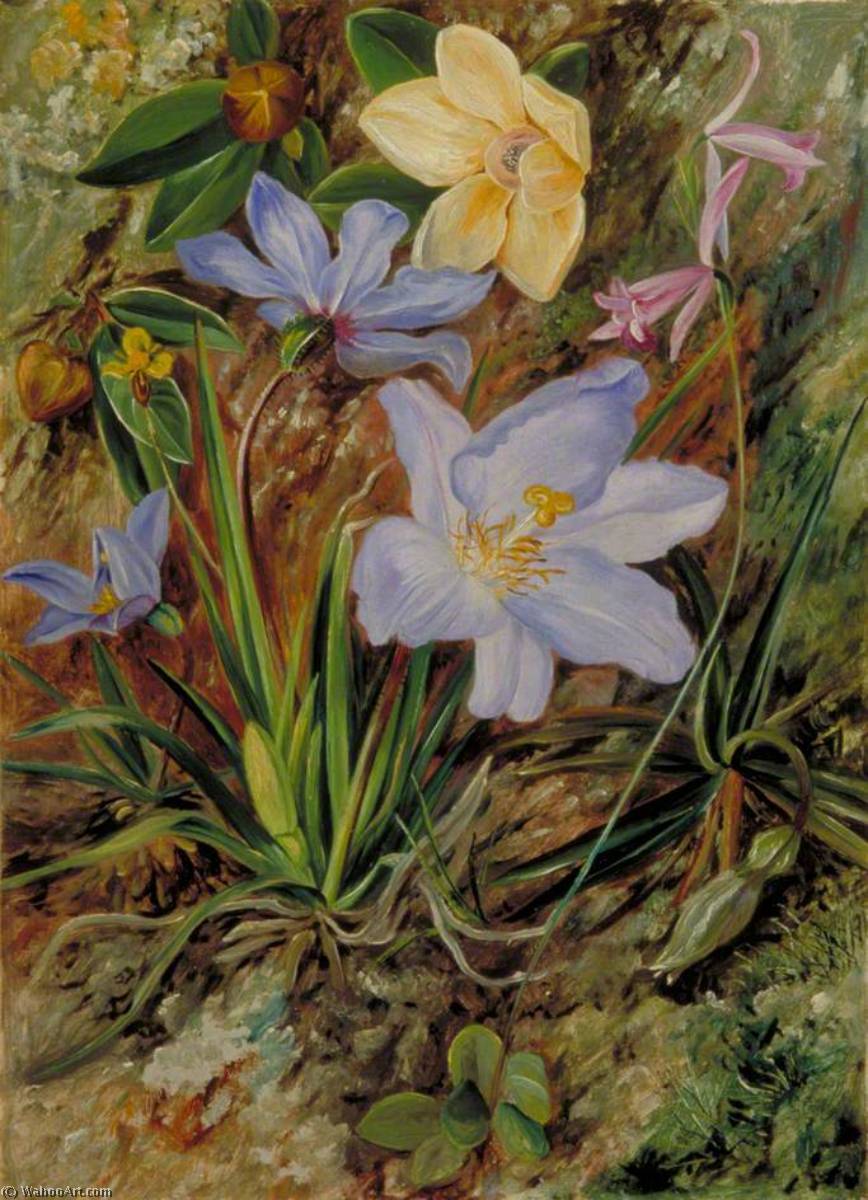
“Brazilian Wild Flowers,” painted in 1873 by Marianne North, isn’t merely a botanical illustration; it’s a vibrant portal to a world teeming with life and color. This exquisite watercolor captures a fleeting moment within the heart of Brazil's rainforest – a landscape rendered not as a static representation, but as an explosion of sensory experience. North, a remarkably independent Victorian explorer and artist, defied societal expectations by embarking on a decades-long journey dedicated to documenting the flora of the world’s most remote corners. This particular piece, executed during her extensive travels in South America, embodies her unique approach: she didn't simply paint what she saw; she sought to capture the very essence of a place, its energy and vitality.
The Artist's Vision: A Hybrid of Observation and Impression
Unlike the meticulous, scientifically-driven illustrations of the time, North’s work possesses a distinctly impressionistic quality. She prioritized capturing the immediate impact of light and color on the scene – the dappled sunlight filtering through the dense canopy, the iridescent hues of the blossoms, the rich textures of the mossy rocks. Her technique involved layering translucent washes of watercolor, building up depth and luminosity with remarkable skill. Notice how she doesn’t attempt to perfectly replicate every detail; instead, she subtly suggests form and texture, relying on the viewer's eye to complete the picture. This approach reflects her belief that art should evoke emotion and transport the observer to the heart of the subject.
The inclusion of a small bird perched amongst the flowers adds an element of life and movement, further enhancing the painting’s dynamism. It suggests a harmonious relationship between the flora and fauna, a testament to North's deep respect for the natural world. Her meticulous observation was matched by a keen understanding of color theory; she expertly combined complementary hues – blues and yellows, purples and oranges – to create a visually arresting composition.
Historical Context: A Victorian Spirit of Exploration
Marianne North’s journey through South America occurred during the height of the Victorian era, a period marked by both scientific advancement and a fervent desire for exploration. The Royal Botanic Gardens, Kew, where she eventually established her gallery, became a hub for botanical research and artistic representation. North's work aligned perfectly with this spirit of discovery, contributing significantly to our understanding of South American flora. Her travels were funded largely through the sale of her paintings and prints, demonstrating her remarkable entrepreneurialism and challenging the traditional roles assigned to women artists.
Furthermore, North’s expeditions coincided with a growing awareness of the importance of conservation – though not yet framed in modern terms. Her detailed documentation served as a powerful advocate for preserving the biodiversity of these fragile ecosystems, highlighting their beauty and ecological significance. The painting itself can be seen as a subtle plea to protect this vibrant corner of the world.
Symbolism and Emotional Resonance
Beyond its botanical accuracy, “Brazilian Wild Flowers” resonates with deeper symbolic meanings. The profusion of color represents abundance, fertility, and the untamed beauty of nature. The rocky surface suggests resilience and endurance – mirroring North’s own unwavering determination in pursuing her artistic vision. The painting evokes a sense of tranquility and wonder, inviting the viewer to lose themselves in the vibrant tapestry of the rainforest. It's a celebration of life, a testament to the power of observation, and a poignant reminder of the beauty that exists within our planet’s most remote corners.
Today, reproductions of “Brazilian Wild Flowers” continue to captivate audiences with their luminous colors and evocative atmosphere. It remains a powerful example of Victorian botanical art – a window into a lost world and a testament to the enduring legacy of Marianne North, the intrepid explorer-artist who dared to paint her way around the globe.