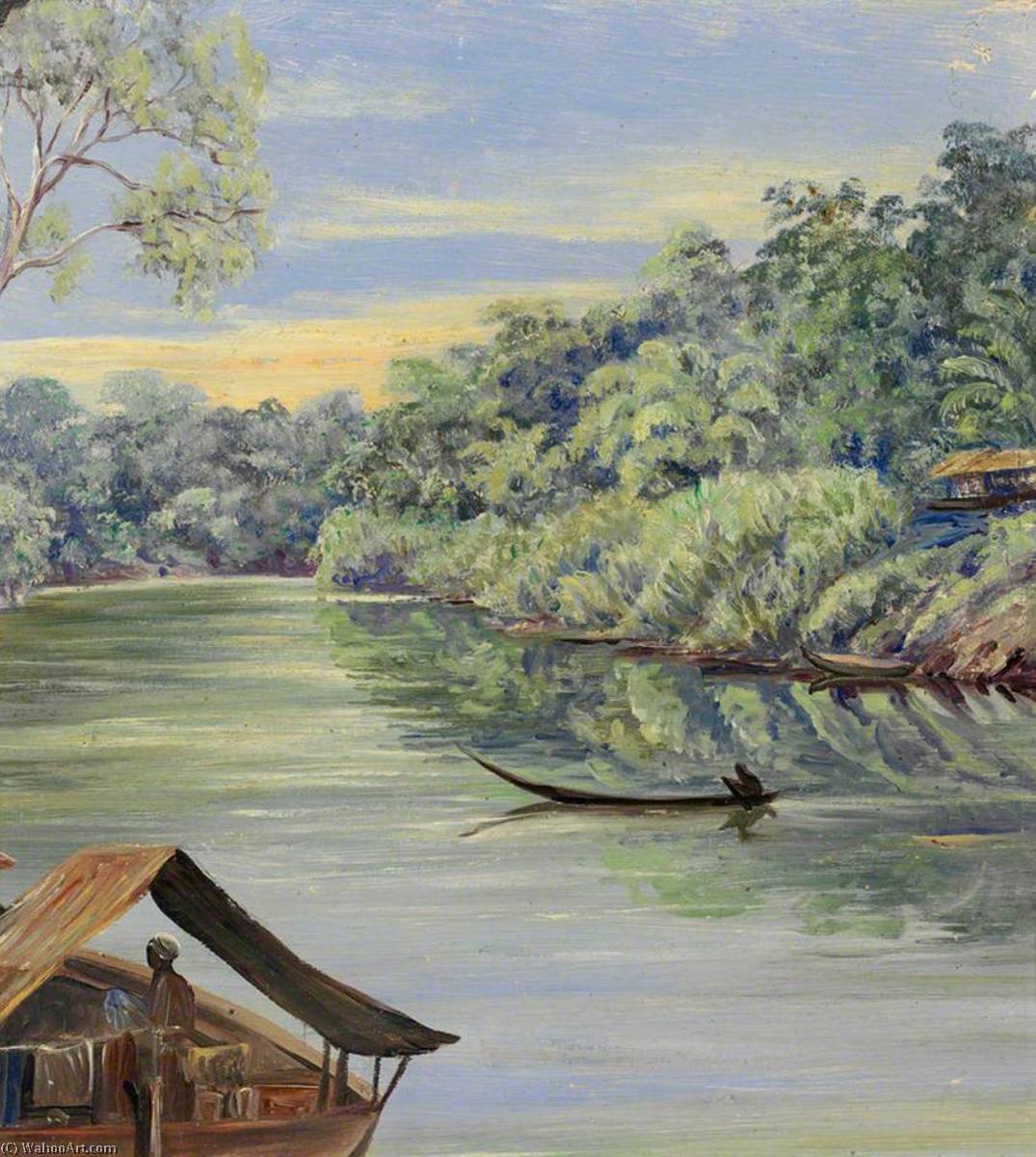
A Serene Borneo River – Marianne North’s Evocative Vision
Marianne North's "River from Bussa, Sarawak, Borneo," painted in 1876, is more than just a landscape; it’s a meticulously observed and profoundly felt immersion into the heart of Southeast Asia. This oil-on-paper masterpiece captures a fleeting moment along the Balikpapan River in Sarawak, offering a glimpse into a world both familiar and utterly exotic for Victorian England. North, a pioneering botanist and artist who embarked on decades of solitary expeditions across the globe, wasn’t simply documenting flora; she was striving to capture the very essence of nature's beauty and power through her art.
The painting immediately draws the eye with its harmonious blend of greens and blues. The river itself dominates the composition, a ribbon of shimmering water reflecting the dense foliage lining its banks. North masterfully employs atmospheric perspective – darker hues in the distance creating a sense of depth and suggesting the vastness of the Borneo rainforest. Loose, impressionistic brushstrokes dance across the canvas, conveying not just the visual appearance but also the humid air, dappled sunlight, and subtle movement of the water. The technique is remarkably fluid, reminiscent of Monet or Pissarro, yet uniquely adapted to capture the specific light and textures of this remote locale.
A Victorian Explorer’s Journey
Marianne North's life was a remarkable testament to female ambition and artistic independence in the 19th century. Born into privilege but chafing against societal expectations, she defied convention by choosing a path of solitary exploration and scientific observation. Her travels were driven not just by botanical curiosity – she meticulously documented hundreds of plant species – but also by a deep desire to understand and represent the natural world with unparalleled accuracy and beauty. The "River from Bussa" painting is a product of this intensely personal journey, reflecting her fascination with the vibrant ecosystems of Borneo.
The painting’s creation coincided with North's extended travels through Southeast Asia in the mid-1870s. She spent months meticulously sketching and painting in remote locations, often relying on local guides and employing a portable studio setup. This dedication to direct observation is evident in the painting’s detailed rendering of the vegetation – from the towering trees to the delicate ferns – and its subtle portrayal of light and shadow. It's important to note that North was one of the few women of her time to undertake such extensive, independent expeditions, a feat rarely seen at the time.
Symbolism and Emotional Resonance
Beyond its technical brilliance, "River from Bussa" resonates with a quiet sense of tranquility and wonder. The small boat, nestled in the foreground, suggests human presence within this immense natural landscape – a reminder of our place within the broader ecosystem. The reflections on the water create an illusion of infinite space, inviting the viewer to lose themselves in the scene’s serene beauty. The painting evokes feelings of peace, contemplation, and a deep appreciation for the unspoiled wilderness.
Furthermore, the choice of subject matter – a river teeming with life – speaks to themes of renewal, flow, and connection. Rivers are often symbolic of journeys, both literal and metaphorical, and North’s painting can be interpreted as an exploration of the interconnectedness between humanity and nature. The rich colors and atmospheric effects contribute to a feeling of immersion, transporting the viewer to this distant corner of the world.
A Legacy in Reproduction
Today, Marianne North's "River from Bussa, Sarawak, Borneo" is celebrated as a pivotal work in the history of botanical art. Reproductions offer an accessible way to experience the painting’s beauty and appreciate North’s extraordinary vision. When selecting a reproduction, consider the quality of materials – a hand-painted reproduction will capture the nuances of brushwork and color that are characteristic of North's original paintings. This artwork is not merely a depiction of a river; it’s a window into a bygone era, a testament to the power of observation, and a celebration of the enduring beauty of the natural world.