A Vision of Tenderness: The Dawn of Renaissance Realism
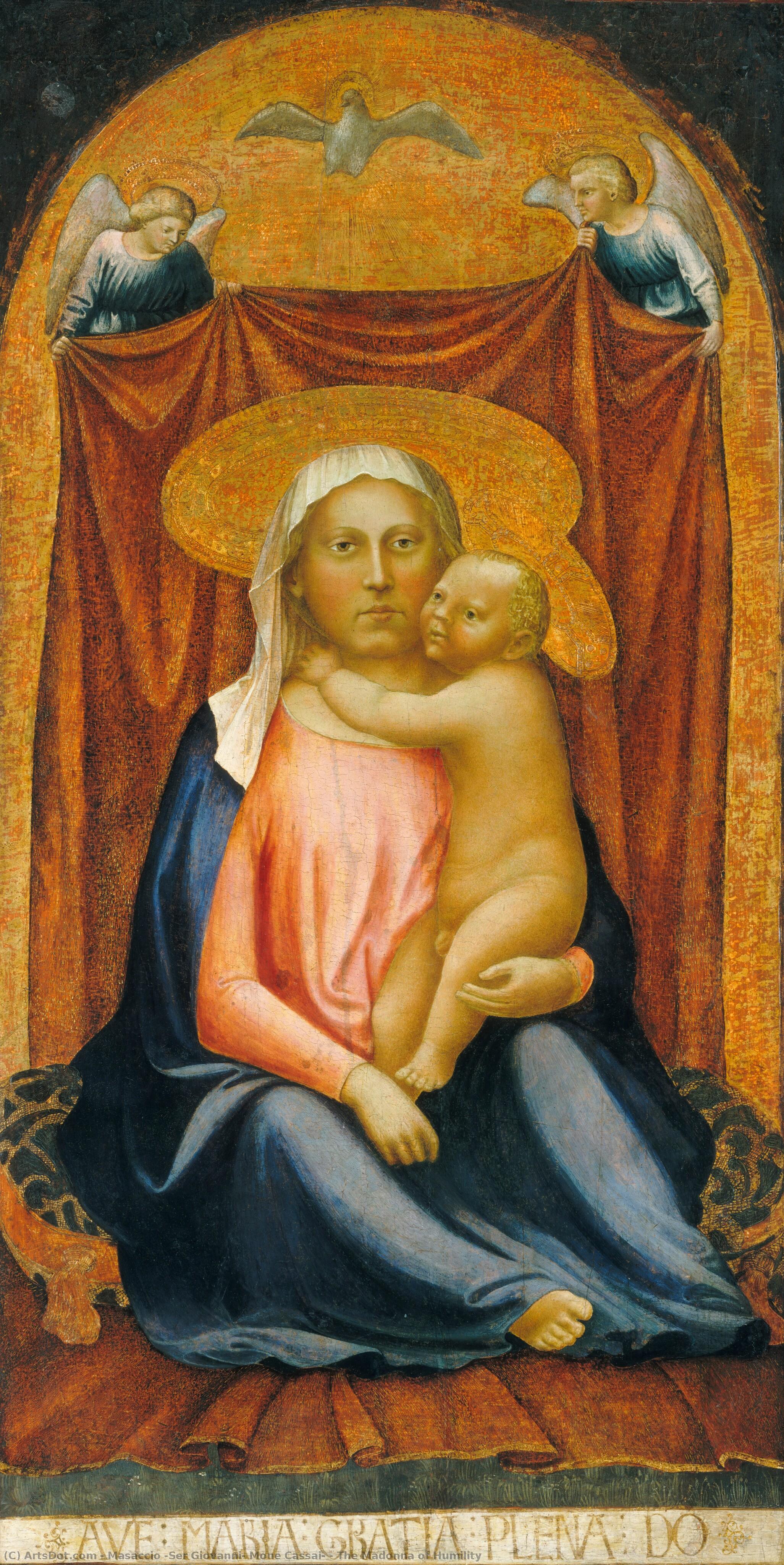
In the quiet, profound stillness of Masaccio’s The Madonna of Humility, we encounter one of the most moving snapshots of the Early Italian Renaissance. Created around 1424, this masterpiece transcends mere religious iconography to offer a window into a moment of raw, maternal intimacy. The scene is set not upon a celestial throne, but on the earth itself, where the Virgin Mary sits upon a blue patterned cushion. This choice of setting—the Madonna of Humility motif—was revolutionary for its time, stripping away the distant, regal stiffness of Gothic traditions to present a Mother and Child that feel tangibly human, grounded, and accessible.
The composition is a masterclass in early Renaissance innovation. As we gaze upon the painting, we see a woman with skin possessing a delicate, almost ethereal gold cast, softened by the gentle flush of pink on her cheeks. She is draped in a rich blue cloak and a white hood that frames a face of serene contemplation. In her arms, she cradles a pudgy, nude infant whose presence brings a startling sense of life to the panel. The child’s movement—reaching up toward his mother’s neck while looking away into the distance—creates a dynamic tension, a flicker of vitality that contrasts beautifully with the solemnity of the surrounding figures.
Light, Shadow, and the Architecture of Emotion
Masaccio, often remembered as the pioneer of chiaroscuro, utilizes light not merely to illuminate, but to sculpt. Through the masterful use of strong contrasts between light and dark, he grants the figures a three-dimensional weight that was unprecedented in the early 15th century. The way the light catches the folds of the brick-red curtain and the soft curves of the Christ child’s body creates a sense of volume and physical presence. This technique invites the viewer to step into the space, making the divine feel remarkably near.
The symbolic language of the piece is woven seamlessly into its visual fabric. Above the central figures, a haloed dove floats at the top center, representing the Holy Spirit, while two angels flank the scene, their blue robes echoing the Madonna's cloak and holding up the heavy red drapery. The gold background, shaped into a celestial arch, serves to sanctify the earthly scene below. Even the Latin inscription at the base—“AVE: MARIA: GRATIA: PLena: DO”—acts as a liturgical chant, grounding the visual beauty in the sacred tradition of the Annunciation.
An Eternal Inspiration for the Modern Collector
For the discerning art lover or interior designer, a high-quality reproduction of this work offers more than just decoration; it provides an emotional anchor for a room. The palette—a sophisticated harmony of deep blues, warm reds, and soft pinks—possesses a timeless elegance that complements both classical and contemporary settings. Whether placed in a sun-drenched library or a quiet study, the painting radiates a sense of peace and historical depth.
Owning a piece that captures Masaccio’s revolutionary spirit allows one to surround themselves with the very origins of Western naturalism. It is an invitation to contemplate the intersection of the human and the divine, making it a profound choice for those who seek art that speaks to the soul as much as it delights the eye. This work remains a testament to the power of simplicity, reminding us that true greatness often lies in the most humble of gestures.