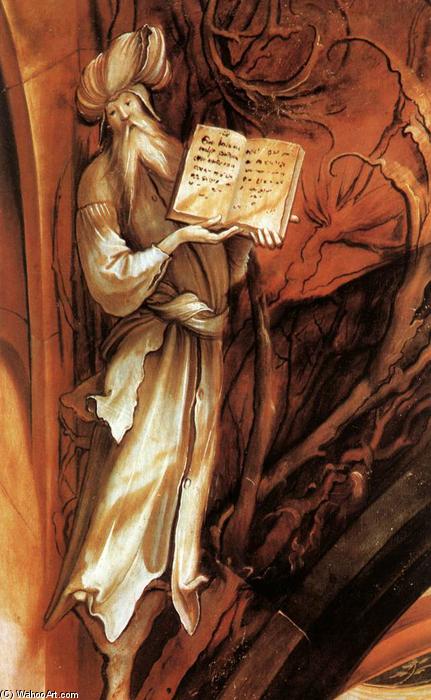
The Annunciation: A Window into Grünewald’s Soul
Matthias Grünewald's "The Annunciation," specifically this exquisite detail from the Isenheim Altarpiece, isn’t merely a depiction of a biblical moment; it’s a profound meditation on faith, humility, and the divine encounter. Created around 1515 in the heart of the German Renaissance, this fragment offers an intimate glimpse into Grünewald's intensely personal and emotionally charged artistic vision. The painting, housed within the Musée d'Unterlinden in Colmar, France, stands as a testament to his mastery of late medieval techniques while simultaneously pushing the boundaries of religious art with its dramatic realism and psychological depth.
Grünewald’s style is immediately recognizable – a potent blend of Northern European tradition and a uniquely expressive sensibility. He inherited the meticulous detail and naturalism favored by artists like Albrecht Dürer, evident in the careful rendering of the angel's robes and the intricate patterns adorning the background. However, unlike many of his contemporaries focused on idealized beauty, Grünewald embraced a raw emotionality, imbuing his figures with an almost palpable sense of urgency and vulnerability. This is particularly striking in this detail, where the angel’s posture conveys both reverence and a quiet apprehension – a feeling that he is bearing a momentous message.
A Symphony of Color and Light
The painting's color palette is dominated by earthy tones—ochres, siennas, and umbers—creating a sense of groundedness and solemnity. Yet, within this restrained scheme, Grünewald masterfully employs light to draw the viewer’s eye and heighten the drama. The soft glow illuminating the angel’s face and the open book emphasizes these key elements, suggesting a divine radiance emanating from the sacred text. Notice how the shadows deepen around the edges of the figures, creating a sense of depth and volume that brings the scene to life. The use of glazing techniques—applying thin layers of translucent paint—allows light to penetrate through the colors, adding richness and luminosity to the overall effect.
Symbolism Woven into the Scene
Beyond its immediate narrative, “The Annunciation” is rich in symbolic meaning. The angel’s posture – a slight bow, his hand outstretched as if offering something precious – speaks of humility and obedience. The open book, often interpreted as representing the Gospel or scripture itself, signifies the divine message being conveyed to Mary. The background, with its swirling patterns reminiscent of foliage and celestial forms, evokes both earthly nature and the heavens—a visual representation of the convergence between the human and the divine. The inclusion of a small, stylized tree – a symbol of life and hope – further reinforces this theme.
A Window into Grünewald’s World
Matthias Grünewald's life was marked by both artistic triumph and personal tragedy. He served as a court painter for the Archbishop of Trier, but his career was tragically cut short when he contracted ophthalmia—an eye infection—which left him permanently blind. Despite this debilitating loss, Grünewald continued to paint with remarkable skill and dedication, driven by an unwavering faith and a profound artistic vision. “The Annunciation” is not just a beautiful work of art; it’s a poignant expression of his resilience, his spiritual depth, and his ability to capture the essence of human emotion even in the face of adversity. Reproductions of this detail offer a remarkable opportunity to experience the power and beauty of Grünewald's legacy.
Further Exploration
For deeper insights into Grünewald’s life and work, consider exploring these resources: