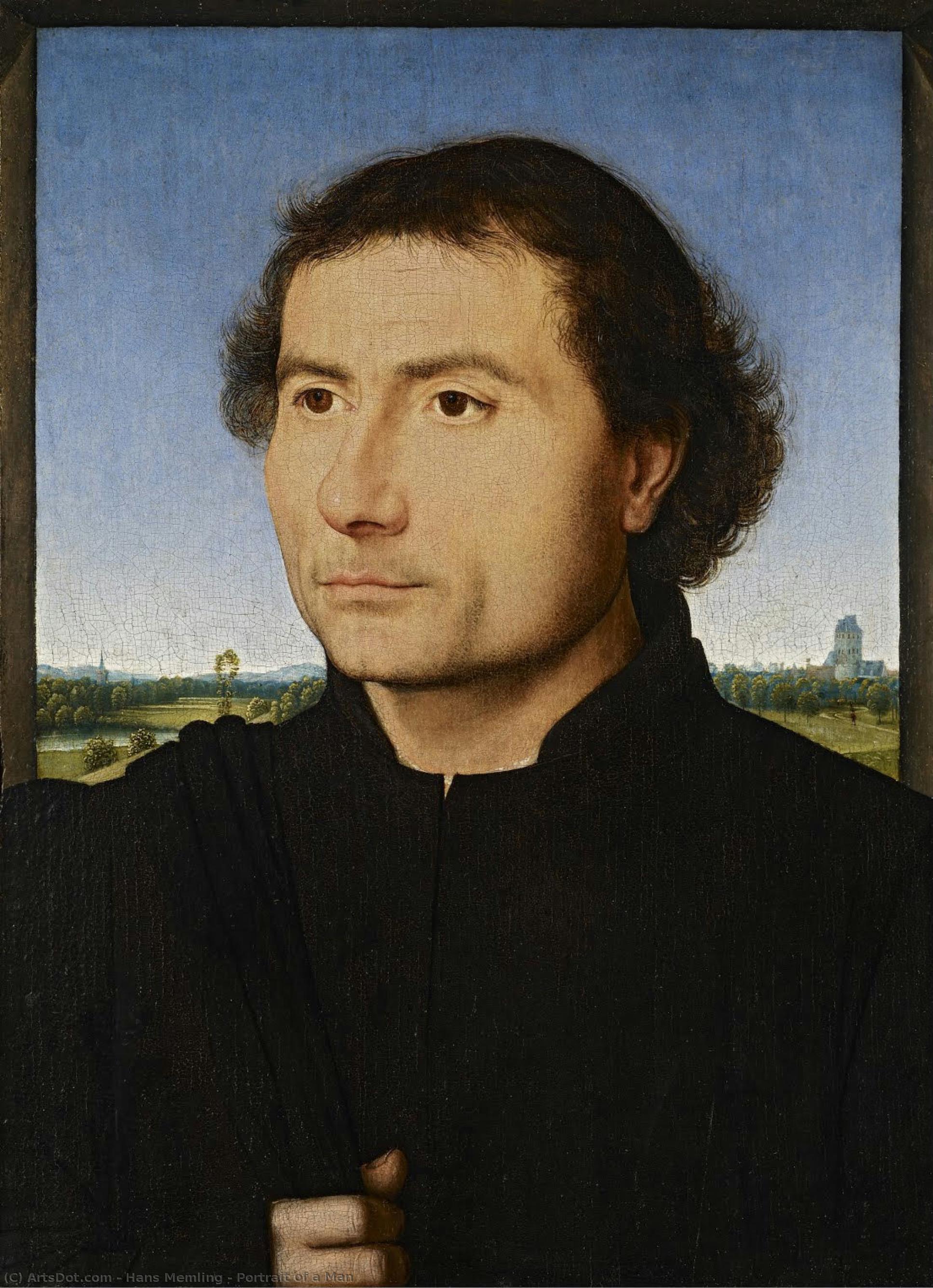
Portrait of a Man: A Glimpse into Renaissance Dignity
Hans Memling's "Portrait of a Man" (circa 1470) stands as a testament to the artist’s mastery of capturing not just likeness, but also character and status. This oil painting, measuring 33 x 23 cm, offers a compelling window into the world of fifteenth-century Northern Europe, specifically the flourishing trade centers that fueled artistic innovation.
Artistic Style and Technique
The artwork exemplifies the meticulous realism characteristic of Early Netherlandish painting. Memling’s technique involved layering and glazing oil paints to achieve rich colors and subtle transitions in tone. The subject is rendered with remarkable detail, from the texture of his dark robe to the carefully modeled contours of his face. Lines are skillfully employed to define forms – the folds of clothing, the shape of the face, and even the distant landscape subtly incorporated into the background. Perspective is present but understated, creating a sense of depth through atmospheric perspective where distant elements appear paler.
Historical Context and Commission
Dating from around 1470, this portrait emerged during a period of significant economic prosperity in the Netherlands. The thriving trade centers created an international market for artists like Memling. While the subject’s plain coat offers no immediate clues to his nationality or occupation, it's likely he was a prominent figure within this burgeoning mercantile society. Panels such as this often served dual purposes – as covers or wings for small private altarpieces. However, many from this era, including this example, were commissioned independently as portraits intended to commemorate an individual and showcase their status.
Symbolism and Emotional Impact
The portrait’s composition is carefully considered. The subject's serious expression and firmly modeled head convey a sense of thoughtfulness and strength. Although positioned close to the viewer, his demeanor suggests a certain aloofness, creating a psychological distance that invites contemplation. His gaze is direct yet reserved, hinting at an inner world beyond immediate perception. Symbolically, the portrait represents status and wealth—common themes in Renaissance portraiture. The muted color palette contributes to a sense of solemnity and dignity, reinforcing the subject’s perceived importance.
The Legacy of Hans Memling
Hans Memling (c. 1430 – 1494), born in Seligenstadt, Germany, became one of the most admired portraitists of his day, renowned both in Italy and Northern Europe. His apprenticeship with Rogier van der Weyden in Brussels profoundly shaped his style, teaching him to balance realism with spiritual depth. Memling settled in Bruges, where he established a successful career painting portraits that captured not only physical likenesses but also the intellectual and spiritual character of his subjects. His ability to convey these qualities made him highly sought after by patrons seeking lasting representations of themselves or their loved ones.
- Early Life and Training: Born around 1430 in Seligenstadt, Germany, Hans Memling emerged as a pivotal figure in the Early Netherlandish painting tradition.
- Apprenticeship with Rogier van der Weyden: A crucial turning point was his apprenticeship with Rogier van der Weyden, learning to balance realism with spiritual depth.
- Settlement in Bruges and Artistic Career: By 1465, Memling had established himself in Bruges, becoming one of the most admired portraitists of his day.