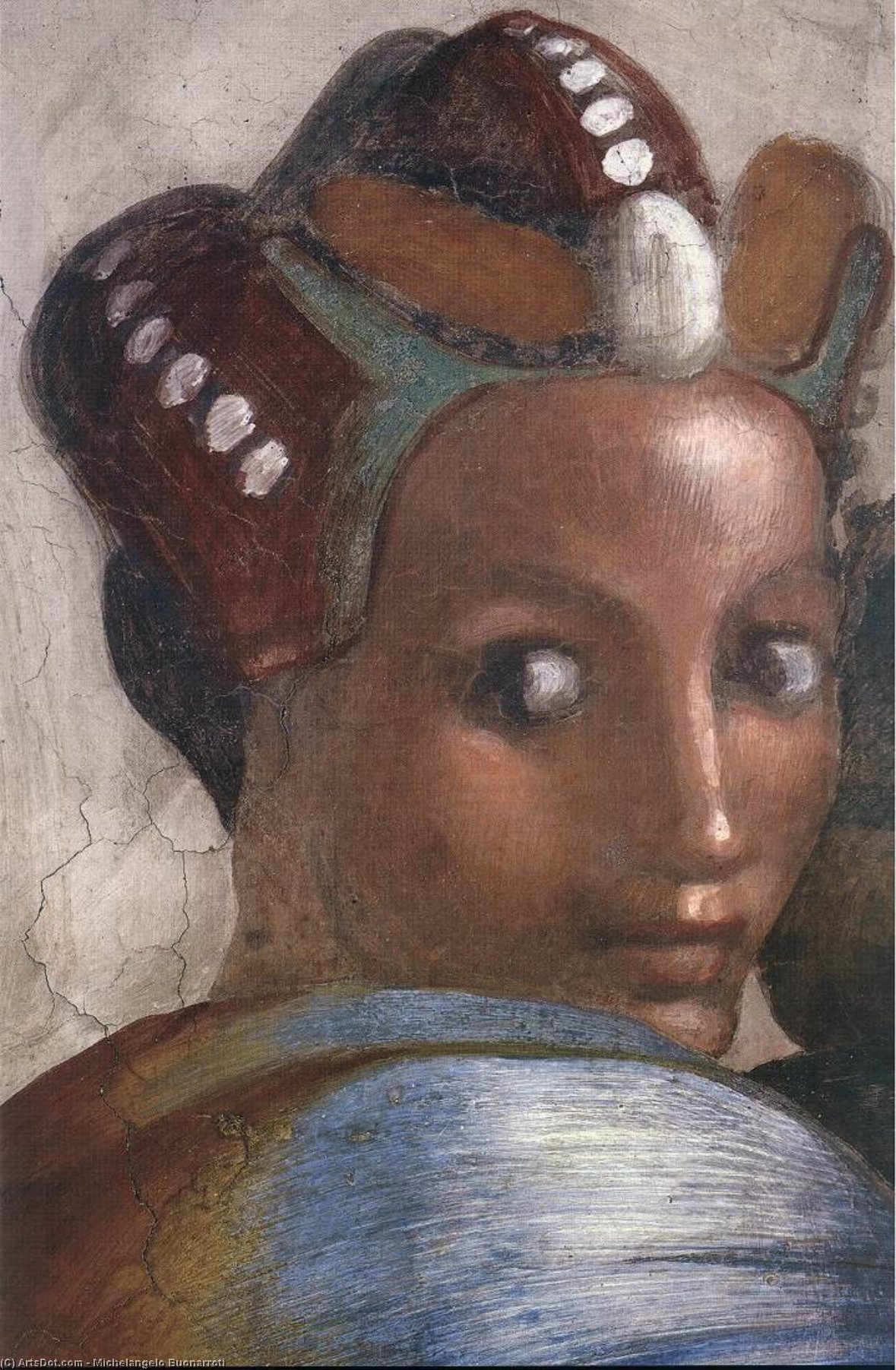
The Genesis of a Vision: Michelangelo’s “Jacob – Joseph (detail)”
Within the colossal embrace of the Sistine Chapel ceiling, a fragment of narrative unfolds—Michelangelo Buonarroti's "Jacob - Joseph (detail)." More than just a painted scene, this fresco is a concentrated distillation of High Renaissance ideals, a testament to human form and divine storytelling. Completed in 1511 as part of Pope Julius II’s ambitious project adorning the chapel’s vault, it captures a pivotal moment from the Book of Genesis: Jacob's encounter with his younger brother Joseph, a scene brimming with familial tension, veiled deception, and ultimately, reconciliation. The detail presented here—a woman in striking blue, her face alight with surprise—offers a tantalizing glimpse into this complex drama, inviting us to contemplate the layers of meaning embedded within Michelangelo’s masterful execution.
The fresco itself is executed in *fresco secco*, a technique demanding meticulous planning and immediate application. Michelangelo's genius lies not just in his anatomical precision—evident in the subtly rendered musculature and flowing drapery—but also in his ability to convey emotion through gesture and expression. The woman’s startled gaze, directed directly at the viewer, is particularly arresting; it establishes an intimate connection, drawing us into the scene’s unfolding narrative. The background, a textured wall adorned with a geometric pattern – likely inspired by classical Roman architecture – provides a sophisticated counterpoint to the figures, anchoring them within a broader visual context.
Contextualizing a Masterwork: The Sistine Chapel and Renaissance Ideals
To fully appreciate “Jacob - Joseph (detail),” one must understand its place within the larger narrative of the Sistine Chapel. Commissioned by Pope Julius II, the chapel’s ceiling was intended to be a visual encyclopedia of biblical history, illustrating key episodes from Genesis through nine scenes. Michelangelo, already renowned for his sculptures like *David* and *Pieta*, accepted the daunting task, transforming himself into both artist and architect. The project spanned four years, pushing him to unprecedented physical and artistic heights. The chapel’s design deliberately juxtaposes clothed and nude figures, a deliberate nod to classical ideals of beauty and proportion while simultaneously reinforcing the theological themes of creation, sin, and redemption.
Michelangelo's approach was revolutionary. He eschewed the traditional Byzantine style prevalent at the time, opting instead for a dynamic, naturalistic representation of the human form—a hallmark of the High Renaissance. The figures are imbued with psychological depth, their emotions rendered through subtle shifts in posture and expression. This emphasis on individual character and emotional resonance distinguishes Michelangelo’s work from earlier artistic conventions.
Symbolism and Interpretation: A Woman's Surprise
The identity of the woman depicted is a subject of ongoing scholarly debate. While traditionally interpreted as Rachel, Joseph’s mother, recent research suggests she may represent Potiphar’s wife, Zuleika, from the Arabic version of the story. Her blue headband and startled expression are particularly intriguing. Blue was associated with royalty and divinity in Renaissance Italy, suggesting a connection to the divine realm. Her surprise could be interpreted as witnessing a clandestine meeting or a moment of revelation—perhaps the beginning of Joseph’s elaborate plan to secure his family's future in Egypt.
The clock visible in the upper left corner adds another layer of symbolic complexity. Clocks were frequently used in Renaissance art to represent time, mortality, and the passage of life. Its presence here could be a reminder of Joseph’s impending journey to Egypt, a journey fraught with danger and uncertainty. It also serves as a subtle commentary on the cyclical nature of history and the enduring themes of family, betrayal, and forgiveness that resonate throughout the biblical narrative.
ArtsDot.com: Experiencing Michelangelo's Genius
At ArtsDot.com, we are dedicated to preserving and celebrating the legacy of artistic masters like Michelangelo Buonarroti. Our meticulously crafted oil painting reproductions capture the essence of his iconic works with unparalleled detail and fidelity. We offer a stunning reproduction of “Jacob - Joseph (detail),” allowing you to bring this captivating scene into your home or office. Experience the power and beauty of Renaissance art, reproduced with the highest quality materials and techniques. View the painting on ArtsDot.com and discover how you can own a piece of art history.
For further exploration, we encourage you to visit Wikipedia for more information about the Sistine Chapel ceiling and its historical context. And don’t hesitate to browse our collection of other Michelangelo reproductions, including *Daniel* and *Rehoboam - Abijah*.