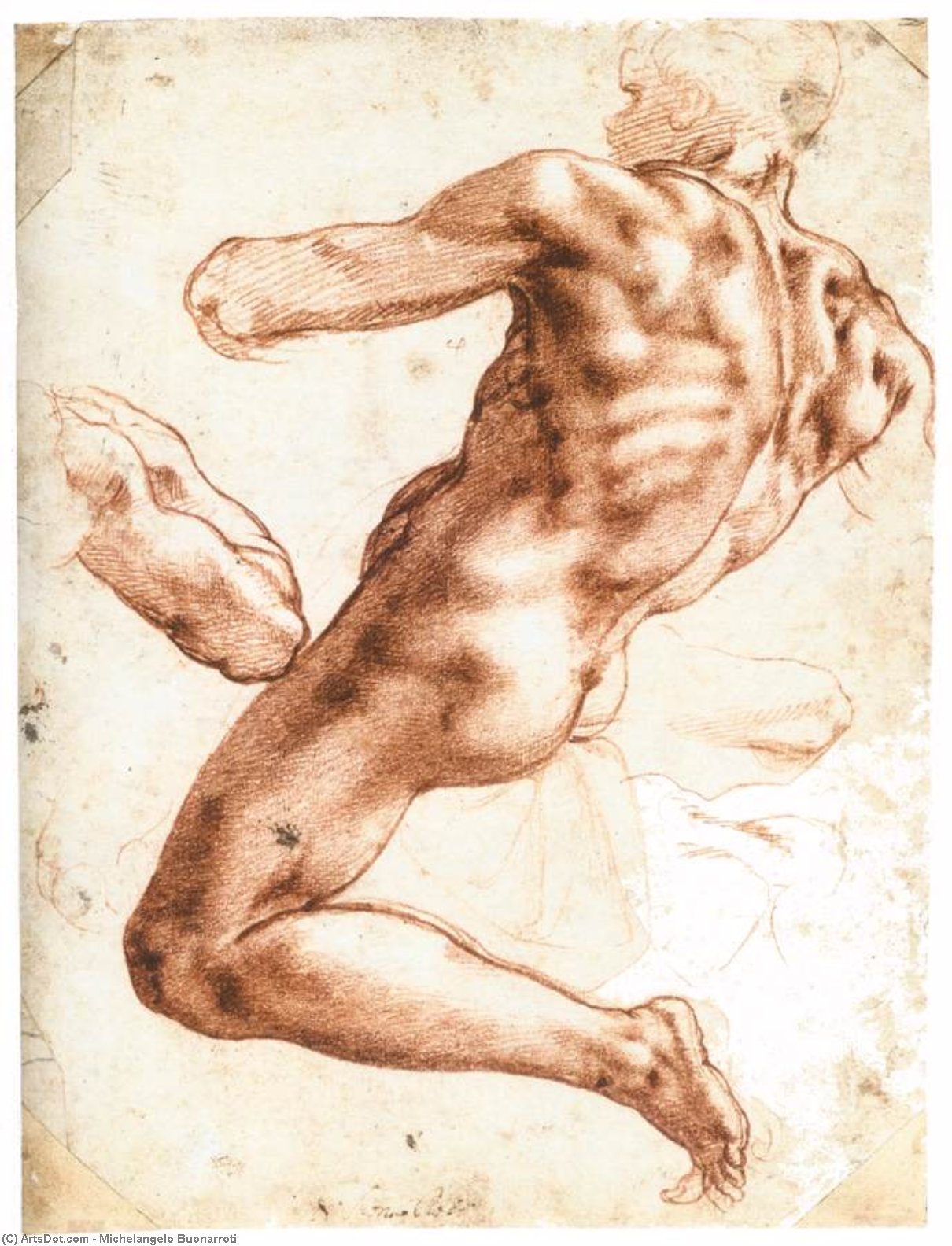
Sitting Male Nude (recto) – A Testament to Michelangelo’s Anatomical Genius
Michelangelo Buonarroti's
Sitting Male Nude (recto) stands as a cornerstone of Renaissance art—a breathtaking chalk drawing that encapsulates the artist’s unparalleled understanding of human anatomy and his masterful ability to convey emotion through form. Created in 1511 during Michelangelo's prolific period in Rome, this artwork transcends mere representation; it embodies the spirit of humanist inquiry and artistic innovation that defined the era. Measuring a substantial 279 x 211 cm, it currently resides within the esteemed
Teylers Museum in Haarlem, Netherlands—a testament to its enduring significance and a beacon for art enthusiasts seeking firsthand experience of Michelangelo’s genius.
Historical Context: The Renaissance Ideal
The creation of
Sitting Male Nude (recto) occurred during the High Renaissance—a period marked by a fervent revival of classical ideals and artistic ambition. Michelangelo’s contemporaries recognized his extraordinary talent across disciplines: sculpture, painting, architecture, and poetry – cementing his position as the embodiment of the Renaissance humanist spirit. The commission itself reflects the broader cultural preoccupation with human beauty and proportion, mirroring the influence of Greek sculptures on artists like Michelangelo. This fascination with idealized form is palpable in every line of chalk, meticulously rendered to capture the musculature and posture of the nude figure.
A Detailed Analysis: Technique and Composition
Michelangelo’s technique—primarily chalk drawing—allowed for exceptional precision and tonal subtlety. He employed a delicate hatching pattern to sculpt volume and contour, skillfully capturing the contours of the torso and limbs with remarkable accuracy. The placement of the circle in the background serves as an intriguing compositional element, subtly directing the viewer's gaze and enhancing the sense of dynamism inherent in the pose. Unlike many other artists of his time who favored idealized representations, Michelangelo’s approach prioritized anatomical realism—a daring departure from convention that nonetheless upheld classical principles of harmony and balance. The artist’s meticulous attention to detail speaks volumes about his dedication to mastering the human form and conveying its expressive potential.
Beyond the Drawing: Michelangelo's Wider Artistic Legacy
Michelangelo Buonarroti’s influence extends far beyond
Sitting Male Nude (recto)—he revolutionized sculpture with monumental works like David and Pietà, redefined architectural grandeur in St. Peter’s Basilica, and elevated painting to new heights of expressive power through frescoes such as those adorning the Sistine Chapel ceiling. These achievements underscore his unparalleled mastery across multiple artistic mediums and solidify his place as one of history's greatest artists. For a deeper understanding of Michelangelo’s oeuvre, exploring reproductions of
Various Studies of Figures and Limbs (verso),
Male Head in Profile and Leg Studies (recto), and
Studies of Arms and Hands (recto) at
Teylers Museum offers invaluable insight into his artistic process and enduring vision.